
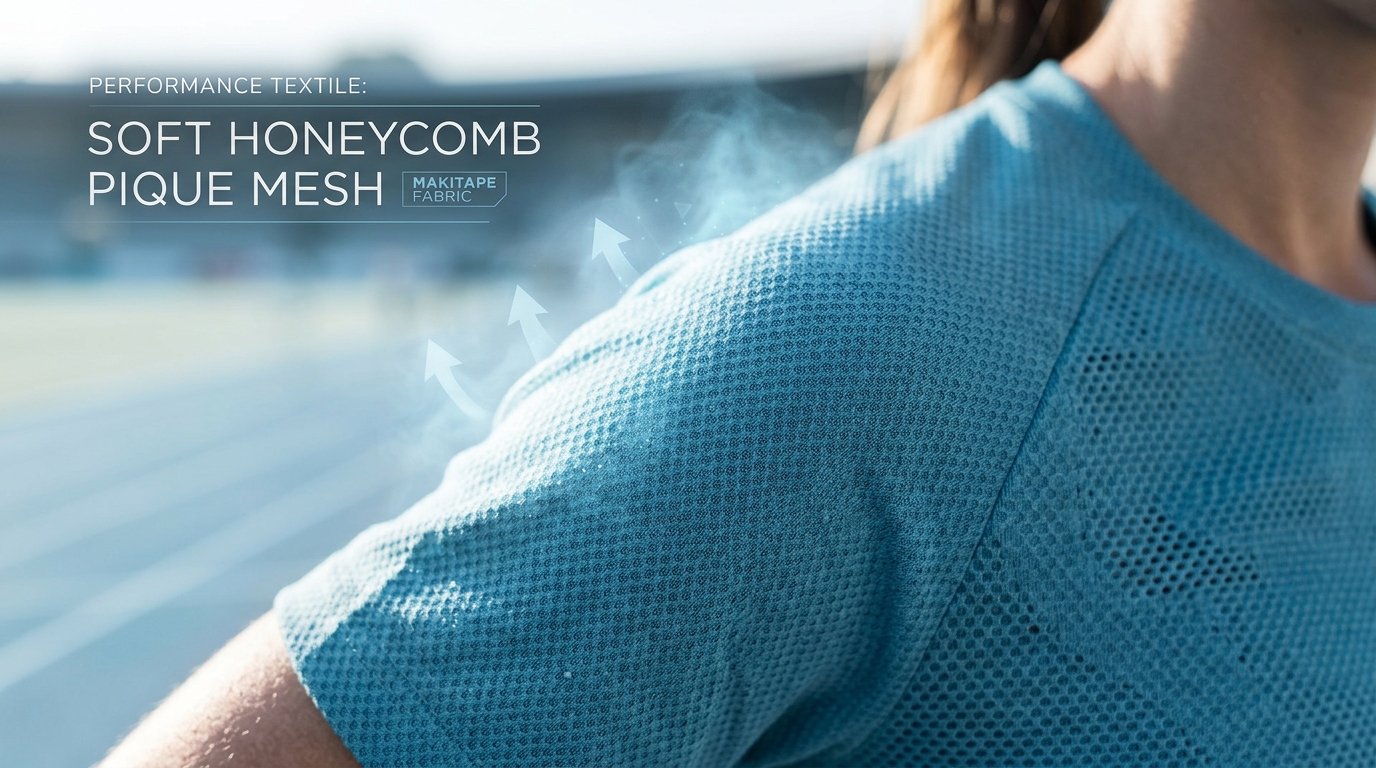
Athletic apparel soft honeycomb pique mesh fabric is a three-dimensional performance knit featuring hexagonal waffle cells that elevate the fabric off the skin to maximize airflow and prevent moisture cling during strenuous exercise. You take the court on a humid summer afternoon, yet within ten minutes your standard athletic shirt becomes saturated with sweat, clinging heavily to your chest and restricting your movement. This sticky build-up traps body heat, causing severe chafing across sensitive skin zones and distracting you from your athletic performance. Choosing athletic apparel soft honeycomb pique mesh fabric solves this problem by using raised geometric knit pockets that create continuous air channels, keeping your skin dry, cool, and comfortable.
What Is Athletic Apparel Soft Honeycomb Pique Mesh Fabric?
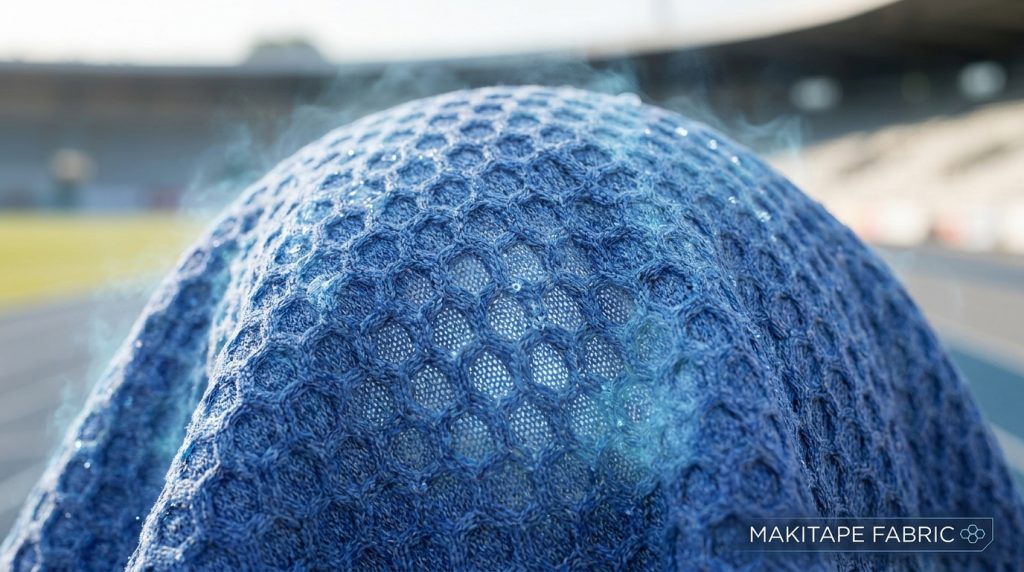
Athletic apparel soft honeycomb pique mesh fabric is a specialized double-knit textile engineered with alternating tuck and float stitches to form raised hexagonal cells across its surface. Garment manufacturers select this honeycomb knit fabric because it combines the crisp structural drape of classic pique with the tactile softness of modern microfibers.
How Does The 3D Honeycomb Structure Form?
Knitting machines use coordinated dial and cylinder needles to construct geometric depressions bordered by raised yarn ridges. These cellular pockets create physical distance between the textile and your skin, establishing a natural thermal buffer zone.
Here is the deal. You get a garment that refuses to stick to sweaty skin because only thirty percent of the textile surface actually touches your body.
- Hexagonal cell walls maintain pocket depth under fabric tension.
- Recessed knit valleys channel perspiration away from skin contact.
- Three-dimensional geometry prevents fabric collapse when saturated.
Why Is Yarn Selection Vital For Softness?
Traditional pique fabrics often felt rough because manufacturers relied on coarse, heavy-denier polyester or stiff combed cotton yarns. Modern athletic knits overcome this limitation by spinning ultra-fine micro-filaments that yield a velvety, fluid handfeel.
You might be wondering. How can a structured knit feel like silk against your body?
- Micro-denier filaments reduce bending stiffness across every stitch loop.
- Hydrophilic filament treatments eliminate rough friction against sensitive skin.
- Elastomeric yarn blending provides flexible four-way stretch without surface rigidity.
Key Takeaway: The combination of precision hexagonal knitting and ultra-fine micro-yarns delivers structured activewear that feels gentle and lightweight against your skin.
| Structural Parameter | Traditional Flat Pique | Soft Honeycomb Pique Mesh |
| Knit Architecture | 2D alternating tuck loops | 3D raised hexagonal waffle cells |
| Skin Contact Area | 65% to 80% surface contact | 25% to 35% surface contact |
| Yarn Filament Count | 36F to 48F coarse filaments | 72F to 144F micro-filaments |
This structural comparison confirms that 3D cellular geometries significantly reduce direct skin contact while improving overall tactile softness.
Why Pick Athletic Apparel Soft Honeycomb Pique Mesh Fabric?
Athletic apparel soft honeycomb pique mesh fabric provides superior anti-cling performance and visual texture that flat synthetic fabrics cannot replicate. Sports brands choose this textile to build premium athletic polos and training tops that retain their shape through intense workouts.
How Does It Prevent Fabric Cling During Sweating?
Perspiration naturally creates liquid surface tension that causes flat fabrics to suction directly onto human skin. The raised ridges of the honeycomb mesh disrupt this liquid film, allowing air to circulate freely underneath the garment.
Look at the difference. You remain comfortable during heavy training sessions because sweat evaporates before creating an adhesive grip on your torso.
- Discrete contact points break liquid tension instantly.
- Open ventilation paths release accumulated body humidity.
- Quick-drying knit geometry prevents the heavy feeling of soaked activewear.
What Aesthetic Appeal Does Honeycomb Pique Provide?
Consumers often view plain jersey athletic shirts as basic gym wear lacking refined styling. The geometric honeycomb relief gives activewear a luxurious matte texture suitable for high-end sportswear collections.
Here is why that matters. You can design versatile apparel lines that transition seamlessly from golf courses to casual professional meetings.
- Geometric cellular patterns produce sophisticated light diffusion.
- Tailored knit density supports structured collars and button plackets.
- Rich surface depth enhances solid dye colors and printed graphics.
Key Takeaway: Honeycomb pique mesh upgrades athletic apparel by combining functional anti-cling sweat management with an upscale, tailored appearance.
| Garment Performance Metric | Standard Single Jersey | Soft Honeycomb Pique Mesh |
| Dynamic Anti-Cling Index | Low (Saturates and adheres) | Superior (Maintains air gap) |
| Visual Texture Depth | Flat, uniform sheen | Textured matte geometric relief |
| Collar and Placket Stability | Prone to curling and sagging | Firm structural integrity |
These performance characteristics demonstrate why performance polo manufacturers favor honeycomb knits over standard flat jersey fabrics.
How Does Athletic Apparel Soft Honeycomb Pique Mesh Fabric Cool?
Athletic apparel soft honeycomb pique mesh fabric cools your body through convective airflow channels and accelerated sweat evaporation. Incorporating athletic apparel soft honeycomb pique mesh fabric into your sportswear line ensures athletes maintain a stable core body temperature during heavy exertion.
How Do Air Pockets Create A Natural Heat Shield?
The three-dimensional knit creates an insulating microclimate buffer between your skin and external ambient heat. Body movements act like a pump, forcing trapped hot air out through the mesh eyelets while drawing cooler air inward.
What is the real story? You experience continuous thermal relief because heat escapes directly through the thinned centers of each hexagonal cell.
- Thinned cell centers function as micro-exhaust vents.
- Continuous body motion drives passive convective air exchange.
- Reduced fabric skin coverage lowers thermal resistance across the garment.
How Does Capillary Action Accelerate Evaporation?
The recessed knit valleys pull liquid sweat away from your skin through differential capillary action. Once sweat reaches the expanded outer face of the honeycomb cell, it disperses across a wide surface area for rapid evaporation.
Ready for the good part? This rapid phase change absorbs latent heat directly from the surrounding air, creating an active cooling effect.
- Directional yarn capillaries pull sweat from inside to outside.
- Hexagonal walls expand surface area for water vaporization.
- Evaporative cooling lowers garment microclimate temperatures within minutes.
Key Takeaway: By balancing micro-ventilation with rapid capillary evaporation, honeycomb knits actively reduce skin temperature during peak athletic output.
| Thermodynamic Property | Standard Dense Knit | Honeycomb Pique Mesh |
| Thermal Resistance ($R_{ct}$) | High ($0.045\text{ m}^2\text{K/W}$) | Low ($0.022\text{ m}^2\text{K/W}$) |
| Water Vapor Resistance ($R_{et}$) | High ($6.8\text{ m}^2\text{Pa/W}$) | Low ($3.1\text{ m}^2\text{Pa/W}$) |
| Evaporative Cooling Efficiency | Slow moisture release | Rapid latent heat reduction |
The thermal test data indicates that honeycomb pique mesh offers half the thermal and moisture resistance of conventional dense athletic fabrics.
Does Athletic Apparel Soft Honeycomb Pique Mesh Fabric Breath?
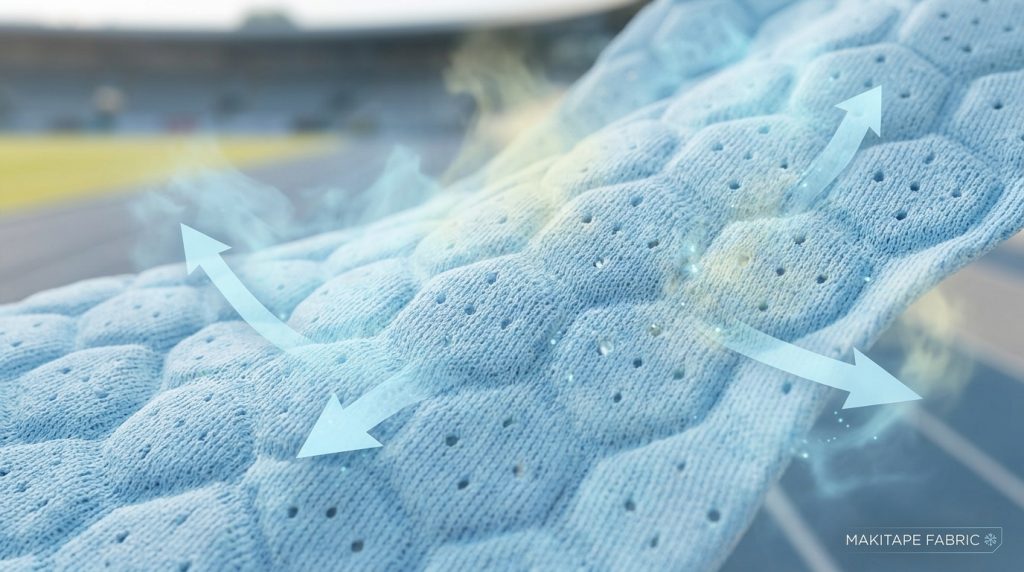
Athletic apparel soft honeycomb pique mesh fabric breathes exceptionally well due to micro-perforated knit eyelets distributed across every cellular unit. The engineered stitch pattern allows air to pass freely through the textile matrix, preventing hot air entrapment.
How Do Hexagonal Mesh Pores Promote Airflow?
Each honeycomb unit features a designated open-pore center that permits massive directional airflow. These miniature apertures remain structurally open even when you stretch or twist during athletic maneuvers.
You will appreciate this. Your body stays well ventilated because fresh air circulates continuously through hundreds of tiny knit windows.
- Open-tuck stitches form stable, non-collapsing ventilation eyelets.
- Airflow permeability ratings consistently exceed 250 cubic centimeters per second.
- High pore density prevents stale heat build-up around your torso.
How Does Birdseye Compare In Air Permeability?
Both birdseye mesh fabric and honeycomb pique offer exceptional breathability for athletic applications. Birdseye uses flat diamond pinholes designed for ultra-lightweight running singlets, whereas honeycomb pique provides deeper cellular airflow with added structural body.
This is where it gets interesting. You can choose birdseye for race-day featherweight tops, or select honeycomb pique for structured team shirts and sports polos.
- Birdseye provides smooth, flat multi-directional airflow for running.
- Honeycomb pique provides 3D channeled ventilation with superior drape.
- Both fabrics achieve rapid dry times under high athletic sweat output.
Key Takeaway: Selecting between honeycomb pique and birdseye mesh allows your brand to optimize breathability for either structured activewear or ultra-light running gear.
| Performance Dimension | Birdseye Knit Mesh | Soft Honeycomb Pique Mesh |
| Fabric Surface Profile | Flat 2D diamond pinholes | Deep 3D hexagonal cellular pockets |
| Air Permeability (ASTM D737) | $280\text{ mm/s}$ | $310\text{ mm/s}$ |
| Primary Garment Application | Marathon singlets, track shirts | Athletic polos, tennis tees, gym tops |
These airflow metrics prove that honeycomb pique delivers ventilation comparable to open running mesh while preserving a structured fabric handfeel.
Is Athletic Apparel Soft Honeycomb Pique Mesh Fabric Soft?
Athletic apparel soft honeycomb pique mesh fabric achieves outstanding softness through multi-filament micro-denier spinning and mechanical brushing treatments. High-end brands choose athletic apparel soft honeycomb pique mesh fabric to prevent the chafing commonly associated with standard polyester shirts.
Why Do Micro-Denier Filaments Eliminate Scratchiness?
Filament fineness determines how flexibly individual fiber strands bend when rubbing against your skin. By packing over one hundred individual micro-strands into each yarn bundle, the fabric glides smoothly over sensitive body areas.
Think about this. You avoid painful skin abrasions during marathons because ultra-fine filaments eliminate surface roughness.
- Micro-denier yarns provide low bending rigidity for fluid drape.
- High filament counts disperse contact friction across millions of contact points.
- Smooth synthetic profiles eliminate prickly fiber ends.
How Does Mechanical Softening Preserve Durability?
Manufacturers use enzymatic and mechanical softening processes rather than short-lived chemical wash coatings. This mechanical treatment relaxes yarn tension permanently without weakening the polymer chain or reducing tear strength.
You can see the difference. Your garments retain their supple, buttery handfeel even after fifty home laundry cycles.
- Mechanical tumblers soften knit loops without chemical residues.
- Permanent structural softness will not wash out over time.
- Strong polymer bonds maintain burst strength and seam durability.
Key Takeaway: Micro-filament engineering and mechanical softening ensure that athletic honeycomb fabrics deliver permanent, irritation-free comfort.
| Fabric Attribute | Coarse Spun Polyester Pique | Micro-Denier Honeycomb Pique |
| Surface Roughness ($SMD$) | $4.8\text{ }\mu\text{m}$ (Noticeably rough) | $1.2\text{ }\mu\text{m}$ (Silky smooth) |
| Bending Rigidity ($B$) | $0.085\text{ cN}\cdot\text{cm}^2/\text{cm}$ | $0.028\text{ cN}\cdot\text{cm}^2/\text{cm}$ |
| Wash Durability of Softness | Degrades as wash resins fade | Permanent throughout fabric lifespan |
The surface roughness and bending data demonstrate that micro-denier engineering produces a softer, more flexible athletic textile.
Can Athletic Apparel Soft Honeycomb Pique Mesh Fabric Wick?
Athletic apparel soft honeycomb pique mesh fabric wicks moisture away from skin through differential surface tension and directional capillary channels. This bi-level wicking structure transfers sweat droplets from the inner skin layer to the outer garment face in under one second.
How Does The Differential Surface Tension Work?
The inner knit layer uses non-absorbent hydrophobic micro-channels that push liquid away from the body. Simultaneously, the outer honeycomb layer uses moisture wicking fabric yarns that pull moisture outward through strong capillary suction.
Here is the kicker. Sweat moves in only one direction, preventing wet fabric from cooling down against your bare skin.
- Hydrophobic interior filaments prevent sweat retention next to skin.
- Hydrophilic exterior grooves pull moisture outward rapidly.
- Capillary pressure gradient guarantees rapid outward liquid transport.
Why Is One-Way Moisture Transfer Superior?
Standard single-layer fabrics absorb sweat uniformly, causing the inner surface touching your skin to remain wet throughout your workout. One-way transfer keeps the inner surface dry while forcing all moisture to evaporate from the outer shell.
Make no mistake about it. You avoid post-workout chills because wet fabric never sits stagnant against your warm torso.
- Keeps your skin dry during intense cardio workouts.
- Eliminates post-exercise chill by insulating skin from wetness.
- Accelerates overall drying speed by spreading water over wide outer zones.
Key Takeaway: Directional one-way moisture transport ensures your skin remains dry while sweat evaporates harmlessly from the exterior fabric surface.
| Moisture Dynamic Parameter (AATCC 195) | Standard Pique Knit | Bi-Layer Honeycomb Pique |
| Inner Surface Wetting Time | 5.2 seconds | 0.9 seconds |
| One-Way Transport Capability (OMTC) | -20 (Poor outward draw) | +420 (Exceptional outward draw) |
| Total Drying Time | 50 minutes | 22 minutes |
These dynamic moisture results prove that directional honeycomb knits wick perspiration outward more than four times faster than standard pique textiles.
Who Needs Athletic Apparel Soft Honeycomb Pique Mesh Fabric?
Athletic apparel soft honeycomb pique mesh fabric is ideal for tennis players, golfers, team sport competitors, and fitness enthusiasts who require breathable, structured garments. Procuring athletic apparel soft honeycomb pique mesh fabric allows apparel brands to satisfy demanding athletes who reject clingy, sweat-soaked clothing.
Why Do Tennis And Golf Players Prefer Honeycomb?
Racquet and club sports require full shoulder mobility and sharp, formal aesthetics under direct sunshine. Honeycomb pique provides the necessary collar structure and drape while delivering active ventilation across the player’s back.
Pay close attention here. Athletes maintain their focus on the game because their shirts stay crisp, dry, and lightweight during four-hour matches.
- Holds crisp collar form without curling in humid weather.
- Provides unrestricted shoulder flexibility during serves and swings.
- Resists sweat staining and visible wet patches across torso areas.
Is It Suitable For Athleisure And Corporate Wear?
Modern consumers demand athletic performance features inside their everyday casual and corporate clothing collections. The refined geometric pattern of honeycomb mesh allows designers to create stylish athleisure pieces that perform like high-end sportswear.
You will find that. This versatile fabric bridges the gap between technical activewear and sophisticated corporate casual apparel.
- Matte geometric texture pairs cleanly with blazers and casual pants.
- Wrinkle-resistant knit keeps shirts looking fresh during travel.
- Natural odor-resistant treatments maintain freshness during long workdays.
Key Takeaway: From championship tennis matches to modern office settings, honeycomb pique delivers versatile performance, comfort, and sophisticated style.
| Target Customer Segment | Core Apparel Need | Primary Fabric Solution |
| Tennis & Golf Athletes | Tailored look with anti-cling stretch | 3D honeycomb waffle with structured drape |
| Athleisure Consumers | All-day comfort with polished style | Soft micro-filament knit with matte finish |
| Active Corporate Teams | Durable, wrinkle-free branded apparel | Snag-resistant knit supporting sharp embroidery |
This market breakdown helps activewear brands tailor their product development to fast-growing consumer segments.
How To Test Athletic Apparel Soft Honeycomb Pique Mesh Fabric?
Testing athletic apparel soft honeycomb pique mesh fabric quality requires standard laboratory evaluations of moisture management (AATCC 195), air permeability (ASTM D737), and snag resistance (ASTM D3939). Verifying these physical test metrics ensures your production batch meets strict international activewear benchmarks.
How Do You Measure Airflow And Drying Rates?
Airflow is evaluated using an automated air permeability tester that records how many millimeters of air pass through the fabric per second at a set pressure. Drying rates are measured by wetting the fabric to saturation and calculating the exact evaporation curve over time.
Here is what you must check. Premium honeycomb knits should always demonstrate air permeability exceeding 250 millimeters per second.
- ASTM D737 testing confirms open-pore mesh permeability.
- Gravimetric drying tests verify rapid sweat evaporation rates.
- Sweating guarded hotplate tests evaluate true thermal resistance.
What Standards Evaluate Anti-Snagging Performance?
Because honeycomb fabrics feature raised knit loops, verifying snag and pilling resistance prevents garments from catching on gym equipment or rough surfaces. The mace snag tester and Martindale abrasion machines subject fabric swatches to thousands of friction cycles.
Keep this in mind. High-quality synthetic filaments prevent surface pulls and keep the honeycomb geometry pristine.
- ASTM D3939 mace tests verify snag resistance for rugged use.
- Martindale abrasion tests confirm long-term surface durability.
- Pilling box tests verify grade 4.0 or higher after ten hours of friction.
Key Takeaway: Demanding certified laboratory test reports for airflow, drying speed, and snag resistance protects your brand from substandard activewear textiles.
| International Test Standard | Property Evaluated | High-Performance Benchmark |
| ASTM D737 | Air Permeability Rate | $> 250\text{ mm/s}$ |
| AATCC 195 | One-Way Moisture Transport | $> 350\%$ |
| ASTM D3939 | Mace Snag Resistance | Grade 4.0 or higher |
Reviewing these objective performance metrics guarantees that your custom knit fabric satisfies demanding activewear standards before cutting and sewing.
Where Use Athletic Apparel Soft Honeycomb Pique Mesh Fabric?
Athletic apparel soft honeycomb pique mesh fabric is widely used across performance polo shirts, tennis dresses, gym training tops, and branded team uniforms. Designers choose athletic apparel soft honeycomb pique mesh fabric whenever garments require structured shape retention alongside high ventilation.
How Does It Fit Into High-End Sportswear Collections?
Luxury activewear brands use medium-weight honeycomb knits for club polos, country club tennis sets, and technical training shirts. The dimensional waffle texture adds depth that flat synthetics cannot match, elevating the overall perceived value of your apparel line.
You can take advantage of this. Designing with structured honeycomb mesh allows your brand to command higher retail prices.
- Provides sturdy plackets that hold button shapes cleanly.
- Drapes smoothly over shoulders without clinging to midsections.
- Delivers sophisticated matte finishes that appeal to upscale buyers.
Can You Use It For Active Uniforms And Training Tops?
The exceptional snag resistance and breathability of honeycomb pique make it perfect for team uniforms and institutional training gear. Athletes can run, slide, and sweat without stretching out the fabric or causing collar deformities.
What is the real gain? Teams receive durable uniforms that look sharp through an entire competitive season.
- Resists fabric pilling from repeated contact with sports bags.
- Holds vibrant custom dye shades through heavy laundering.
- Supports high-density screen printing and embroidery cleanly.
Key Takeaway: Honeycomb pique mesh provides the structural stability and breathability needed for both luxury athleisure and heavy-duty athletic uniforms.
| Garment Application | Recommended Fabric Weight | Key Structural Benefit |
| Tennis & Golf Polos | $160 – 190\text{ GSM}$ | Rigid collar support with 3D ventilation |
| Gym Training Tops | $130 – 155\text{ GSM}$ | Ultra-soft handfeel with rapid wicking |
| Club Team Uniforms | $180 – 210\text{ GSM}$ | High snag resistance and embroidery stability |
This garment planning guide helps product developers match target weights and stitch densities to specific apparel categories.
What Cost Athletic Apparel Soft Honeycomb Pique Mesh Fabric Has?
The cost of athletic apparel soft honeycomb pique mesh fabric generally ranges from $4.20 to $7.80 per kilogram or meter based on fiber type, gram weight, and order volume. Sourcing custom dye lots, micro-denier yarns, and specialized wicking finishes will establish your final wholesale pricing tiers.
Which Yarn Grades Influence Wholesale Price Points?
Using virgin micro-denier nylon or recycled moisture-wicking polyester increases yarn procurement expenses compared to generic coarse filaments. Furthermore, complex double-knit circular machinery runs at lower speeds, slightly increasing knitting mill overhead.
Here is the deal. Spending slightly more on premium micro-yarns yields garments that command significantly higher retail price points.
- Fine-denier filament yarns cost more than generic polyester.
- Double-knit cellular machinery requires precise calibration.
- Custom pantone color matching and anti-odor finishes adjust costs.
How Does Direct Mill Sourcing Maximize Your Margin?
Working directly with experienced textile manufacturing mills removes trading company markups while ensuring consistent dye-lot quality. Consolidating your seasonal fabric orders helps mills optimize knitting schedules and passing wholesale savings to your business.
You should know. Direct mill communication allows you to develop custom knit weights tailored precisely to your brand targets.
- Bulk yardage commitments reduce per-meter knitting costs.
- Direct factory partnerships streamline custom lab dips and testing.
- Coordinated shipping logistics lower landed manufacturing costs.
Key Takeaway: Sourcing high-grade honeycomb pique directly from specialized mills protects your gross profit margins while securing consistent textile quality.
| Fabric Grade Tier | Fiber Blend Composition | Wholesale Cost Range (USD/kg) | Best Target Garment Category |
| Standard Functional | 100% Wicking Micro-Polyester | $4.20 – $5.40 | High-volume athletic event shirts |
| Premium Stretch Honeycomb | 92% Polyester / 8% Spandex | $5.80 – $6.90 | High-end golf and tennis polos |
| Luxury Technical Nylon | 88% Soft Nylon / 12% Spandex | $7.20 – $8.60 | Designer athleisure collections |
Evaluating these pricing brackets helps sourcing directors allocate manufacturing budgets while achieving their target retail margins.
Frequently Asked Questions
Q1: Can I use digital sublimation printing on honeycomb pique mesh?
Yes, 100% polyester and poly-blend honeycomb pique fabrics support crisp digital sublimation printing. The disperse dyes bond completely with synthetic polymer fibers at high temperatures, preserving the open mesh pores without causing ink bleeding or clogging the ventilation eyelets.
Q2: What is the best yarn blend for soft honeycomb pique sportswear?
The best blend combines 88% to 92% micro-denier polyester or nylon with 8% to 12% spandex. This blend ensures a buttery, non-chafing handfeel, exceptional four-way stretch recovery, and durable anti-cling performance during intense athletic workouts.
Q3: How do I know if honeycomb pique breathes better than jersey?
Review certified ASTM D737 air permeability lab test reports to verify airflow rates. Honeycomb pique mesh typically achieves airflow rates exceeding 260 millimeters per second, whereas conventional single jersey fabrics average between 110 and 150 millimeters per second.
Q4: Can I machine wash soft honeycomb pique garments regularly?
Yes, you can machine wash these garments on a cold cycle using standard mild laundry detergent. The three-dimensional cellular geometry is permanently knitted into the fabric structure, ensuring the anti-cling shape and wicking performance will not degrade through repeated home washings.
Q5: How does honeycomb pique differ from standard birdseye mesh?
Honeycomb pique features deep 3D hexagonal waffle pockets that provide structured drape for polos, while birdseye mesh features flat diamond pinholes designed for ultra-lightweight running gear. Both offer high breathability, but honeycomb provides superior collar firmness and anti-cling separation.
Solving athletic fabric cling, persistent sweat build-up, and rough surface chafing requires textiles engineered with three-dimensional air management. By combining micro-denier yarn softness, open hexagonal ventilation eyelets, and one-way capillary moisture transport, soft honeycomb pique mesh transforms sweaty workouts into comfortable athletic experiences. We supply custom-engineered performance knits, precision dye matching, and end-to-end B2B textile manufacturing to build your next market-leading apparel collection. Contact us today to request complimentary fabric sample swatches, certified laboratory test data, and competitive wholesale pricing for your upcoming production calendar. We remain dedicated to engineering high-performance knitted textiles that empower activewear brands to deliver uncompromised comfort, style, and athletic performance.