
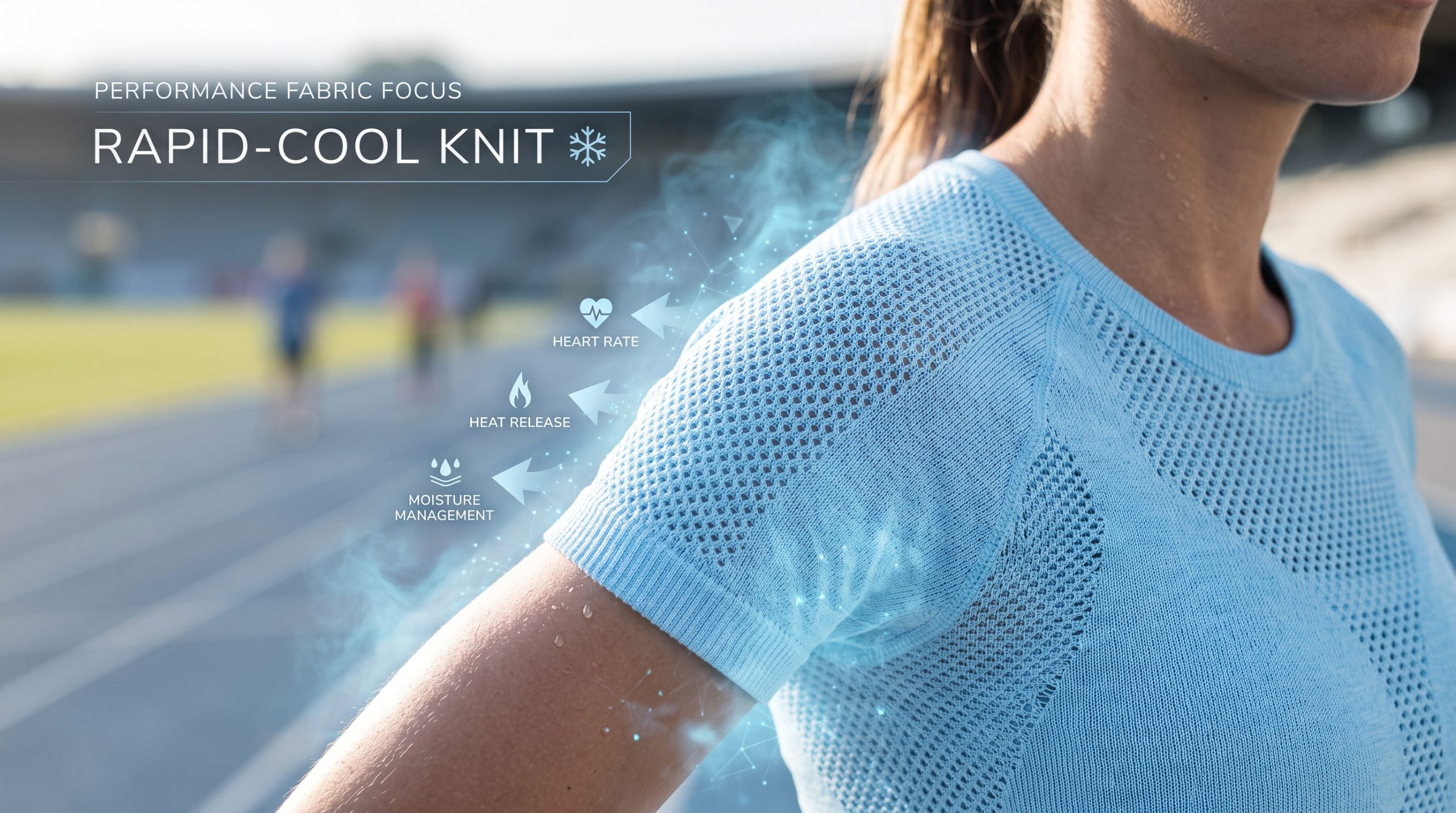
Sportswear rapid-cool knitted fabric is an engineered performance textile designed to rapidly transfer body heat and accelerate sweat evaporation during intense physical activity. Intense training in humid environments often causes ordinary cotton or polyester garments to trap body heat, leading to heavy sweat saturation, chafing, and premature muscle fatigue. When your activewear fails to dissipate excess heat, athletic endurance drops and athletes experience discomfort. Investing in premium sportswear rapid-cool knitted fabric eliminates thermal build-up through micro-engineered hydrophilic and hydrophobic yarn channels that actively lower skin surface temperature upon contact.
Why Choose Sportswear Rapid-Cool Knitted Fabric?
Sportswear rapid-cool knitted fabric delivers immediate thermal relief through high-conductivity yarns and moisture-wicking capillary channels that traditional activewear textiles cannot match. Apparel brands choose this textile because modern athletes demand lightweight performance materials that keep skin dry during endurance training.
Does It Keep Athletes Cooler During Intense Workouts?
Thermal dissipation begins the second the textile touches warm skin by leveraging high thermal conductivity fibers. Traditional synthetic fabrics hold warm stagnant air against your body, whereas this specialized structure pulls thermal energy away and spreads it across a wide surface area.
Here is the deal. You get instant thermal relief because the specialized knit geometry promotes rapid airflow through its micro-porous channels.
- High thermal conductivity yarns absorb skin heat instantly.
- Micro-ventilation pores discharge trapped warm air.
- Rapid surface evaporation pulls away excess body heat.
What Advantages Does It Offer For Activewear Lines?
Adopting advanced cooling textiles gives your garment catalog an immediate competitive edge in the crowded athletic market. Modern fitness enthusiasts look for garments that prevent clinginess during high-intensity training.
Think about this. Premium sportswear rapid-cool knitted fabric combines tactile softness with industrial-grade tensile strength for superior wear resistance.
- Resists fabric pilling across repeated wash cycles.
- Provides four-way elasticity without losing shape memory.
- Delivers soft skin comfort without static cling.
Key Takeaway: Choosing this performance knit gives your activewear line measurable cooling performance, higher perceived value, and greater customer retention.
| Performance Metric | Standard Polyester Knit | Sportswear Rapid-Cool Knitted Fabric |
| Instant Touch Cooling Value ($q_{max}$) | $0.09\text{ W/cm}^2$ | $\ge 0.18\text{ W/cm}^2$ |
| Air Permeability | Moderate ($120\text{ mm/s}$) | High ($260\text{ mm/s}$) |
| Drying Speed | Standard ($45\text{ mins}$) | Ultra-Fast ($18\text{ mins}$) |
This data confirms that specialized rapid-cooling knits double both instant thermal dissipation and drying velocity compared to standard athletic textiles.
How Does Sportswear Rapid-Cool Knitted Fabric Work?
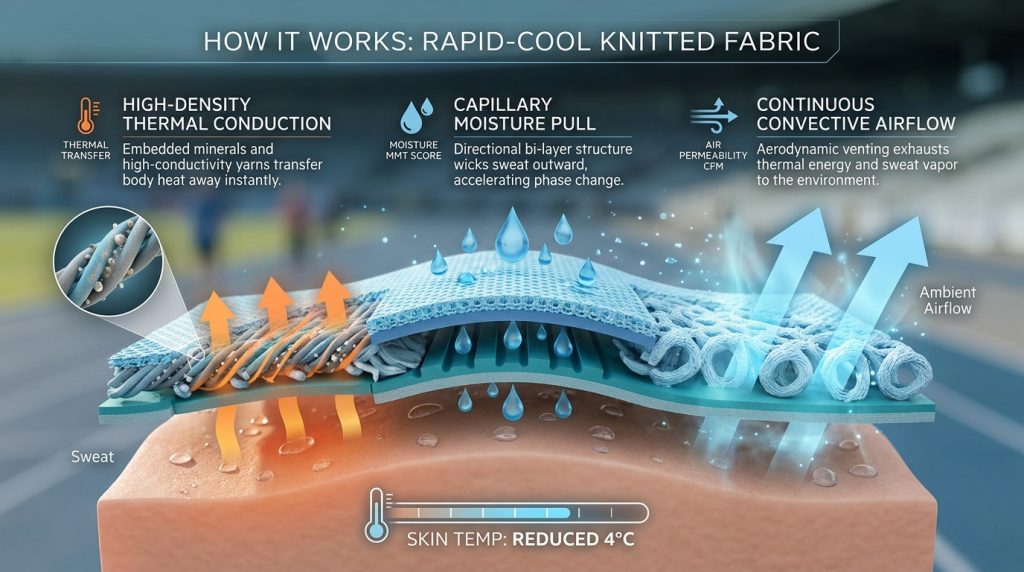
Sportswear rapid-cool knitted fabric works through a combination of high-density thermal conduction, capillary moisture pull, and continuous convective airflow. This triple-action cooling process actively drops skin temperature during physical exertion.
How Do Conductive Yarns Lower Skin Temperature?
Conductive filaments utilize mineral-infused fibers and cooling yarn technology with ultra-high thermal absorption rates to draw heat outward. When the textile touches warm skin, heat moves from high concentration to low concentration through solid conduction.
You might be wondering. Does this cooling effect wash out over time?
- Mineral micro-particles remain permanently embedded inside fiber cores.
- Cold-touch properties withstand industrial laundering cycles.
- Hydrophilic filament treatments stay stable across heavy use.
What Role Does The Knit Structure Play In Heat Release?
The geometric pattern of the knitting needles creates microscopic air vents that facilitate continuous air exchange. As you move, natural body motion pumps hot air through open knit vents while drawing in cooler ambient air.
Here is why that matters. Proper stitch tension ensures that the fabric maintains its ventilated shape even when stretched over muscles.
- Loop construction prevents wet fabric from sticking to sweaty skin.
- Open interstitial spaces accelerate moisture vapor release.
- Three-dimensional back channels guide air movement along your torso.
Key Takeaway: The synergy between fiber-level thermal conductivity and open-loop structural ventilation guarantees sustained cooling throughout long athletic sessions.
| Cooling Mechanism | Functional Component | Primary Athlete Benefit |
| Conduction | Mineral-infused modified nylon yarns | Immediate chilled sensation upon skin contact |
| Convection | 3D knit micro-ventilation mesh pores | Continuous heat exhaust during body movement |
| Evaporation | Differential hydrophilic capillary channels | Rapid sweat dissipation without cold clamminess |
These combined physical mechanisms ensure that the textile actively regulates heat transfer across all workout intensities.
Is Sportswear Rapid-Cool Knitted Fabric Breathable?
Sportswear rapid-cool knitted fabric offers exceptional breathability due to precision-engineered inter-loop pores that maximize directional air exchange. The fabric structure allows air to circulate freely across your skin to prevent heat accumulation.
How Does Airflow Affect Endurance Performance?
Unrestricted airflow accelerates natural perspiration evaporation, which prevents the athlete from overheating during endurance sports. When moving air sweeps through the garment, heat transfer rates spike significantly.
What is the real story? Poor airflow traps hot moisture against your skin, forcing your cardiovascular system to work harder to cool down.
- High CFM ratings ensure continuous fresh air circulation.
- Micro-gap stitches vent hot moisture plumes quickly.
- Decreased humidity inside the garment microclimate preserves athletic energy.
Can Open-Structure Knits Maintain Fabric Strength?
High breathability does not require delicate or fragile yarn arrangements that tear under athletic stress. Modern warp-knitting and circular-knitting methods lock filaments together to resist friction and snagging.
You will appreciate this. You can design featherweight athletic tops without sacrificing structural integrity during rugged training.
- Interlocking loops prevent stitch runs from sharp friction.
- High-twist synthetic yarns provide remarkable burst resistance.
- Elastic filament blending supports shape retention during stretching.
Key Takeaway: High breathability in rapid-cool knits optimizes internal microclimates without compromising garment durability or tear resistance.
| Fabric Construction | Air Permeability (ASTM D737) | Bursting Strength (ASTM D3786) |
| Standard Plain Jersey | $110\text{ cm}^3/\text{cm}^2/\text{s}$ | $280\text{ kPa}$ |
| Rapid-Cool Birdseye Knit | $245\text{ cm}^3/\text{cm}^2/\text{s}$ | $340\text{ kPa}$ |
| High-Vent Athletic Mesh | $380\text{ cm}^3/\text{cm}^2/\text{s}$ | $290\text{ kPa}$ |
The test numbers demonstrate that engineered rapid-cooling knits maintain strong bursting thresholds while delivering twice the airflow of standard jerseys.
Why Pick Birdseye Sportswear Rapid-Cool Knitted Fabric?
Birdseye sportswear rapid-cool knitted fabric features distinctive diamond-shaped tuck patterns that create exceptional surface area for moisture dispersion. Selecting between birdseye mesh fabric and traditional pique knit depends on your specific handfeel and airflow requirements.
How Does Birdseye Structure Differ From Pique Knit?
Birdseye fabric is engineered with continuous micro-tuck eyelets that produce a smooth, lightweight geometric pattern against the skin. In contrast, pique knit uses alternating tuck stitches to create a pronounced honeycomb or waffle texture with a heavier handfeel.
Look at the difference. Birdseye eyelets act like miniature exhaust ports across your garment, while pique creates a thicker barrier with higher tactile friction.
- Birdseye delivers an ultra-smooth, low-friction handfeel ideal for running.
- Pique presents a structured, formal appearance suited for athletic polos.
- Birdseye distributes sweat droplets across flat surface boundaries faster.
Which Fabric Structure Delivers Higher Breathability?
Birdseye knit provides superior air passage because its tuck gaps stay open regardless of body posture or fabric tension. Pique knits offer good ventilation, but their thicker yarn layers retain more hot air inside the fabric core.
Here is the bottom line. For pure endurance training and rapid cooling, birdseye mesh outperforms pique in moisture dispersion and light weight.
- Birdseye dries up to 30% faster than traditional pique.
- Pique provides a crisper collar structure for golf and tennis apparel.
- Birdseye minimizes skin contact surface area to eliminate sweat cling.
Key Takeaway: Birdseye knits offer silky handfeel and high-speed sweat evaporation for active sports, while pique delivers structural stiffness for classic sportswear styling.
| Structural Feature | Birdseye Rapid-Cool Knit | Traditional Pique Knit |
| Fabric Surface Texture | Smooth diamond micro-mesh pores | Raised honeycomb geometric relief |
| Handfeel & Skin Friction | Silky, ultra-soft, zero-chafe glide | Textured, substantial, dry-touch grip |
| Ideal Garment Application | Marathon singlets, gym shirts, active tees | Golf shirts, tennis polos, club sportswear |
This structural comparison helps product development teams match specific knit characteristics to intended athletic use cases.
What Makes Sportswear Rapid-Cool Knitted Fabric Durable?
Sportswear rapid-cool knitted fabric achieves long-term durability through synthetic filament matrix blending and high-gauge knitting precision. This resilient yarn arrangement withstands repeated wash cycles and abrasive athletic contact without degrading cooling properties.
Does Frequent Washing Degrade The Cooling Effect?
Permanent cooling properties do not rely on temporary topical chemical dips that wash away after several laundry cycles. Top-tier manufacturers integrate cooling minerals and engineered yarn geometries directly into the synthetic matrix.
Ready for the good part? Your garments maintain their cold-contact ratings and wicking capabilities for the entire lifecycle of the sportswear item.
- Embedded mineral particles will not leach into wash water.
- Cross-sectional yarn channels retain their moisture-guiding shapes.
- Elastic fibers retain recovery tension after hot water washing.
How Well Does It Resist Snagging And Surface Abrasion?
Warp-knit and interlocking circular-knit constructions secure filament loops tightly to resist snagging from equipment or rough surfaces. This tight loop geometry prevents loose fibers from fraying when rubbing against gym equipment or hydration packs.
You can see the difference. High-grade multi-filament nylon blends prevent the fuzzy surface wear common in low-cost workout gear.
- High Martindale abrasion ratings resist heavy friction.
- Low hairiness yarn spinning stops pills from forming.
- Reinforced edge stitching prevents unraveling along garment seams.
Key Takeaway: Mineral-infused and precision-knit cooling fabrics protect your brand reputation by providing lifetime cooling performance and rugged wash resistance.
| Durability Test Parameter | Standard Chemical-Treated Knit | Sportswear Rapid-Cool Knitted Fabric |
| Wash Resistance (Cooling Retention) | Fails after 15-20 washes | Intact after 50+ industrial washes |
| Martindale Abrasion (Cycles) | 15,000 cycles | 40,000+ cycles |
| Pilling Resistance (ASTM D3512) | Grade 2.5 (Moderate Pilling) | Grade 4.5 (Negligible Pilling) |
The test metrics prove that physical yarn engineering maintains thermal performance far longer than chemical wash-on alternatives.
Can Sportswear Rapid-Cool Knitted Fabric Manage Sweat?
Sportswear rapid-cool knitted fabric manages sweat by utilizing a bi-layer push-pull mechanism that draws sweat off skin and spreads it across an expansive outer surface. This capillary action transforms liquid perspiration into cool vapor in seconds.
How Does The Bi-Layer Push-Pull System Function?
The inner fabric face uses hydrophobic fibers that refuse to hold water, while the outer face uses hydrophilic moisture wicking fabric yarns that actively pull liquid outward. This directional gradient prevents moisture from flowing back toward the athlete’s body.
This is where it gets interesting. You stay dry because sweat never gets the chance to accumulate between your skin and the fabric.
- Inner hydrophobic layer creates a dry touch boundary against skin.
- Outer hydrophilic zone pulls sweat through differential capillary pressure.
- Broad outer surface area maximizes air exposure for fast drying.
Why Does Rapid Moisture Spreading Produce Cooling?
When liquid sweat spreads across a wide surface area, it absorbs ambient thermal energy from your body to fuel the evaporation phase change. This thermodynamic process strips away latent heat and rapidly cools your skin.
Make no mistake about it. Fast spreading speed is the secret behind real athletic temperature reduction.
- Broad water droplet dispersion speeds up drying rates.
- Evaporative heat loss lowers garment microclimate temperature.
- Eliminates heavy, soggy fabric weight during long training runs.
Key Takeaway: The bi-layer push-pull capillary structure ensures sweat is rapidly pulled outward and evaporated, converting athlete perspiration into an active cooling mechanism.
| Moisture Management Metric (AATCC 195) | Standard Single Jersey | Bi-Layer Rapid-Cool Knit |
| Liquid Moisture Absorption Time | 4.5 seconds | 0.8 seconds |
| Maximum Wetted Radius | 12 mm | 28 mm |
| One-Way Transport Capability (OMTC) | -50 (Poor directional pull) | +380 (Superior outward pull) |
These standardized test figures show that bi-layer rapid-cool textiles transfer moisture outward nearly five times faster than traditional knit fabrics.
Who Needs Sportswear Rapid-Cool Knitted Fabric Most?
Sportswear rapid-cool knitted fabric is essential for outdoor endurance runners, high-intensity fitness athletes, and team sports players competing in high-heat environments. Industrial workers and active lifestyle consumers also rely on this material to maintain thermal comfort throughout daily wear.
Which Athletic Disciplines Benefit The Most?
Endurance runners, cyclists, and team sports athletes generate immense metabolic heat and require garments that actively regulate skin temperatures. Without rapid cooling textiles, these athletes face early overheating, heavy dehydration, and reduced cardiovascular performance.
Pay close attention here. Equipping athletes with rapid-cooling apparel preserves glycogen stores by reducing cardiovascular strain.
- Marathoners avoid heavy sweat-logged shirts on long runs.
- HIIT gym athletes avoid sticky, clinging garments during sets.
- Soccer and basketball players maintain agility with featherweight gear.
Is This Fabric Suitable For Daily Athleisure Wear?
Consumers now expect their daily lifestyle clothing to feature the same advanced moisture-wicking and cooling performance found in elite activewear. Commuters, outdoor workers, and casual joggers enjoy dry comfort during warm summer afternoons.
You will find that. Versatile cooling knits bridge the gap between high-level athletic function and stylish casual aesthetics.
- Soft matte yarn finishes look sophisticated in lifestyle cuts.
- Anti-odor properties keep everyday garments smelling clean.
- Wrinkle-resistant knit drape maintains clean silhouette lines.
Key Takeaway: From high-stakes marathon courses to daily urban commutes, cooling performance knits enhance physical comfort across a diverse spectrum of users.
| Target Consumer Group | Core Physical Challenge | Fabric Functional Solution |
| Marathon & Trail Runners | High sweat volume and severe chafing | Ultra-smooth birdseye knit with 18-minute dry time |
| Crossfit & HIIT Athletes | Rapid core body temperature spikes | High touch cooling value ($q_{max}$) with rapid heat venting |
| Warm-Climate Commuters | Stifling humidity and sweat staining | Subtle matte appearance with discreet moisture dispersion |
Aligning specific textile capabilities with these user groups allows activewear brands to target high-growth apparel market niches.
How To Test Sportswear Rapid-Cool Knitted Fabric Quality?
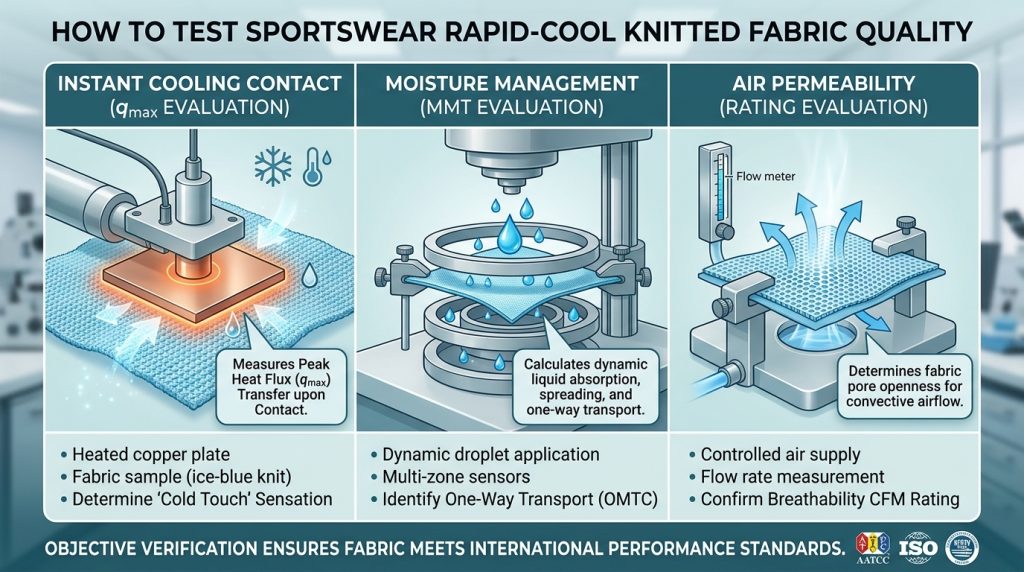
Testing sportswear rapid-cool knitted fabric quality requires standard laboratory evaluations of instant cooling contact ($q_{max}$), moisture management tester (MMT) scores, and air permeability ratings. Verifying these objective physical metrics ensures that the fabric meets international performance standards.
What Standard Tests Measure Instant Surface Cooling?
The $q_{max}$ test (such as FTTS-FA-019 or GB/T 35263) measures the peak heat flux transferred when a heated sensor contacts the fabric surface. A higher number indicates that the fabric pulls heat away from skin faster upon initial contact.
Here is what you must check. Premium cooling knits should always demonstrate a certified $q_{max}$ value of $0.15\text{ W/cm}^2$ or higher.
- Test plates simulate warm human skin at 35°C.
- Sensor logs instantaneous heat transfer within fractions of a second.
- Certified lab reports confirm true cooling performance before production.
How Do You Verify Airflow And Moisture Transport?
Air permeability is evaluated using the ASTM D737 standard to measure how many cubic centimeters of air pass through the fabric per second. Moisture dynamics are measured using AATCC 195 to quantify absorption, spreading speed, and one-way moisture transport.
Keep this in mind. Testing both metrics together guarantees that the fabric cools through both ventilation and sweat evaporation.
- Air permeability testing confirms pore openness.
- Moisture management testing calculates top-to-bottom water pull.
- Evaporation rate tests verify rapid drying efficiency.
Key Takeaway: Demanding certified laboratory test data for $q_{max}$, MMT, and ASTM standards protects your apparel business from subpar or unverified textiles.
| International Test Method | Physical Property Measured | High-Performance Benchmark |
| FTTS-FA-019 / GB/T 35263 | Touch Cooling Sensation ($q_{max}$) | $\ge 0.18\text{ W/cm}^2$ |
| AATCC 195 | One-Way Moisture Transport Index | $> 300\%$ |
| ASTM D737 | Air Permeability Rate | $> 200\text{ mm/s}$ |
Reviewing these objective lab benchmarks helps procurement managers verify authentic cooling performance before placing bulk wholesale orders.
Where Is Sportswear Rapid-Cool Knitted Fabric Used?
Sportswear rapid-cool knitted fabric is used across modern athletic t-shirts, running tank tops, training shorts liners, cycling jerseys, and performance base layers. Designers also incorporate this versatile material into athletic caps, sports bras, and tactical active apparel.
How Is It Applied In High-Performance Tops?
Running tops and training shirts use lightweight rapid-cool knits across the chest and back to target major human sweat zones. The fabric moves freely with body mechanics while keeping core torso zones ventilated.
You can take advantage of this. Zoned garment mapping pairs open-knit birdseye panels along the spine with smooth-knit cooling panels across the shoulders.
- Featherweight jerseys reduce shoulder drag during movement.
- Flatlock stitching eliminates friction seams along chest panels.
- Quick-drying fibers prevent tops from sticking when wet.
Can It Be Engineered For Bottoms And Compression Gear?
Adding high-tenacity elastane or spandex into rapid-cooling knits creates supportive compression textiles for training shorts and leggings. The fabric provides muscle stabilization while drawing away heat from working quad and hamstring muscles.
What is the real gain? Athletes stay supported without feeling trapped in thick, sweltering compression layers.
- Elastic memory supports repetitive muscle contractions.
- Breathable inner liners prevent sweat rashes and thigh chafing.
- High opacity prevents see-through stretching during deep squats.
Key Takeaway: The flexibility of rapid-cooling knits allows apparel designers to construct comprehensive athletic lines covering tops, bottoms, and essential accessories.
| Garment Category | Recommended Fabric Weight | Key Functional Requirement |
| Ultra-Light Running Tops | $110 – 135\text{ GSM}$ | Maximum airflow and rapid sweat spreading |
| Multi-Sport Athletic Tees | $140 – 165\text{ GSM}$ | Balance of opacity, durability, and cooling handfeel |
| Compression Shorts & Liners | $180 – 220\text{ GSM}$ | Four-way stretch support with active sweat wicking |
This garment matrix helps design teams choose the ideal fabric weight and density for each activewear product category.
What Is The Cost Of Sportswear Rapid-Cool Knitted Fabric?
The cost of sportswear rapid-cool knitted fabric ranges between $4.50 and $8.50 per kilogram or meter depending on fiber composition, gram weight, order volume, and functional specifications. Custom dyeing, specialized yarn blends, and certified testing influence final wholesale price brackets.
Which Factors Influence Wholesale Fabric Pricing?
Using specialized mineral-infused nylon or ultra-high molecular weight polyethylene fibers raises raw material costs compared to baseline recycled polyester. High-gauge knitting machinery and rigorous quality inspections also add value to the finished fabric roll.
Here is the deal. Premium yarn selection slightly increases production costs but yields a superior garment that commands higher retail pricing.
- Specialized cooling nylon yarns cost more than generic polyester.
- Complex bi-layer jacquard or birdseye knitting requires precise machine setups.
- Custom pantone color matching and antibacterial treatments adjust meter rates.
How Does Bulk Procurement Lower Production Costs?
Ordering larger dye lots and consolidating yardage requirements across your seasonal collections significantly reduces the per-meter price from the textile mill. Direct mill sourcing cuts out intermediary markup costs while ensuring consistent dye-lot consistency.
You should know. Planning production volumes in advance enables mills to optimize raw yarn purchases and passing savings directly to your brand.
- High-volume orders lower per-unit machine setup overheads.
- Consolidated seasonal shipping reduces global logistics costs.
- Direct mill relationships give you custom development support.
Key Takeaway: Investing in certified rapid-cooling knits delivers higher retail margins and stronger brand loyalty that easily justifies raw material costs.
| Fabric Tier | Fiber Composition | Estimated Price Range (USD/kg) | Best Market Fit |
| Entry-Level Functional | 100% Wicking Polyester | $3.80 – $4.80 | Budget promotional sportswear |
| Performance Birdseye | 100% Rapid-Cool Micro-Poly | $5.00 – $6.50 | Core athletic and gym wear lines |
| Premium Pro Cooling | 80/20 Cool Nylon / Spandex | $7.00 – $9.20 | High-end endurance and pro apparel |
Evaluating these pricing tiers helps sourcing teams allocate manufacturing budgets effectively while achieving their target retail margins.
Frequently Asked Questions
Q1: Can I wash rapid-cooling knitted fabrics in standard laundry machines?
Yes, you can machine wash these fabrics on a cold, gentle cycle using mild detergent. The physical cooling minerals and engineered yarn channels remain permanently embedded within the fiber structure, meaning normal machine washing will not strip away cooling or moisture-wicking capabilities.
Q2: What is the best fabric blend for high-sweat endurance sportswear?
The best fabric blend combines mineral-modified cooling nylon or polyester with 10% to 15% spandex in a bi-layer or birdseye knit construction. This combination delivers instant touch cooling, rapid outward moisture transport, and flexible four-way stretch comfort.
Q3: How do I know if a cooling fabric uses permanent technology rather than chemical coatings?
Check the fabric’s technical specification sheet and certified wash test data for $q_{max}$ and moisture management after 30 to 50 washes. Permanent cooling textiles utilize cross-sectional modified filaments or mineral-infused yarns that maintain their physical cooling scores throughout extended laundry cycles.
Q4: Can I use sublimation printing on rapid-cool knitted fabrics?
Yes, 100% polyester and poly-blend rapid-cooling knits are fully compatible with digital sublimation printing. The disperse dyes bond directly with synthetic fiber molecules at high temperatures without clogging open knit pores or compromising moisture transport.
Q5: How does rapid-cool knit fabric feel against sensitive skin?
It feels exceptionally smooth, cool, and lightweight with zero scratchiness or static cling. The high filament count and micro-knit loop structure minimize skin friction, making it comfortable for all-day training and sensitive skin types.
Developing high-performance activewear lines requires materials that effectively solve heat build-up, heavy sweat accumulation, and skin chafing for demanding athletes. By leveraging mineral-infused thermal conduction, directional bi-layer moisture transport, and high-airflow knit structures like birdseye mesh, apparel brands can build market-leading garments that deliver verified physical cooling performance across any workout condition. We supply precision-engineered performance textiles, custom-developed cooling knits, and end-to-end B2B fabric solutions designed to elevate your seasonal collections. Contact us today to request customized fabric swatches, technical lab test reports, and wholesale pricing for your upcoming sportswear production run. We are committed to engineering next-generation textile technologies that keep athletes cool, dry, and performing at their absolute peak.