
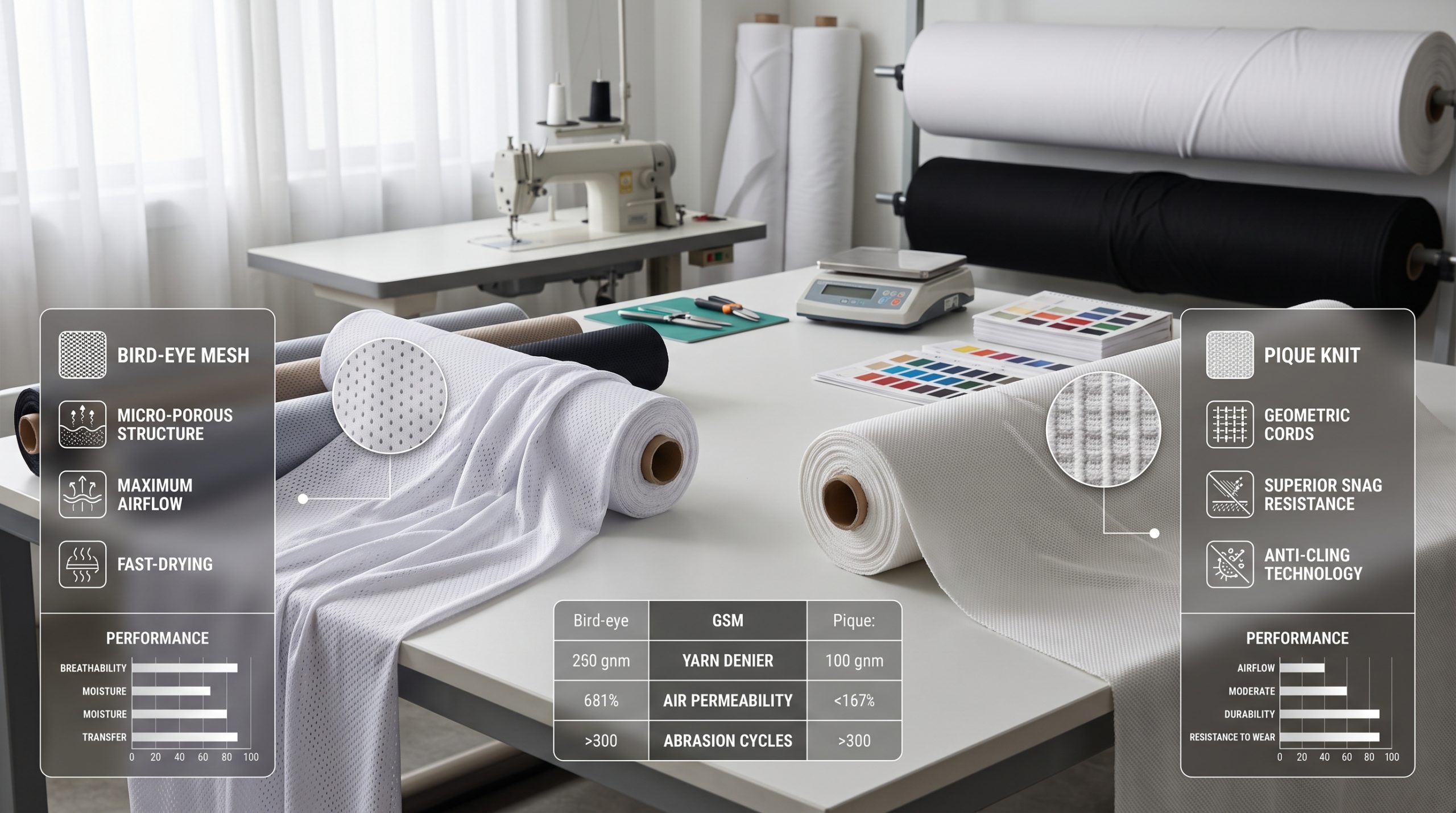
High-performance synthetic polyester engineered with micro-porous knits represents the best basketball fabric material for competitive uniforms. Athletic apparel brands frequently struggle with jerseys clinging to sweaty skin or tearing during intense physical defense. Cheap textiles trap body heat, degrade quickly after repeated washing cycles, and generate expensive return rates from frustrated sports teams. Selecting a high-performance basketball fabric material with balanced weight and rapid moisture dispersal solves these production bottlenecks immediately.
1. What Defines Modern Basketball Fabric Material?
Modern basketball fabric material relies on engineered synthetic yarns configured to maximize airflow and resist high-tension grabbing during full-court play. Garment manufacturers demand fabrics capable of managing rapid sweat output without adding extra physical drag on running players.
Standard textiles fail under professional court conditions because they absorb liquid weight instead of transporting sweat across surface fibers. Sourcing specialized basketball fabric material provides athletic apparel lines with consistent dimensional stability and active cooling properties.
What Mechanical Demands Do Players Face?
Competitive basketball involves continuous sprinting, rapid direction shifts, and abrasive defensive body contact. Your uniform textiles must withstand sharp pulling along jersey seams without splitting stitches or warping out of shape.
Here is the deal: players generate substantial surface perspiration that must evaporate without creating friction hotspots against skin.
- Tensile resistance protects jersey armholes during heavy rebounding battles.
- Multi-directional stretch allows unrestricted overhead shooting mechanics.
- Fiber flexibility prevents neckband sagging across intense tournament seasons.
How Does Moisture Transport Function?
Specialized synthetic fibers pull sweat drops away from skin through continuous capillary channels built into each yarn bundle. Knitted surface grooves distribute moisture over a broad exterior area so ambient air evaporates liquid swiftly.
What is the real story? Hydrophobic polymers refuse to retain liquid inside individual yarn cores, keeping uniforms featherlight during double-overtime games.
- Fast capillary action moves moisture outward within seconds.
- Outer surface evaporation maintains dry contact against athlete skin.
- Non-retaining synthetic filaments eliminate soggy jersey deadweight.
Key Takeaway: Selecting active moisture transport textiles prevents jersey clinging and preserves full athletic range of motion throughout four quarters.
| Metric Parameter | Standard Cotton Jersey | Advanced Synthetic Mesh |
| Moisture Retention Rate | 8.5% Base Weight | Under 0.4% Base Weight |
| Evaporation Speed | 120 Minutes | 18 Minutes |
| Wet Tensile Strength | Weakens by 15% | Retains 100% Strength |
The data proves synthetic filament construction outperforms traditional staple yarns in active heat dissipation and sweat management.
2. Why Does Basketball Fabric Material Use Polyester?
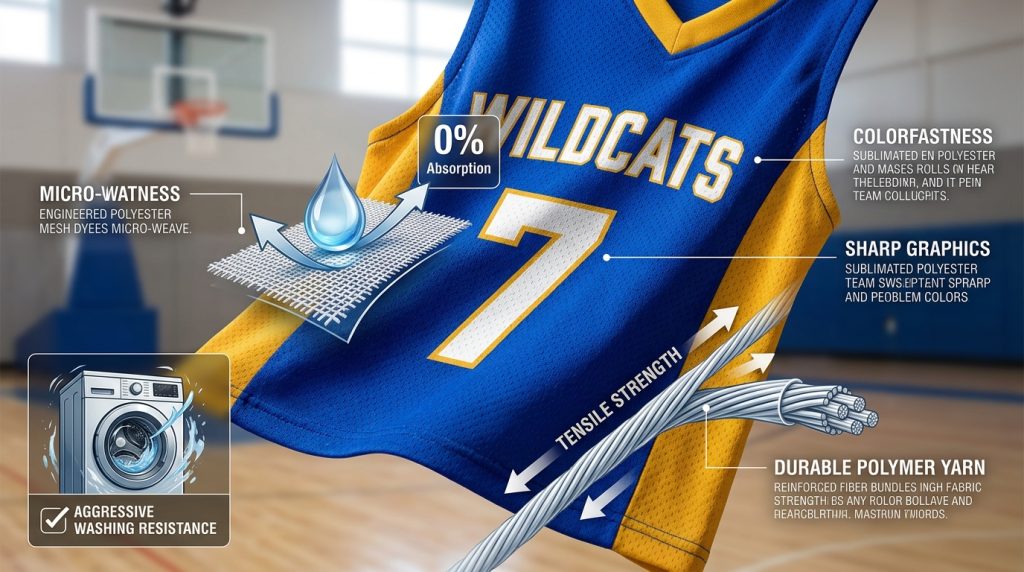
Polyester serves as the primary basketball fabric material because it delivers unmatched tensile strength, zero water absorption, and complete colorfastness. This polymer yarn withstands aggressive washing routines while holding team numbers crisp throughout full seasons.
Apparel manufacturers select polyester yarn packages to balance raw production costs against intense court durability requirements. Modern yarn texturizing creates supple fabric finishes without losing the core resilience expected by sports organizations.
Why Not Choose Pure Cotton?
Cotton fibers absorb up to twenty times their weight in player sweat during an hour of high-intensity basketball. Heavy waterlogged cotton fabrics stick directly to athletic torsos, causing severe chafing along underarms and chest areas.
Look at the facts: wet natural yarn stretches out of form easily and shrinks unpredictably during hot commercial laundries.
- Cotton traps sweat inside fiber walls, adding noticeable weight.
- Saturated fabrics cause abrasive skin friction during continuous running.
- Repeated washing causes severe color fading across dark team shades.
How Do Spandex Blends Alter Performance?
Adding small ratios of spandex yarn into polyester knit programs introduces targeted multi-directional elasticity. This mechanical rebound helps modern athletic garments snap back into place after opposing players pull at jerseys.
Think about this: even five percent elastane content makes garments conform naturally to dynamic torso movements without restricting lung expansion.
- Elastane integration prevents permanent jersey stretching after contact.
- Snug compression panels reduce loose fabric for opponents to grab.
- High elastic recovery preserves sharp uniform silhouettes over time.
Key Takeaway: Combining polyester durability with subtle spandex flexibility prevents garment deformation under physical defense.
| Fiber Composition | Elastic Recovery Rate | Moisture Absorption | Typical Garment Use Case |
| 100% Filament Polyester | Moderate (88%) | Negligible (<0.5%) | Standard Game Uniforms |
| 92% Poly / 8% Spandex | High (98%) | Low (<1.0%) | Pro Cut Compression & Trims |
| 100% Ring-Spun Cotton | Poor (50%) | High (8.0% – 10.0%) | Casual Fan Merchandise |
Selecting the correct synthetic ratio guarantees balanced recovery performance without compromising overall garment longevity.
3. How Does Bird-Eye Basketball Fabric Material Work?
Bird-eye basketball fabric material features an engineered micro-tuck knit pattern that creates tiny dot-like ventilation pores across the face. This structural geometry allows warm air to escape immediately from the athlete body.
Clothing brands prefer basketball fabric material in bird-eye configurations for game tops because it combines high airflow with a smooth printing surface. The tiny eyelets circulate air without revealing underlying base layers.
What Creates the Distinct Pinhole Grid?
Special circular knitting machinery drops specific needles during continuous yarn rotations to produce distinct micro-apertures. These structured geometric holes form an open-work matrix across the cloth without weakening overall tear strength.
Here is the deal: the tiny eyelet pattern breaks boundary air layers around the running torso to accelerate continuous heat exchange.
- Micro-aperture matrix increases dynamic ventilation across chest zones.
- Tuck stitch configuration preserves fabric integrity against snagging.
- Smooth face loops support clean screen printing and transfer graphics.
Why Does Bird-Eye Knit Dry Rapidly?
The combination of miniature surface voids and fine synthetic filaments maximizes the total surface area exposed to room atmosphere. Perspiration spread along the pore edges encounters constant air movement generated by player motion.
What is the real story? The knit structure pulls liquid toward hole perimeters where air currents evaporate it twice as fast as flat knits.
- Open pore perimeters act as continuous miniature evaporation zones.
- Thin knit cross-sections prevent moisture entrapment between yarns.
- Rapid drying cycles keep jerseys lightweight through prolonged games.
Key Takeaway: Bird-eye mesh provides maximum cooling efficiency and accelerated drying rates for high-aerobic court play.
| Fabric Architecture | Air Permeability (CFM) | Drying Time (5ml Water) | Surface Softness |
| Bird-Eye Micro Mesh | 185 CFM | 14 Minutes | Soft Matte Finish |
| Closed Flat Interlock | 65 CFM | 28 Minutes | Ultra Smooth Gloss |
| Heavy Open Hole Mesh | 310 CFM | 11 Minutes | Textured Semi-Rough |
Air permeability measurements demonstrate how bird-eye knits balance active ventilation against sufficient surface opacity.
4. Why Select Pique Basketball Fabric Material Today?
Pique basketball fabric material offers a textured double-knit surface with raised geometric cords that hold the textile slightly off sweaty skin. This physical air pocket prevents sticky fabric clinging during humid indoor arena conditions.
Uniform designers select pique options for training warmups and heavy-contact shorts due to its superior snag resistance and elegant hand feel. The sturdy waffle-style exterior resists fabric pulls from sharp fingernails and locker room Velcro straps.
How Does the Geometric Weave Prevent Cling?
Pique textiles utilize parallel raised ribs and recessed valleys formed by complex knit tuck stitches. Only the raised surface ridges make direct contact with skin, leaving open air channels in the recessed valleys.
Think about this: continuous micro-channels between fabric valleys allow sweat vapor to dissipate before it saturates the cloth.
- Raised geometric nodes minimize total skin contact surface area.
- Recessed weave channels maintain passive air circulation under uniforms.
- Three-dimensional structure eliminates clammy cling during intense sweat.
What Makes Pique Ideal for Heavy Contact?
Double-knit pique construction binds multiple yarn layers together into a firm, puncture-resistant textile package. This tight structural density prevents loose threads from catching on court gear or sharp accessories.
Ready for the good part? Pique preserves crisp garment structure and tailored draping even after hundreds of commercial wash cycles.
- Interlocked yarn systems resist pulling along defensive scrimmage lines.
- Enhanced dimensional weight provides premium drape for travel gear.
- Tight knit ridges reduce surface abrasion against floor slide impacts.
Key Takeaway: Choosing pique fabric provides superior anti-cling performance and rugged structural stability for heavy-wear basketball apparel.
| Feature Matrix | Single Jersey Knit | Bird-Eye Knit | Double Pique Knit |
| Snag Resistance | Low (Prone to Runs) | Moderate | High (Interlocked Cords) |
| Skin Contact Feel | Continuous Flat | Smooth with Micro Dots | Three-Dimensional Textured |
| Garment Body & Drape | Very Light / Floppy | Soft Fluid Movement | Structured Firm Silhouette |
Structural evaluations highlight double pique as the superior choice for durable team shorts and structured warm-up tops.
5. Which Basketball Fabric Material Has Better Feel?
Bird-eye knit delivers a smoother, lighter hand feel against skin, while pique provides a structured, textured grip with lower fabric-to-skin adhesion. Choosing between them depends on whether your athletic collection prioritizes featherlight airflow or rugged structural body.
Brand development teams evaluate tactile drape alongside airflow ratings when sourcing custom basketball fabric material for complete team apparel lines. Game day tops require fluid softness, whereas shorts and sideline apparel demand solid structural heft.
How Do Surface Textures Differ on Skin?
Bird-eye cloth uses ultra-fine denier yarns that slide easily over shoulders and chest muscles without creating friction. Pique knits present a firmer, raised honeycomb feel that feels substantial and crisp to the touch.
Look at the facts: players with sensitive skin prefer the smooth glide of micro-perforated bird-eye fabrics during four quarters of physical running.
- Bird-eye delivers a silky, low-friction glide across torso contours.
- Pique offers a dry, tactile hold that prevents wet fabric clinging.
- Micro-brushed finishing processes further soften interior polyester loops.
Which Knit Delivers Superior Airflow?
Bird-eye textiles provide measurably higher through-flow ventilation due to direct micro-apertures piercing the fabric surface. Pique breathes through permeable yarn passages rather than open holes, resulting in moderate airflow with higher insulation.
What is the real story? Direct air penetration through bird-eye pores cools skin temperatures up to two degrees faster during active sprints.
- Through-hole geometry in bird-eye maximizes active convective cooling.
- Pique structures temper airflow, making them perfect for pre-game shooting shirts.
- Yarn thickness differences directly control overall thermal conductivity.
Key Takeaway: Specifying bird-eye mesh for jerseys and pique knits for shorts maximizes both athlete ventilation and lower-body apparel durability.
| Performance Attribute | Bird-Eye Micro Mesh | Double Knit Pique | Primary Application |
| Tactile Skin Friction | Low (Silky Smooth) | Medium (Textured Grid) | Jerseys vs. Shorts |
| Thermal Dissipation | Fast Active Cooling | Moderate Balanced Flow | Game Tops vs. Warm-Ups |
| Structural Weight (GSM) | 135 – 160 GSM | 170 – 220 GSM | Light Tops vs. Heavy Bottoms |
Careful tactile balancing ensures each uniform piece matches player physiological needs during distinct game phases.
6. How Heavy Should Basketball Fabric Material Be?
Standard basketball fabric material should weigh between 140 and 160 GSM for game jerseys, and between 180 and 220 GSM for competition shorts. This weight distribution prevents top-heavy drag while providing adequate thickness to avoid transparent uniform shorts.
Apparel manufacturers select fabric weights according to intended garment function, climate conditions, and target price points. Specifying incorrect square meter weights leads to either flimsy, see-through jerseys or overly hot, stiff apparel.
When Should You Specify 140 to 160 GSM?
Lightweight fabrics falling between 140 and 160 GSM allow unhindered upper-body motion and swift heat dissipation during fast breaks. This weight bracket keeps game jerseys airy without sacrificing necessary seam tensile strength.
Here is the deal: lighter jersey textiles reduce overall uniform burden, conserving player stamina during tournament play.
- 140 GSM provides ultra-light performance for elite youth and pro leagues.
- 155 GSM delivers optimal opacity for white and light-colored game tops.
- Balanced weights support clean collar ribbing without neckband distortion.
Why Pick 180 to 220 GSM for Shorts?
Basketball shorts require heavier weights between 180 and 220 GSM to endure repeated floor slides, aggressive defense, and heavy drawstrings. Heavier knit density eliminates transparency under bright court lighting when players bend or jump.
What is the real story? Higher density yarns prevent uniform shorts from tearing when caught on court floors or player fingernails.
- 190 GSM ensures complete non-see-through opacity across all dye colors.
- Dense knits anchor heavy elastic waistbands and reinforced drawcords securely.
- Heavier fabric drape maintains a professional knee-length silhouette during running.
Key Takeaway: Specifying 150 GSM for jersey tops and 200 GSM for team shorts achieves the ideal balance of agility and durable coverage.
| Garment Component | Target GSM Range | Recommended Weave | Performance Benefit |
| Game Jersey Tops | 140 – 160 GSM | Bird-Eye Mesh / Micro Interlock | Maximum Agility & Breathability |
| Team Game Shorts | 180 – 220 GSM | Heavy Pique / Double Mesh | Zero Opacity & Puncture Strength |
| Reversible Practice Pennies | 120 – 135 GSM | Open Mini-Mesh | Ultra-Light Double-Layer Build |
Selecting precise GSM tiers prevents costly manufacturing revisions and ensures uniform sets hang properly on athletic builds.
7. Can Basketball Fabric Material Handle Sublimation?
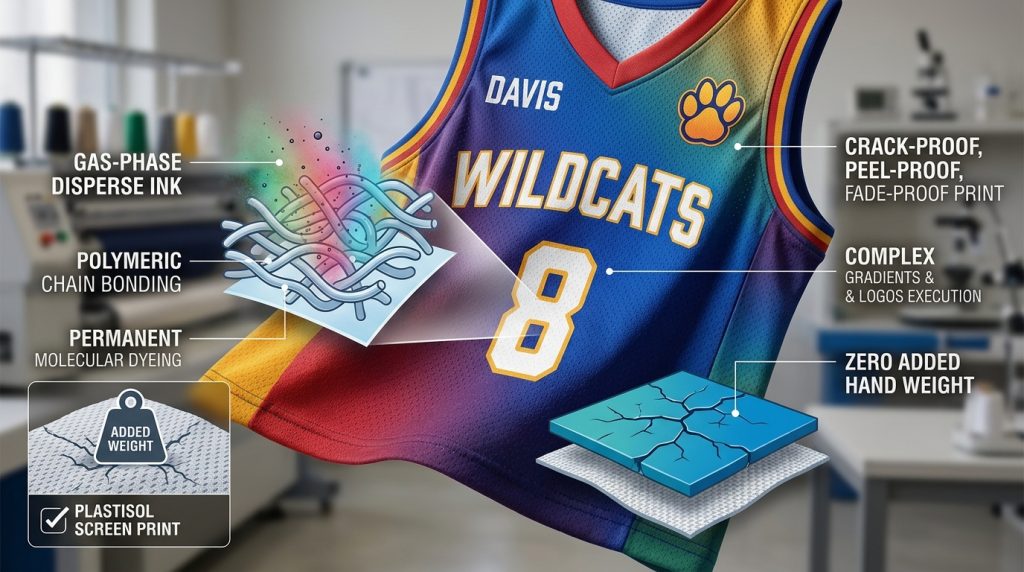
Polyester basketball fabric material handles digital dye-sublimation exceptionally well because synthetic polymer chains bond permanently with gas-phase disperse inks. This printing technique creates vibrant team artwork that never cracks, peels, or fades after hundreds of washes.
Sportswear brands choose basketball fabric material engineered for sublimation to execute complex gradients, player names, and high-definition sponsorship logos. Digital printing maintains zero added hand weight compared to thick plastisol screen printing pastes.
Why Is Synthetic Base Composition Required?
Sublimation dyes bond exclusively with synthetic polyester molecules under high-temperature heat press conditions exceeding 200 degrees Celsius. Natural fibers like cotton or rayon cannot fuse with gas dyes, resulting in washed-out graphics.
Think about this: heat press activation permanently locks ink pigments inside synthetic yarn filaments rather than coating the exterior surface.
- High polymer purity ensures intense color brilliance across all CMYK tones.
- Molecular ink fusion preserves 100% of the fabric original breathability.
- Sublimated graphics will never crack, peel, or stiffen under player sweat.
How Do Mesh Pores Impact Print Sharpness?
Surface texture directly affects graphic resolution and small text clarity on sublimated basketball uniforms. Flat micro-interlock knits hold crisp vector edges, whereas open-pore bird-eye meshes create a slight dot-matrix visual effect.
Ready for the good part? High-density micro bird-eye knits bridge the gap by delivering sharp print definition alongside high air permeation.
- Tight surface loops prevent fine player numbers from blurring at edges.
- Controlled pore sizing maintains continuous logo lines across seams.
- Optimized heat settings prevent aperture distortion during sublimation pressing.
Key Takeaway: Sourcing 100% polyester fabric with smooth surface loops ensures photographic sublimation clarity without clogging ventilation pores.
| Printing Technology | Color Longevity | Breathability Impact | Hand Feel Quality |
| Digital Dye Sublimation | Lifetime Colorfastness | Zero Airflow Restriction | Undetectable Ink Feel |
| Plastisol Screen Print | Cracks After 30 Washes | Completely Blocks Pores | Thick Rubberized Barrier |
| Direct-to-Film (DTF) | Moderate Durability | Partial Breathability Loss | Noticeable Plastic Layer |
Sublimation printing remains the gold standard for custom team sportswear due to its seamless integration into functional textiles.
8. Is Recycled Basketball Fabric Material Durable?
Recycled polyester basketball fabric material delivers the exact same tensile strength, abrasion resistance, and moisture wicking as virgin synthetic yarn. Modern recycling processes purify post-consumer plastic bottles into high-grade spinning pellets with zero structural loss.
Eco-conscious apparel lines specify recycled polyester (rPET) to meet global sustainability standards without compromising athletic performance. High-end basketball programs increasingly require recycled textile certifications before approving large production contracts.
How Do Recycled Fibers Match Virgin Polymers?
Advanced mechanical and chemical recycling cleans, shreds, and melts consumer plastic bottles into purified polyester filament chips. Modern extruders draw these recycled chips into microfibers that match virgin polymers in tensile strength.
Look at the facts: certified recycled polyester yarn achieves identical color absorption, heat resistance, and yarn smoothness during knitting.
- Recycled polymers divert post-consumer plastic waste from coastal landfills.
- Identical melting points allow standard sublimation printing setups.
- Fiber spinning precision eliminates diameter variance across knitted rolls.
Can Eco Yarns Pass Tensile Bursting Tests?
Certified rPET athletic fabrics undergo stringent hydraulic bursting and tensile pull evaluations prior to mass garment cutting. The interlocked knit bonds resist high-force grabbing without fiber breakage or seam failure.
Here is the deal: rigorous laboratory tests confirm recycled textiles handle intense athletic stress just as reliably as virgin synthetics.
- Bursting strength ratings exceed standard athletic league requirements.
- Yarn tensile elasticity matches virgin polymer performance benchmarks.
- Anti-pilling resistance ratings score four out of five on standard Martindale scales.
Key Takeaway: Specifying recycled polyester lets sports brands market sustainable uniforms while delivering professional-grade durability on court.
| Sustainability Spec | Virgin Polyester (PET) | Recycled Polyester (rPET) | Production Variance |
| Carbon Footprint | High Virgin Petrochemical | 45% Lower CO2 Emissions | Significant Eco Benefit |
| Tensile Breaking Force | 420 N Across Warp | 415 N Across Warp | Under 1.5% Difference |
| Sublimation Color Yield | 100% Delta-E Match | 99.5% Delta-E Match | Visually Indistinguishable |
Environmental textile specifications provide substantial marketing advantages without sacrificing competitive athletic performance metrics.
9. How Do You Test Basketball Fabric Material Quality?
Testing basketball fabric material quality requires evaluating colorfastness, abrasion resistance, moisture wicking rates, and seam bursting pressure in certified laboratories. Standardized testing guarantees apparel will survive intense athletic competition and frequent industrial wash cycles.
Garment buyers must request verified laboratory test sheets before approving bulk basketball fabric material roll shipments from textile mills. Catching low-grade yarns during fabric testing prevents expensive recalls and damaged brand reputations.
What Does Martindale Abrasion Reveal?
Martindale testing rubs circular wool pads against fabric samples under precise oscillating friction pressures. This test reveals how many thousand rubbing cycles a basketball uniform can endure before fibers fray or form pills.
What is the real story? Uniform fabrics must withstand at least twenty thousand Martindale cycles to avoid fuzzy surface pilling during active play.
- High abrasion ratings ensure uniforms resist friction against athletic pads.
- Controlled friction tests expose weak filament spinning batches early.
- Surface pilling evaluations ensure team numbers remain sharp and legible.
How Is Wicking Speed Measured Accurately?
Vertical wicking tests submerge fabric sample edges into distilled water to measure how high liquid climbs within ten minutes. Rapid vertical climb confirms that capillary knit pathways pull perspiration away from skin effectively.
Think about this: premium basketball textiles transport liquid upward more than one hundred millimeters within ten minutes of testing.
- High vertical wicking indicates fast cross-torso sweat transport.
- Horizontal drop tests measure how fast moisture spreads across surface pores.
- Evaporation speed measurements confirm rapid drying in ambient locker rooms.
Key Takeaway: Demanding verified Martindale abrasion and vertical wicking laboratory data ensures zero quality defects in finished team uniforms.
| Quality Inspection Standard | Minimum Pass Threshold | Premium Industry Standard | Test Objective |
| Martindale Abrasion (ISO 12947) | 15,000 Cycles | 25,000+ Cycles | Evaluates Anti-Pilling Durability |
| Vertical Wicking (AATCC 197) | 60 mm / 10 Min | 110 mm / 10 Min | Verifies Moisture Movement Speed |
| Wash Colorfastness (ISO 105-C06) | Grade 3.5 | Grade 4.5+ | Prevents Dye Bleeding & Fading |
Verifying technical lab test metrics guarantees that production bulk yardage meets stringent athletic league specifications.
10. How to Source Bulk Basketball Fabric Material?
Sourcing bulk basketball fabric material requires partnering directly with specialized knitting mills capable of providing custom Pantone dye matching and certified lab test reports. Direct mill partnerships cut production lead times and secure wholesale volume pricing.
Apparel brands need reliable textile suppliers who maintain strict color consistency across multiple re-orders throughout busy sports seasons. Establishing clear technical fabric specifications prevents mismatched jersey dye lots across separate production runs.
What Minimum Order Quantities Apply?
Direct textile knitting mills generally require minimum order quantities ranging between three hundred and five hundred kilograms for custom dye colors. Stock greige goods with standard sublimation white bases often carry lower order thresholds.
Here is the deal: buying ready-to-print white sublimation fabric rolls allows brands to produce small custom uniform batches with zero dyeing surcharges.
- Sublimation white fabric inventories allow flexible low-MOQ team runs.
- Custom pantone piece-dyeing requires larger bulk roll commitments.
- Direct mill relationships eliminate middleman markups on volume orders.
How Do You Inspect Production Yardage?
Standard 4-point inspection systems evaluate bulk fabric rolls for yarn snags, uneven dyeing, dirty oil spots, and GSM weight consistency. Every roll should carry a comprehensive inspection tag before leaving the mill warehouse.
Ready for the good part? Rejecting rolls that fail 4-point standards prevents defective cut pieces from reaching your sewing lines.
- 4-point grading detects yarn flaws before fabrics enter cutting tables.
- Width consistency checks ensure maximum pattern layout efficiency.
- Roll-to-roll color shading tests guarantee uniform visual harmony.
Key Takeaway: Establishing direct mill relationships with strict 4-point quality inspections protects apparel margins and ensures reliable bulk deliveries.
| Sourcing Stage | Critical Verification Step | Risk Factor to Mitigate | Expected Turnaround |
| Lab Dip Approval | 3-Angle Light Box Color Match | Metamerism & Shade Drift | 3 – 5 Business Days |
| Pre-Production Sample | Full GSM & Stretch Verification | Incorrect Weight or Hand Feel | 7 – 10 Business Days |
| Bulk Roll Production | 4-Point Inspection System | Knitted Snags & Oil Spots | 15 – 25 Business Days |
Systematic sourcing checkpoints guarantee smooth garment factory handoffs and on-schedule team sportswear deliveries.
Frequently Asked Questions
Q1: What is the best fabric for basketball jersey tops?
Polyester bird-eye mesh is the best fabric for basketball jerseys. Its micro-pore pattern maximizes airflow while keeping uniform tops lightweight and fast-drying during intense play.
Q2: Can I use 100% cotton for basketball uniforms?
No, cotton is not recommended for competitive basketball uniforms. Cotton fibers trap moisture, become heavy with sweat, cause painful skin chafing, and lose shape quickly.
Q3: What weight fabric should I choose for basketball shorts?
A weight between 180 and 220 GSM is ideal for basketball shorts. This density provides sufficient structural durability, avoids transparency under bright court lights, and resists tearing during physical play.
Q4: How do I know if my fabric supports dye sublimation?
Check that the fabric contains at least 85% polyester with a white or light base color. Pure synthetic polyester fibers bond permanently with disperse sublimation inks under high heat.
Q5: What is the difference between bird-eye mesh and pique fabric?
Bird-eye mesh features open micro-holes for maximum ventilation, while pique uses a double-knit textured weave that prevents skin cling and provides higher snag resistance.
Partner With Us for High-Performance Athletic Textiles
Selecting the proper textile package resolves player discomfort, improves uniform longevity, and eliminates expensive product returns for athletic apparel businesses. We manufacture premium knitted textiles engineered specifically for demanding contact team sports, providing verified GSM consistency, rapid moisture dispersal, and superior sublimation color clarity. Whether you need lightweight bird-eye mesh for elite tournament jerseys or rugged double pique for structured team shorts, our manufacturing lines deliver dependable bulk roll stock on schedule. Reach out to our technical textile team and contact us today to request custom fabric sample swatches for your upcoming sportswear collections. We are dedicated to powering global sportswear brands with advanced textile science that elevates court performance.