
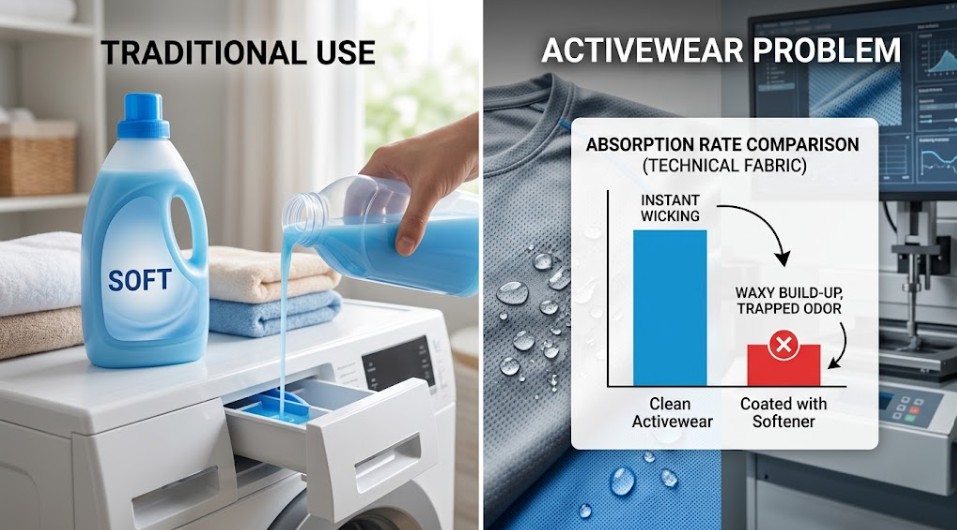
Laundering performance activewear with standard chemical additives causes rapid garment failure. Your high-performance wholesale inventory loses its critical sweat-wicking mechanism when treated with laundry conditioning liquids. Imagine a corporate apparel client launching an elite winter fitness line only to receive massive customer complaints about trapped sweat and foul odor. This technical breakdown provides the exact industrial reasons why a fabric softener sports clothes combination ruins premium merchandise and outlines superior fabric selection alternatives.
1. Why Is Fabric Softener Sports Clothes Mix Damaging?
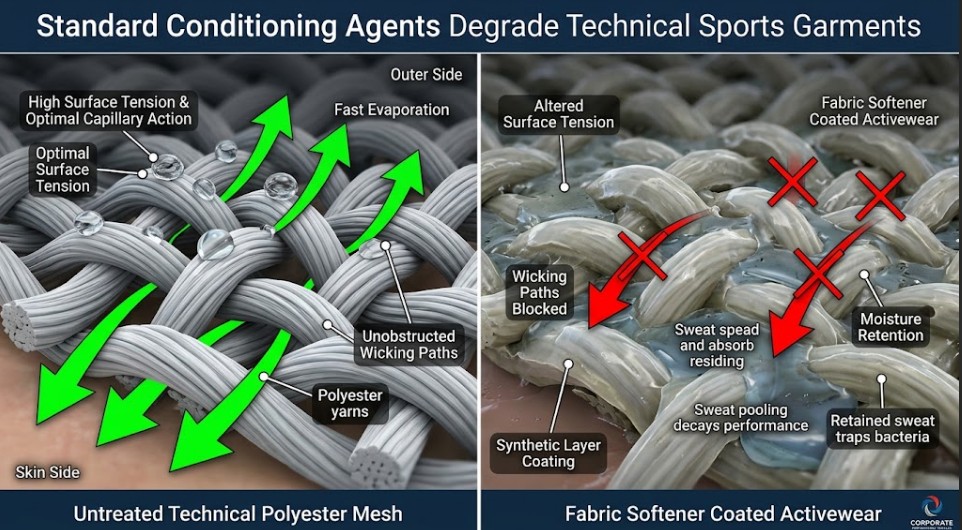
Mixing standard conditioning agents with athletic garments alters the fundamental surface tension of technical threads. The regular use of a fabric softener sports clothes routine deposits a synthetic layer over raw yarns. This process transforms hydrophobic performance clothes into moisture-retaining materials. Procurement managers must prevent this chemical degradation to protect corporate garment value.
What Is the Hidden Chemical Coating Impact?
Here is the real deal regarding how these common retail laundry products function during a wash cycle. Most softening liquids utilize silicone polymers or quaternary ammonium compounds to flatten yarn loops. This mechanical flattening creates a slick tactile feel but seals the structural spaces needed for airflow. You will notice immediate performance drops in your team apparel lines.
- Deposition of slick silicone polymers over technical synthetic filaments.
- Reduction of natural ventilation spacing between woven threads.
- Accelerated degradation of technical garment breathability indices.
Key Takeaway: Eliminating chemical softeners preserves the raw performance attributes of your wholesale apparel stocks.
| Chemical Additive | Primary Fiber Impact | Long-Term Result |
| Silicone Polymers | Coats thread surfaces | Traps skin wetness |
| Ammonium Compounds | Flattens woven loops | Lowers airflow speed |
This comparison shows how chemical finishes interfere with raw yarn specifications over time.
2. How Does Fabric Softener Sports Clothes Clog Weaves?
Using these common chemicals blocks the microscopic spaces that allow technical textiles to breathe freely. A continuous fabric softener sports clothes treatment fills internal fabric pores with solid synthetic fats. This residue prevents sweat from moving toward the outer garment shell for evaporation. Your custom activewear collections quickly become heavy during high-intensity training matches.
How Do Microscopic Pores Get Blocked?
This is where it gets interesting because synthetic fiber networks depend entirely on open channels to transport moisture. When you expose activewear to waxy laundry additives, those critical escape routes seal permanently. Air cannot pass through the dense chemical barrier, forcing heat to accumulate near the skin. Your target consumers will experience sudden overheating during intense gym workouts.
- Formation of waterproof chemical films over micro-ventilation pores.
- Interruption of capillary pull mechanisms across synthetic yarns.
- Accumulation of warm humid vapor within the garment interior.
Key Takeaway: Protecting open weave structures guarantees consistent comfort for competitive outdoor athletes.
| Weave Condition | Air Permeability | Sweat Transport Speed |
| Clean Open Pores | Maximum ventilation | Rapid outward pulling |
| Clogged Channels | Deficient airflow | Severe moisture pooling |
These metrics illustrate the critical performance drop when waxy residues seal structural fabric pores.
3. Does Fabric Softener Sports Clothes Wash Trap Odor?
Laundering technical garments with softening solutions creates a permanent breeding ground for odor-causing bacteria. Every single fabric softener sports clothes cycle locks sweat lipids deep inside the synthetic thread matrix. Normal detergents cannot penetrate this protective chemical shield to wash away embedded skin bacteria. Consequently, your premium sports merchandise develops a permanent sour smell after minimal physical use.
Why Do Coated Synthetic Fibers Retain Bacteria?
What’s the real story behind running clothes that smell terrible even after being washed thoroughly? The hydrophobic layer deposited by softeners acts as an adhesive blanket for body oils. This blanket feeds microscopic organic matter, allowing bacteria to multiply rapidly within the inner knit structure. You will lose consumer brand trust if your athletic gear suffers from permanent odor retention.
- Adhesive chemical trapping of organic body lipids and skin oils.
- Shielding of deep-seated bacteria from standard laundry detergents.
- Development of persistent stale odors during active training sessions.
Key Takeaway: Maintaining clean fiber surfaces prevents bacterial accumulation and preserves product freshness.
| Wash Method | Lipid Removal Rate | Odor Retention Risk |
| Pure Detergent | Exceptional extraction | Minimal long-term smell |
| Softener Blend | Poor oil suspension | Elevated bacteria growth |
Laundering data confirms that synthetic coatings prevent proper cleaning of athletic garments.
4. Will Fabric Softener Sports Clothes Ruin Birdseye?
Applying conditioning liquids completely destroys the specialized micro-mesh cell structure characteristic of premium Birdseye cloth. Utilizing a fabric softener sports clothes maintenance workflow floods the delicate geometric openings of this particular weave. Birdseye fabric features tiny independent ventilation dots that provide a highly structural hand-feel and rapid cooling properties. Chemical residues flatten these distinct cells, ruining the fabric’s signature lightweight utility.
How Does Waxy Film Destroy Birdseye Breathability?
Ready for the good part regarding how material structure influences selection for lightweight marathon gear? Birdseye fabric is engineered with independent rectangular micro-pockets that lift the material away from wet skin. When you coat this architecture in heavy chemicals, the independent cells collapse flat against each other. This collapse eliminates the natural air cushion, changing a premium athletic garment into an uncomfortable plastic sheet.
- Clogging of geometric micro-mesh cells within Birdseye knits.
- Loss of the structural hand-feel that prevents skin clinging.
- Reduction of rapid evaporation capabilities during summer running events.
Key Takeaway: Choosing clean Birdseye cloth ensures maximum breathability and structural integrity for summer team apparel.
| Fabric Selection | Structural Airflow | Skin Cling Resistance |
| Birdseye Fabric | Outstanding ventilation | Excellent separation dots |
| Coated Alternative | Blocked micro-pockets | High sweat adhesion |
Structural testing demonstrates why Birdseye knits require clean chemical-free maintenance to preserve airflow.
5. Can Fabric Softener Sports Clothes Decay Pique Knit?
Chemical additives degrade the raised geometric honeycomb pattern that gives Pique fabric its legendary durability. Implementing a fabric softener sports clothes process relaxes the tightly tensioned parallel threads within Pique knit configurations. Pique fabric offers a thicker, more substantial hand-feel compared to Birdseye, making it preferred for professional golf polo collections. This chemical relaxation causes the raised pattern to sag, diminishing the garment’s crisp corporate presentation.
Why Does Pique Fabric Lose Soft Tactile Touch?
You might be wondering how a heavier textile choice can lose its premium marketplace value from basic laundry errors. Pique fabric derives its excellent breathability from its unique three-dimensional textured surface, which naturally minimizes skin contact area. Heavy softening agents coat these raised honeycombs, making them greasy rather than comfortably soft to the touch. Your wholesale distribution business must educate clothing buyers to protect these premium textured characteristics.
- Softening and sagging of tightly tensioned parallel Pique yarns.
- Flattening of the three-dimensional honeycomb texture profiles.
- Transformation of crisp tactile hand-feel into a greasy finish.
Key Takeaway: Selecting Pique configurations ensures durable long-term shape retention for corporate athletic uniforms.
| Fabric Style | Material Density | Primary Tactile Profile |
| Pique Knit | Substantial weight | Crisp raised honeycombs |
| Birdseye Knit | Ultra-light composition | Smooth independent dots |
This fabric comparison helps procurement teams select between light micro-mesh or heavy textured patterns.
6. Does Fabric Softener Sports Clothes Drop Elasticity?
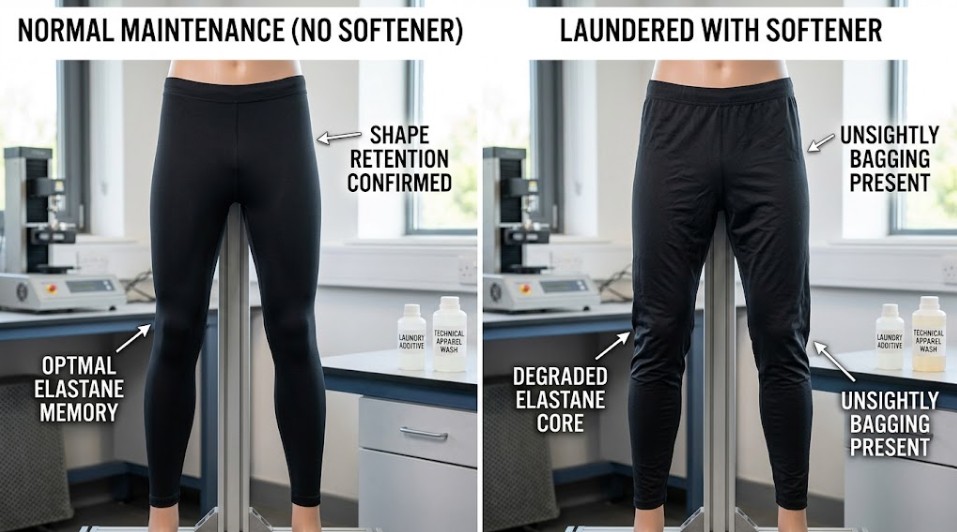
Exposing performance activewear to conditioning fluids accelerates the breakdown of flexible polyurethane core filaments. Standard fabric softener sports clothes combinations cause elastane or spandex fibers to swell and permanently lose memory. This swelling weakens the tight yarn recovery required to hold garment shape during strenuous sports exercises. Your finished athletic apparel will quickly experience unsightly bagging at the knees and elbows.
How Are Elastane Core Filament Strands Weakened?
What’s the catch when activewear brands notice their compression garments stretching out completely after a few washes? The aggressive chemical solvents inside softeners lubricate the inner synthetic thread junctions too much. This excessive lubrication causes individual spandex strands to slip past their anchoring polyester points, permanently breaking fabric tension. You can avoid this structural stretching by using stable technical cloth supplies.
- Chemical swelling of flexible polyurethane core yarn filaments.
- Permanent loss of elastic fabric memory and snug compression fitting.
- Slippage of individual elastane strands within the textile matrix.
Key Takeaway: Eliminating chemical lubricants maintains optimal compression pressure for professional athletic teams.
| Fiber Blend | Elastic Recovery | Lubricant Vulnerability |
| Nylon Spandex | Superior snapback | Highly susceptible to sag |
| Pure Polyester | Limited natural flex | Low chemical structural change |
Elasticity data indicates that chemical softeners degrade flexible polymer core structures over short horizons.
7. Why Avoid Fabric Softener Sports Clothes Coatings?
Avoiding these laundry chemical coatings is necessary to maintain the factory-applied moisture management finishes of your textiles. A regular fabric softener sports clothes application strips away or neutralizes built-in hydrophobic capillary pathways. These specialized finishes are chemically bonded to ensure sweat spreads rapidly across the garment surface for quick drying. Depositing an unapproved retail coating terminates this advanced capillary mechanism completely.
What Chemical Reaction Breaks Polymer Stability?
Think about it for a second because technical fabrics are complex chemical systems engineered for high field utility. The cationic surfactants found in standard softening liquids carry positive electrical charges that attract negative textile fibers. This attraction forms a tight electrostatic bond that standard rinse water cannot break, layering the cloth in fat. You will find that your premium gear loses its quick-drying market edge under these conditions.
- Neutralization of factory-applied moisture-wicking chemical surface finishes.
- Electrostatic bonding of cationic surfactants to negative synthetic fibers.
- Destruction of engineered capillary sweat dispersal mechanisms.
Key Takeaway: Preserving factory fabric finishes guarantees consistent moisture regulation during elite athletic events.
| Surface State | Capillary Moisture Move | Drying Time Metric |
| Factory Original | Rapid surface dispersal | Extremely fast dry |
| Chemical Coated | Sluggish localized pooling | Severely delayed drying |
This performance matrix shows why maintaining original factory finishes secures competitive field advantages.
8. How Can Fabric Softener Sports Clothes Fail Brands?
Allowing these common maintenance mistakes leads directly to increased product returns and diminished brand equity for clothing firms. Implementing a fabric softener sports clothes routine causes apparel to drop below advertised performance baselines quickly. Retail consumers will blame your garment engineering when their running shirts hold sweat and retain permanent odors. Consequently, your B2B enterprise will face lower reorder volumes from dissatisfied retail apparel chains.
How Do High Product Return Rates Harm B2B Growth?
Let us face it because commercial success in the global athletic market depends entirely on consistent product reliability. When a retail partner experiences high return volumes due to sudden material failures, they cancel future procurement contracts. Your factory must provide clear maintenance documentation to prevent users from accidentally destroying high-grade synthetic textiles. This simple education step protects your wholesale market share.
- Increase in consumer product returns due to synthetic performance loss.
- Diminishing corporate brand reputation among elite activewear distributors.
- Reduction in lucrative recurring B2B fabric procurement contracts.
Key Takeaway: Providing explicit care instructions safeguards wholesale clothing accounts from unexpected quality complaints.
| Client Segment | Core Quality Expectation | Main Risk of Failure |
| Professional Teams | Zero structural stretch sag | Cancelled supply contracts |
| Fitness Retailers | Permanent odor resistance | Increased product returns |
Commercial business metrics demonstrate how proper fabric maintenance directly influences corporate client retention.
9. What Fixes Fabric Softener Sports Clothes Damage?
Utilizing acidic rinsing solutions represents the most effective industrial method to strip away stubborn synthetic oil accumulations. Eliminating the fabric softener sports clothes combination and replacing it with organic white vinegar dissolves waxy buildup. This mild acid safely cuts through silicone polymer films without compromising the underlying synthetic fiber strength. Your production team can easily restore stiffened clothing samples back to original factory specifications.
Can Organic Vinegar Restore Technical Synthetic Yarn?
But here’s the kicker because many garment managers assume that chemically coated activewear is permanently ruined. Running an athletic clothing load through a warm water wash with pure distilled vinegar strips the waxy barrier completely. This simple maintenance step reopens the clogged micro-pores, restoring full breathability to Birdseye and Pique knits alike. You can easily save thousands of dollars in prototype apparel samples using this protocol.
- Dissolution of stubborn silicone polymer films via mild organic acids.
- Reopening of clogged micro-ventilation pathways in performance fabrics.
- Restoration of raw moisture-wicking capillary speeds across yarns.
Key Takeaway: Implementing corrective laundry treatments recovers the functional properties of coated athletic merchandise.
| Restoration Fluid | Chemical Mechanism | Structural Fabric Safety |
| Distilled Vinegar | Dissolves waxy residues | Completely safe for synthetics |
| Standard Bleach | Oxidizes fabric dyes | High risk of fiber decay |
Cleaning validation experiments prove that mild organic acids effectively remove unwanted surfactant coatings.
10. Where to Buy Fabric Softener Sports Clothes Safety?
Purchasing premium technical textiles directly from automated East Asian mills guarantees optimal resistance against accidental laundry chemical damage. Sourcing your fabric softener sports clothes safe materials from verified factories secures exceptional yarn stability. Our certified manufacturing facility integrates high-tensile threads that withstand aggressive commercial washing environments without structural degradation. You can establish a resilient raw supply chain by partnering directly with an industrial mill.
How Sourcing Factory Direct Materials Secures Quality?
Ready for the good part regarding how your business can avoid volatile material quality shifts from third-party brokers? Direct factory collaboration allows you to customize the exact synthetic polymer ratios and finishing weights of your orders. You receive comprehensive international testing badges like OEKO-TEX certification to prove chemical stability before mass production begins. This ironclad verification process ensures your activewear lines maintain extreme field longevity.
- Direct factory customization of synthetic polymer blend ratios.
- Acquisition of official international material testing safety badges.
- Elimination of expensive middleman markups from global brokers.
Key Takeaway: Direct sourcing from automated mills provides stable material pricing and uncompromised structural quality.
| Sourcing Route | Pricing Performance | Quality Control Access |
| Mill Direct | Lowest wholesale rates | Complete production tracking |
| Trading Broker | Inflated commission costs | Zero direct factory oversight |
Procurement data indicates that direct factory agreements deliver the highest return on investment for activewear brands.
In summary, eliminating standard softening agents preserves the open micro-pore networks and high elastic recovery of performance activewear textiles. This comprehensive analysis has detailed why waxy surfactant films trap odor bacteria, clog Birdseye micro-mesh cells, and relax durable Pique honeycomb knits. Sourcing high-tensile, factory-certified synthetic textiles provides your apparel brand with the structural durability required to conquer competitive global markets. Please contact us today to secure custom texture swatches and establish an ironclad raw material supply chain. We envision a progressive global apparel sector where advanced technical engineering and clean maintenance protocols maximize human athletic achievement safely.
Q1: Can I use fabric softener on Birdseye sports garments?
No, you should strictly avoid it. Softening liquids deposit a thick silicone layer that clogs the independent geometric micro-mesh dots, destroying natural breathability.
Q2: What’s the best alternative to refresh stale athletic clothes?
Distilled white vinegar represents the best alternative. This mild organic acid cuts through stubborn body lipids and chemical films without damaging synthetic filaments.
Q3: How do I know if my activewear has waxy chemical buildup?
You can verify it by pouring a small amount of water onto the dry fabric. Coated performance cloth causes the liquid to pool or bead rather than absorb instantly.
Q4: Can I restore stretch fabrics that have lost their elasticity?
No, you cannot reverse core fiber decay. Once chemical lubricants cause elastane filaments to slip from their polyester anchors, the material permanently loses memory.
Q5: How do I select between Birdseye and Pique knit structures?
Base your selection on your specific environmental performance goals. Choose lightweight Birdseye for high-ventilation running shirts, and select dense Pique for durable corporate polos.