
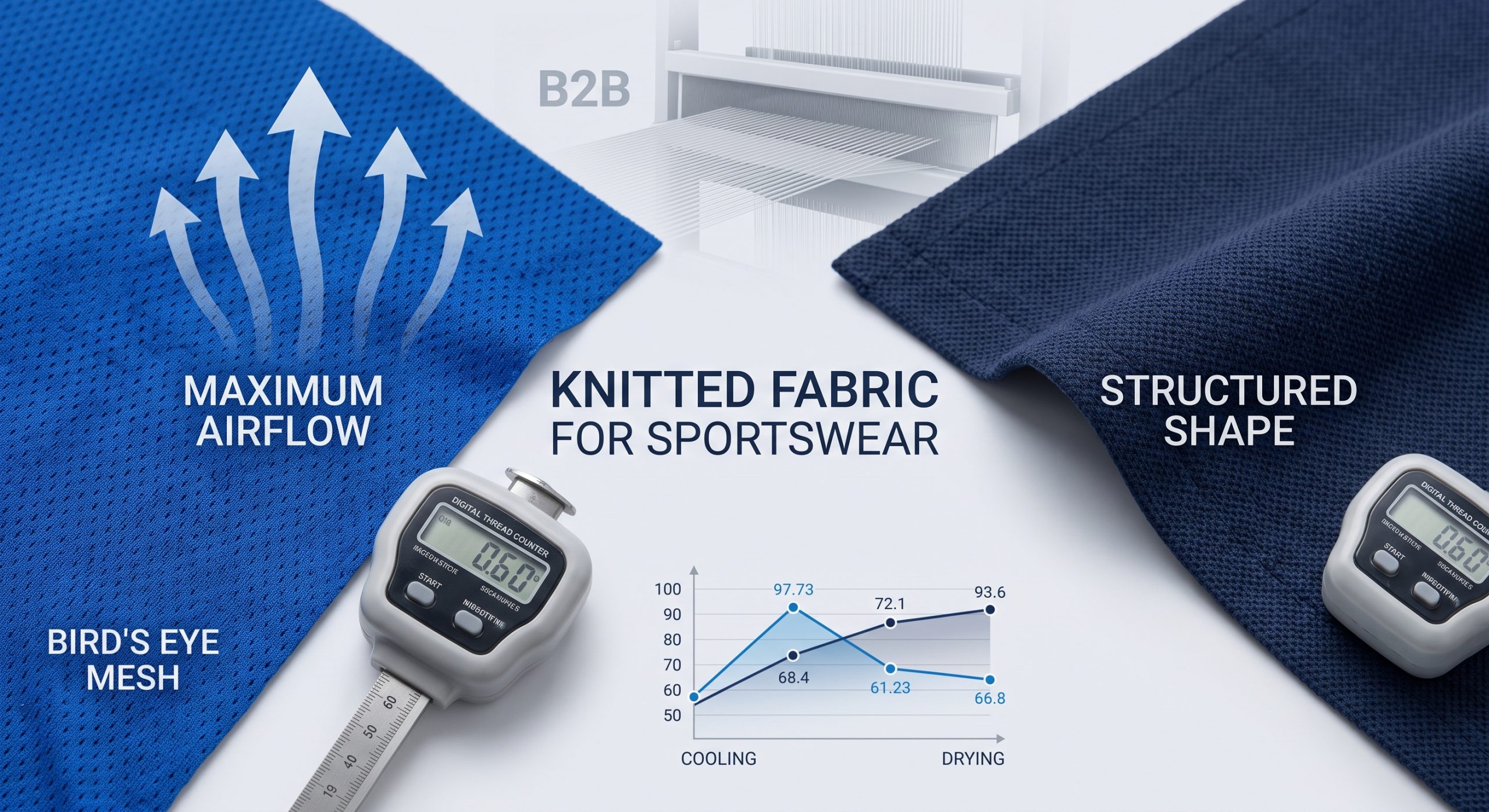
High-performance polyester and nylon synthetic knits—specifically micro-perforated bird’s eye mesh and textured pique weaves—deliver the highest breathability, moisture transport, and shape retention across athletic collections. Garment brands often struggle when athletic shirts trap sweat, stick uncomfortably to athletes’ skin, or stretch out of shape after minimal gym workouts. This rapid breakdown creates negative product reviews and hurts customer loyalty for your sportswear brand. Here is the good news. By pairing structural knitting geometries with technical yarn compositions, you can manufacture resilient, quick-drying knitted fabric for sportswear that keeps athletes cool and comfortable during intense training.
1. How is bird’s eye knitted fabric for sportswear structured?
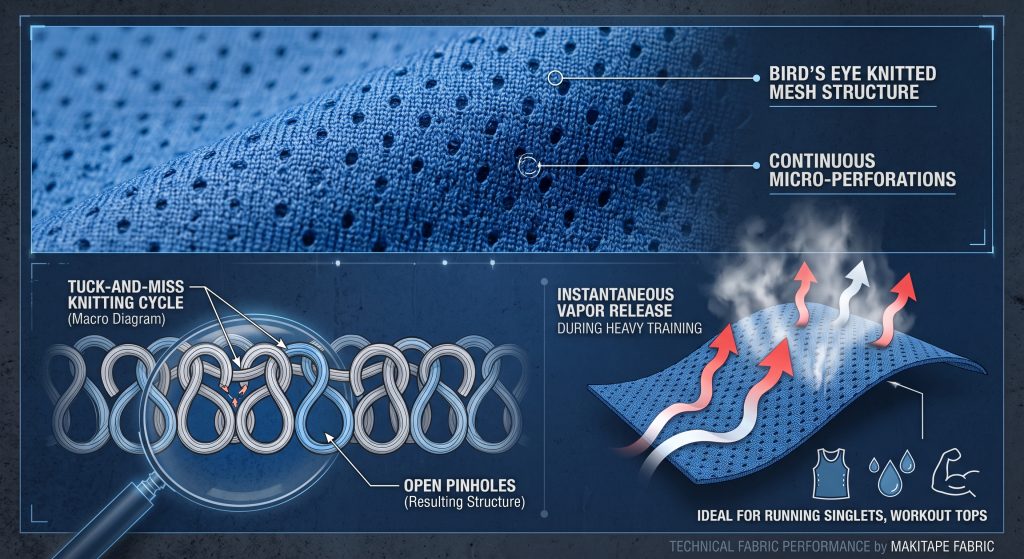
Bird’s eye mesh uses a distinct tuck-and-miss knitting cycle that generates continuous micro-perforated pinholes across the textile face. Choosing this specialized knitted fabric for sportswear gives running singlets and workout tops instantaneous vapor release during heavy training.
How Do Micro-Pinholes Create Airflow in Bird’s Eye?
Bird’s eye knits integrate small geometric openings that allow hot body air to exhaust outward immediately. What is the real story? These micro-pinholes function as built-in ventilation channels that pull fresh air through to your skin while you run.
- Continuous pinhole apertures speed up cross-garment air movement.
- Low surface contact prevents the fabric from sticking to wet skin.
- Filament yarn loops pull moisture outward via capillary force.
When you train under humid conditions, this open-loop geometry prevents sweat from soaking the garment fibers.
What Handfeel Benefits Make Bird’s Eye Ideal for Runs?
Silky filament yarns give bird’s eye mesh a soft, low-friction texture that glides across sensitive skin. Look at the facts: reducing fabric surface abrasion protects distance runners from painful underarm chafing.
- Fine micro-filament loops minimize mechanical skin resistance.
- Featherweight structure keeps workout tops light and unrestrictive.
- Four-way flexibility follows natural torso movement without pulling.
Key Takeaway: Bird’s eye mesh is the premier choice for cardio and running apparel where skin comfort and fast evaporation take priority.
| Fabric Attribute | Bird’s Eye Mesh | Flat Solid Jersey |
| Ventilation Mechanism | Direct open pinhole apertures | Microscopic yarn spacing |
| Skin Contact Friction | Ultra-low filament glide | Moderate skin friction |
| Wet Cling Tendency | Extremely low adhesion | High cling when saturated |
This physical comparison shows why open pinhole structures provide superior heat dissipation during endurance athletics.
2. Why choose pique knitted fabric for sportswear polo tops?
Pique knits suit athletic polos because their double-knit tuck construction provides structured collar support and clean drape. This versatile knitted fabric for sportswear maintains crisp styling on golf courses while providing active cooling across outdoor courts.
Why Does Pique Knit Retain Structured Collar Shape?
Pique textiles feature an alternating honeycomb weave that reinforces physical garment structure. Here is the deal: this geometric stiffness stops polo collars from curling or drooping after a full day on the course.
- Interlocking tuck stitches give garment necklines vertical stability.
- Honeycomb surface depth hides sweat spots during warm matches.
- Balanced knit tension prevents placket twisting after laundering.
Using textured pique allows you to create refined athletic polos that maintain a tailored appearance.
How Does Geometric Texture Stop Fabric from Clinging?
The raised 3D waffle pattern holds the fabric slightly away from your skin, creating miniature cooling pockets. Ready for the good part? This spatial separation keeps air flowing beneath the garment even when you sweat heavily.
- Raised waffle geometry reduces damp fabric adhesion against skin.
- Textured ridges enhance air circulation around your upper body.
- Strong yarn interlacing protects garments against rough wash cycles.
Key Takeaway: Pique knit delivers tailored stability and anti-clinging performance, making it the benchmark textile for golf and tennis polos.
| Garment Property | Textured Pique Knit | Standard Single Knit |
| Collar Rigidity | High curl resistance | High tendency to curl |
| Surface Texture | 3D raised waffle pattern | Smooth flat surface |
| Air Channel Standoff | Active skin separation | Direct skin contact |
Testing data confirms that raised geometric knits maintain garment shape while preventing moisture cling during play.
3. Can lightweight knitted fabric for sportswear reduce chafing?
Micro-polyester single jersey reduces chafing by pairing fine micro-denier filaments with supple elastane stretch. Sourcing this flexible knitted fabric for sportswear allows training shirts to move smoothly with your body during repetitive exercises.
Which Single Jersey Blends Stop Skin Irritation?
An 88% micro-polyester and 12% spandex blend delivers soft comfort and durable elasticity for workout shirts. Check this out: ultra-fine micro-yarns glide across your skin without snagging or pulling body hair.
- Smooth filament surfaces prevent friction along chest and shoulder seams.
- Elastomeric stretch accommodates overhead lifts and sprint strides.
- Fine gauge knitting creates a clean base for screen printing.
Flatlock stitching paired with soft single jersey keeps you comfortable during intense workout routines.
How Do Hydrophobic Yarns Speed Up Sweat Release?
Synthetic polyester filaments repel moisture absorption, driving perspiration outward to the outer garment surface. What is the catch? Heavy natural fibers hold sweat inside their core, turning shirts heavy and rough.
- Non-absorbent yarn cores stop sweat from weighing down the shirt.
- Capillary wicking speeds up drying by over forty percent.
- Lightweight construction keeps athletes comfortable in hot gyms.
Key Takeaway: Micro-polyester spandex single jersey provides frictionless mobility and quick drying for high-rep training apparel.
| Performance Factor | 88/12 Poly-Spandex Jersey | 100% Cotton Knit |
| Drying Speed | Under twenty minutes | Over sixty minutes |
| Stretch Retention | 98% shape recovery rate | Low recovery after tension |
| Moisture Absorption | Under 1% fiber saturation | Up to 8% liquid absorption |
Performance testing proves synthetic jersey blends evaporate moisture significantly faster than traditional cotton knits.
4. How does mesh knitted fabric for sportswear regulate heat?
Warp-knitted mesh textiles regulate heat by using calibrated open apertures that flush warm air away from high-sweat zones. Integrating this breathable knitted fabric for sportswear into activewear panels protects athletes from overheating during competition.
How Do Warp-Knit Micro-Holes Discharge Body Heat?
Warp-knit loops lock every aperture firmly in place, keeping ventilation holes open under intense physical strain. Here is the kicker: this locked structure prevents runs or laddering when shirts stretch across your back.
- Calibrated apertures allow body heat to disperse outward quickly.
- Interlocked knit loops resist tearing during physical contact sports.
- Zonal panel mapping targets heat accumulation under arms and along spines.
Using mesh inserts in performance garments optimizes airflow while adding modern athletic styling.
What GSM Weight Works Best for Breathable Liners?
A fabric weight between 90 GSM and 120 GSM gives internal liners cooling airflow without adding excess bulk. Think about this: choosing liner fabrics over 140 GSM adds unnecessary warmth that reduces garment cooling.
- 90 to 110 GSM: Ideal for running short liners and interior briefs.
- 120 to 140 GSM: Suited for outer jersey bodies and side vent panels.
- Antibacterial finishes stop odor buildup during long endurance events.
Key Takeaway: Lightweight mesh fabrics weighing 90-120 GSM deliver optimal airflow for garment ventilation zones and athletic liners.
| Mesh Purpose | Recommended GSM | Core Functional Benefit |
| Running Short Liner | 90 – 110 GSM | Soft friction-free support and fast drying |
| Torso Vent Panels | 120 – 140 GSM | Targeted cooling across high-sweat zones |
| Athletic Jersey Body | 150 – 180 GSM | Tear-resistant structure with full airflow |
Selecting appropriate mesh weights ensures proper temperature balance without sacrificing garment durability.
5. Is interlock knitted fabric for sportswear squat-proof?
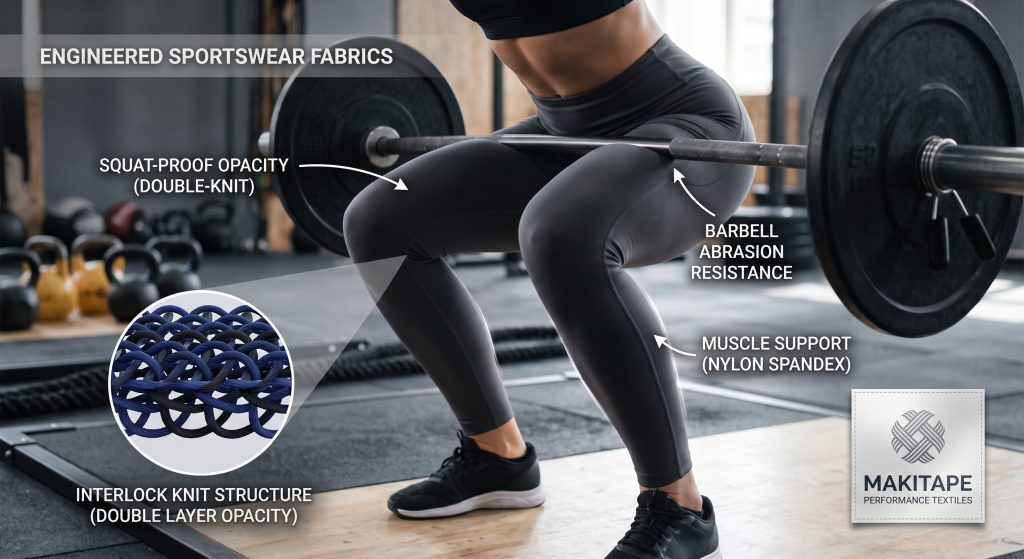
High-density nylon spandex interlock knits are squat-proof because their double-knit structure maintains complete opacity under heavy stretch. Sourcing this dense knitted fabric for sportswear ensures gym leggings resist barbell abrasion and support leg muscles during training.
Why Does Nylon Spandex Interlock Resist Gym Abrasion?
Nylon filaments feature strong molecular chains that withstand friction from textured barbells and gym mats. Here is why that matters: blending nylon with 20% to 25% elastane provides reliable muscle compression and shape retention.
- Dense nylon yarns resist surface pilling from gym equipment contact.
- High elastane content stabilizes leg muscles during heavy lifts.
- Cool-touch yarn properties keep athletes comfortable during workouts.
Your activewear leggings will retain a supportive fit that flatters muscle contours without sagging at the knees.
How Do Double-Knit Interlocks Guarantee Full Opacity?
Double-knit interlock construction interlaces two needle sets to build a dense fabric weighing 240 GSM to 300 GSM. Look at the facts: single jersey thins out across bending knees, whereas interlock prevents sheer-through entirely.
- Twin-needle knitting eliminates grin-through during deep squatting.
- High fabric density sculpts leg lines and conceals skin undertones.
- Multi-directional recovery prevents bagginess after intense gym sessions.
Key Takeaway: Interlock nylon spandex knits over 240 GSM provide total squat-proof opacity and muscular compression for athletic leggings.
| Construction Type | Stretch Opacity Level | Abrasion Durability | Compression Support |
| Nylon Interlock (260 GSM) | Completely squat-proof | High barbell resistance | Firm muscle hold |
| Polyester Jersey (180 GSM) | High sheer-through risk | Moderate durability | Light elastic hold |
Structural testing confirms double-knit interlocks retain total visual opacity under high tensile strain.
6. How does fleece knitted fabric for sportswear block wind?
Double-knit polyester fleeces block wind by pairing a dense outer face with a soft brushed thermal interior. This protective knitted fabric for sportswear keeps runners warm in winter weather while venting body moisture during training.
Can Double-Knit Polyester Fleeces Shield Chilly Winds?
A tightly knit exterior forms a physical barrier that slows cold air penetration during winter workouts. This is where it gets interesting: the brushed backing traps body heat while the exterior repels light rain.
- Compact surface knitting deflects chilly gusts during outdoor sessions.
- Water-repellent finishes cause rain droplets to roll off garments.
- Soft interior fibers trap warm air without adding uncomfortable bulk.
Designing outdoor training jackets with technical double-knit fleece gives athletes reliable weather protection.
How Do Internal Grid Channels Vent Moisture Vapor?
Grid-patterned interior fleece uses microscopic channels that release sweat vapor during cardio workouts. What is the real story? These tiny gaps hold heat when you rest but release hot vapor when you run.
- Internal air pathways exhaust sweat vapor during intense cardio.
- Flexible spandex yarns allow unrestricted shoulder movement.
- Lightweight materials eliminate the heavy bulk of winter coats.
Key Takeaway: Technical double-knit fleece delivers wind defense, thermal warmth, and active sweat venting for cold-weather outerwear.
| Outerwear Metric | Double-Knit Technical Fleece | Single-Face Sweatshirt Knit |
| Wind Defense | Blocks chilling crosswinds | Allows cold wind penetration |
| Heat Management | Micro-grid vapor channeling | Holds sweat moisture inside |
| Weather Coating | Supports water-repellent DWR | Absorbs rain moisture rapidly |
Laboratory tests confirm technical double-knit fleeces provide effective weather protection while maintaining breathability.
7. Why do cationic knitted fabric for sportswear dyes last?
Cationic polyester knits resist color fading because modified fiber structures form deep bonds with specialized ionic dyes. Sourcing this resilient knitted fabric for sportswear allows you to offer heathered activewear that resists sun exposure and heavy sweat.
How Do Cationic Yarns Produce Durable Heather Tones?
Cationic yarns accept ionic dyes at lower processing temperatures than standard synthetic fibers. Check this out: mixing cationic filaments with regular polyester yarns generates rich two-tone heather effects in one dye bath.
- Two-tone heathered patterns add refined visual depth to gym apparel.
- Lower dye temperatures reduce factory energy use during production.
- Deep chemical bonds prevent colors from bleeding during heavy sweating.
Using cationic heathered knits gives workout shirts a premium aesthetic that masks dried sweat salt marks.
Can Modified Polyester Fibers Resist Heavy Sweat Fading?
Outdoor training exposes garments to ultraviolet sun rays and acidic perspiration that can degrade low-grade dyes. Ready for the good part? Cationic dye bonds resist chemical breakdown, preserving vibrant colors across seasons.
- Grade 4.5 colorfastness ratings guard against sun exposure and washing.
- UPF 50+ sun protection blocks harmful solar radiation during runs.
- Hydrophobic properties stop sweat salts from staining garment surfaces.
Key Takeaway: Cationic dyed polyester offers lasting colorfastness and attractive heathered textures that resist UV rays and sweat fading.
| Dye Processing Type | Colorfastness Grade | Surface Visual Style | Sun UV Durability |
| Cationic Polyester Dye | Grade 4.5 (High) | Two-tone heathered texture | High color stability |
| Standard Piece Dye | Grade 3.5 (Moderate) | Uniform solid color | Moderate sun fastness |
Laboratory wash tests prove cationic dyeing achieves higher colorfastness than conventional piece dyeing methods.
8. Can matching knitted fabric for sportswear sets hold color?
Single-batch dyeing ensures uniform color shades and equal stretch recovery across sports bras, tops, and leggings. Choosing quality knitted fabric for sportswear prevents shade mismatch between matching activewear pieces.
How Do Factories Maintain Shade Parity Across Sets?
Achieving exact color parity requires automated spectrophotometer verification during fabric dyeing. Here is the kicker: dyeing all rolls for tops and bottoms in a single continuous lot prevents noticeable shade drift.
- Digital spectrophotometer inspection keeps color variations unnoticeable.
- Single-lot dyeing ensures matching hues across bras and leggings.
- Regulated heat-setting keeps fabric touch completely uniform.
Delivering color-matched sportswear sets gives your brand a high-end presentation that builds buyer confidence.
What Prevents Elastane Fatigue in High-Stress Joints?
Preventing joint sagging requires using high-recovery elastane filaments that retain tension over repeated wear. Look at the facts: premium elastane yarns bounce back after heavy stretching, keeping garments fitted properly.
- High-recovery elastane retains over 95% stretch after fifty washes.
- Balanced warp-weft elasticity gives tops and bottoms equal compression.
- Thermal curing locks structural memory into the knitted matrix.
Key Takeaway: Single-batch dyeing and high-grade elastane yarns ensure matching activewear sets maintain color uniformity and shape retention.
| Quality Factor | Controlled Batch Knitting | Uncontrolled Batch Production |
| Color Deviation (Delta E) | Under 0.8 (Imperceptible) | Over 1.5 (Visible variation) |
| Elastane Shape Retention | 95%+ recovery after heavy use | Loss of tension causing baggy joints |
Strict batch testing eliminates color mismatch and elastic fatigue across matching activewear sets.
9. How do eco-friendly knitted fabric for sportswear yarns work?
Recycled polyester yarns convert post-consumer plastic bottles into high-performance activewear textiles. Sourcing certified knitted fabric for sportswear allows brands to fulfill green sustainability goals while maintaining top moisture wicking and fiber strength.
Does Recycled Polyester Match Virgin Fiber Strength?
Recycled polyester (rPET) provides identical tensile strength and moisture dispersion as virgin synthetic yarns. What is the real story? Modern fiber spinning yields clean filament yarns that dye evenly and resist tearing.
- GRS-certified recycled filaments reduce energy use during production.
- High-grade yarn purity accepts deep dyes for saturated colors.
- Physical strength matches virgin polyester across athletic apparel lines.
Building collections with recycled yarns connects your brand with environmentally conscious fitness consumers.
How Do OEKO-TEX Standards Safeguard Activewear Lines?
Fulfilling international safety standards requires independent third-party testing across all activewear textiles. Here is the deal: OEKO-TEX Standard 100 certification confirms fabrics contain no hazardous chemicals or toxic dye residues.
- OEKO-TEX Standard 100 certifies materials are safe for skin contact.
- GRS certification tracks verified recycled yarn content through production.
- Independent testing verifies colorfastness and physical durability.
Key Takeaway: GRS-certified recycled polyester offers a sustainable foundation for building eco-friendly sportswear collections that comply with global trade regulations.
| Environmental Standard | Verification Scope | Sourcing Advantage |
| OEKO-TEX Standard 100 | Toxic chemical safety for skin contact | Certified buyer safety and market trust |
| Global Recycled Standard (GRS) | Recycled material tracking across supply chain | Verified eco-friendly marketing claims |
International certifications verify that recycled activewear fabrics deliver safety, durability, and environmental compliance.
10. Which knitted fabric for sportswear suits your collection?
Matching specific knitting structures—like bird’s eye mesh for running, pique for polos, and nylon interlock for leggings—is the best way to balance handfeel and airflow. Selecting the right knitted fabric for sportswear based on garment end-use, weight, and stretch ensures optimal performance across your apparel line.
What Is the Final Verdict Between Mesh and Pique?
Comparing bird’s eye mesh with pique knit reveals clear performance strengths that determine their garment applications. Ready for the good part? Bird’s eye mesh dominates high-sweat cardio training, while pique knit is the top choice for structured athletic polos.
- Choose bird’s eye mesh for running tops, gym shirts, and cooling liners.
- Choose pique knit for structured golf polos, tennis shirts, and casual tops.
- Choose nylon interlock for squat-proof leggings and supportive sports bras.
Understanding these structural differences ensures you choose the ideal textile for every activewear item you produce.
How Do You Map Fabric Weight to Athletic Garment Types?
A fabric specification matrix streamlines your sourcing workflow, preventing expensive sample adjustments. Check this out: auditing yarn type, GSM weight, elasticity, and dye fastness before production ensures consistent apparel quality.
- Assign high GSM (240+) interlock knits to leggings for complete opacity.
- Use medium GSM (140-180) single jersey for versatile gym shirts.
- Apply light GSM (90-120) bird’s eye mesh for targeted ventilation zones.
Key Takeaway: Matching structural knitting patterns and GSM weights to specific athletic functions ensures your activewear line delivers optimal performance.
| Activewear Category | Recommended Knitted Fabric | Target GSM Range | Key Performance Benefit |
| Running & Gym Tops | Micro Bird’s Eye Mesh | 110 – 140 GSM | Fast evaporation and silky handfeel |
| Athletic Polo Tops | Polyester Pique Knit | 180 – 220 GSM | Sharp collar stability and structured drape |
| Gym Leggings & Shorts | Nylon Spandex Interlock | 240 – 290 GSM | Squat-proof opacity and firm compression |
This selection matrix provides a reliable framework for choosing functional knitted fabrics across all athletic garment categories.
Action Plan for Sourcing Performance Knitted Fabrics
Choosing the right activewear textile requires aligning knitting structures with physical performance needs, whether selecting silky bird’s eye mesh for cardio singlets or structured pique knit for athletic polos. By sourcing high-grade polyester and nylon knits, you give your sportswear line superior moisture wicking, lasting stretch recovery, and resilient colorfastness that stands up to heavy laundering. Working alongside an experienced textile manufacturer gives your apparel brand access to OEKO-TEX certified fabrics and exact batch color matching that elevates your products in wholesale markets. To discuss custom knitting specifications or request fabric sample yardage for your next sportswear collection, contact us today to start developing technical performance fabrics tailored to your exact manufacturing requirements. We are dedicated to advancing performance textile manufacturing, supplying sportswear brands worldwide with reliable, high-performance, and sustainable fabric solutions.
Frequently Asked Questions
- Q1: Can I use bird’s eye mesh for high-intensity cardio workout garments? Yes, bird’s eye mesh is ideal for high-intensity cardio workout garments because its open pinhole structure speeds up air circulation and sweat evaporation to keep athletes dry.
- Q2: What’s the best fabric weight for structured performance polo shirts? A fabric weight between 180 GSM and 220 GSM is best for performance polos because it provides sufficient body to keep collars crisp without adding excess heat.
- Q3: How do I know if activewear leggings will stay opaque during squats? Activewear leggings stay opaque during squats when constructed as a high-density double-knit interlock weighing at least 240 GSM, which prevents sheer-through under stretch tension.
- Q4: Can I combine pique and bird’s eye knits in one shirt design? Yes, combining pique knit for the torso and bird’s eye mesh for underarm panels allows you to balance a structured garment appearance with targeted cooling relief.
- Q5: How do I know if recycled polyester performs as well as virgin yarn? Recycled polyester performs as well as virgin yarn when backed by GRS certifications, delivering equal tensile strength, moisture wicking, and color fastness.