
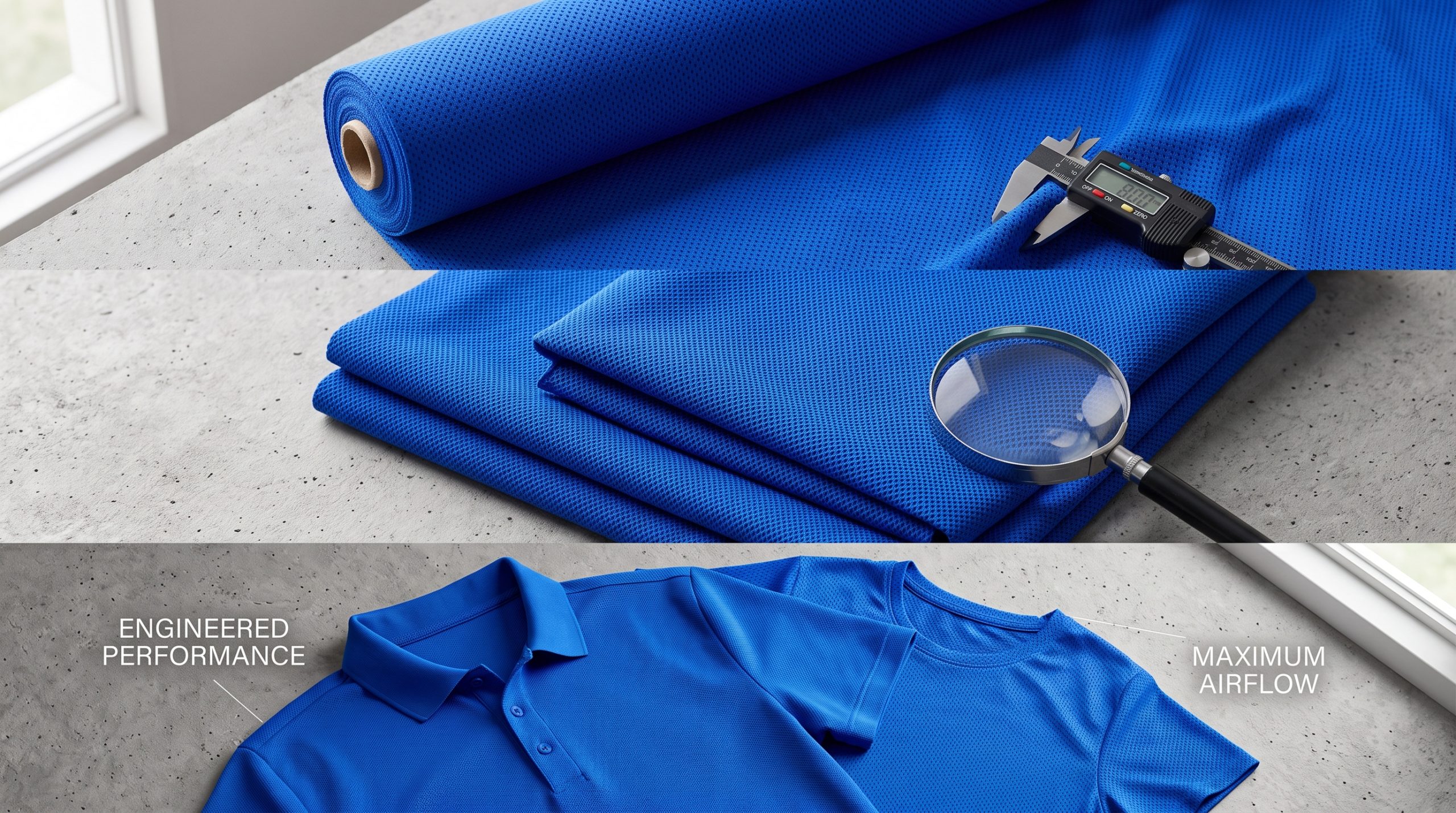
High-performance synthetic knitted structures—such as micro-perforated bird’s eye mesh and dimensional pique knits—deliver superior temperature control, rapid sweat evaporation, and lasting durability for athletic garments. Sourcing teams frequently face garment failure when inferior knitted materials lose shape, trap moisture, or show severe color fading after repeated washing cycles. This unexpected material degradation ruins garment appearance, causes uncomfortable skin friction, and compromises buyer confidence in your sportswear collection. Here is the good news. By evaluating structural yarn arrangements and physical knitting patterns, you can select resilient, quick-drying sports textiles that keep athletes cool and comfortable during peak physical exertion.
How do sports textiles improve breathability in workout tops?
Technical bird’s eye mesh and pique knits improve breathability in athletic tops by using engineered yarn patterns that channel body heat and speed up sweat evaporation. Selecting specialized sports textiles allows sportswear developers to balance tactile softness against air circulation for running and cardio training.
How Does Bird’s Eye Mesh Structure Drive Cooling?
Bird’s eye mesh features tiny micro-perforations across the fabric matrix that mimic small open apertures. What is the real story? These tiny openings allow warm air to exit instantly while fresh air passes through toward your skin.
- Micro-perforated pinholes create constant air movement across your skin.
- Lightweight yarn loops minimize contact area to prevent skin sticking.
- Smooth filament surfaces drastically reduce friction during running motion.
When you wear bird’s eye knitted tops during intense cardio sessions, liquid sweat moves rapidly along synthetic fibers toward the outer surface. This rapid fluid dispersion prevents heavy fabric soaking during long workouts.
Why Does Pique Fabric Provide Structured Comfort?
Pique fabric uses a raised geometric waffle weave that gives the material physical substance and visual depth. Look at the facts: this 3D surface structure holds the garment slightly away from your body, forming natural cooling spaces.
- Raised waffle pattern prevents full fabric adhesion when sweating.
- Textured geometry adds structured drape for premium athletic tops.
- Dense knitting construction maintains shape under repeated stretching.
Choosing pique fabric gives your athletic apparel a refined look while maintaining reliable ventilation across warm training environments.
Key Takeaway: Bird’s eye mesh offers maximum airflow for high-sweat training, whereas pique fabric delivers structured drape with subtle air ventilation.
| Fabric Type | Surface Structure | Handfeel Experience | Primary Airflow Mechanism |
| Bird’s Eye Mesh | Micro-perforated pinholes | Silky and ultra-smooth | Direct aperture air circulation |
| Pique Knit | Raised geometric waffle | Crisp with physical texture | Standoff air channel spacing |
Comparing physical structures demonstrates how open mesh pinholes maximize direct airflow while pique waffle knits preserve garment structure.
Why do sports textiles like pique fabric suit athletic polos?
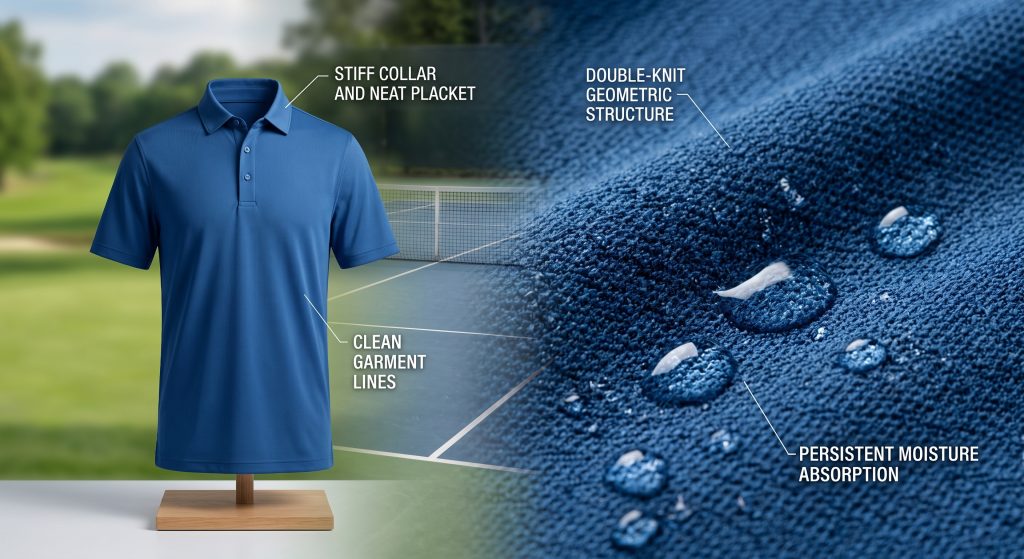
Pique knit fabrics suit athletic polos because their double-knit geometric structure provides collar stiffness, placket neatness, and persistent moisture absorption. Premium sports textiles retain clean garment lines while allowing active stretch across golf courses and tennis courts.
How Does Pique Construction Support Crisp Collars?
Pique knits utilize interwoven tuck stitches that build structural stability throughout the fabric matrix. Here is the deal: this structural firmness prevents collar curling and keeps plackets standing straight after full day wear.
- Tuck-stitch matrix adds vertical stability to garment necklines.
- Honeycomb pattern hides surface wear and minor sweat markings.
- Balanced knit tension prevents edge rolling during active play.
Designing sports polos with pique material ensures your garments retain a tailored silhouette without sacrificing athletic flexibility.
Can Pique Fabrics Preserve Deep Blue Dye Shades?
Solution-dyed synthetic yarns inside pique fabrics retain deep royal blue and navy tones through extensive laundering. Ready for the good part? High-grade disperse dye treatments bond deep into the polyester fiber core, resisting sweat acidity and solar rays.
- Superior colorfastness ratings guard against sun exposure.
- Washing resistance preserves dye depth through dozens of laundry cycles.
- Dye-receptive fibers maintain vivid shade saturation over extended wear.
Key Takeaway: Pique knit construction provides the structural rigidity needed for sharp polo collars alongside strong color preservation in rich blue shades.
| Material Property | Pique Knit Structure | Flat Jersey Knit |
| Collar Resistance | High stability against curling | Prone to edge rolling |
| Surface Appearance | Dimensional 3D texture | Smooth flat surface |
| Shape Retention | Exceptional structural memory | Moderate edge distortion |
Structural testing confirms that pique knit construction prevents collar distortion compared to standard flat jersey materials.
Can sports textiles prevent skin chafing in performance tees?
Micro-polyester spandex single jersey fabrics prevent skin chafing by combining ultra-fine filament yarns with multi-directional stretch elasticity. Synthetic sports textiles glide effortlessly across high-friction zones, protecting your body from irritation during long-distance workouts.
Which Single Jersey Blends Deliver Superior Softness?
An 88% micro-polyester and 12% spandex blend delivers remarkable softness and rapid moisture transportation for active tees. Check this out: micro-denier synthetic filaments feel as gentle as silk against sensitive skin zones.
- Fine micro-filaments reduce surface roughness against your skin.
- Four-way elastomeric stretch adapts to dynamic shoulder movement.
- Rapid drying action stops damp material from dragging on your torso.
Wearing micro-jersey tees eliminates painful skin friction around underarm seams and chest zones during extended physical activity.
How Do Hydrophobic Fibers Manage Heavy Sweat?
Polyester filaments reject internal moisture absorption, pushing water droplets directly to the outer garment surface. What is the catch? Standard natural fibers absorb sweat and expand, becoming heavy and abrasive against skin.
- Hydrophobic fiber core prevents liquid retention inside yarn loops.
- Surface moisture dispersion accelerates drying speed by over forty percent.
- Lightweight fabric composition preserves athlete comfort in warm weather.
Key Takeaway: Micro-polyester spandex single jersey provides friction-free comfort and dynamic stretch, making it ideal for athletic training tees.
| Performance Metric | 88/12 Micro-Poly Spandex | 100% Ring-Spun Cotton |
| Drying Duration | Under twenty minutes | Over sixty minutes |
| Elastic Recovery Rate | 98% shape recovery | Poor recovery after stretch |
| Moisture Retention | Less than 1% water retention | Retains up to 8% body sweat |
Performance testing shows synthetic jersey blends dry three times faster than cotton while maintaining full elastic recovery.
How do sports textiles mesh structures drive thermal regulation?
Engineered mesh fabrics drive thermal regulation by utilizing calibrated micro-hole distributions that release trapped body heat and accelerate sweat evaporation. Utilizing specialized sports textiles in high-heat garment zones keeps athletes cool during demanding competitive sports.
How Do Micro-Apertures Flush Out Trapped Heat?
Engineered micro-apertures in bird’s eye mesh function as micro exhaust ports, rapidly releasing body heat during physical exertion. Here is the kicker: warp-knitted mesh construction locks every loop tightly, preventing fabric tears along high-stress seams.
- Calibrated hole patterns maximize air exchange without fabric sheer-through.
- Warp-knit loop locks resist snagging and tearing under physical stress.
- Strategic ventilation zones target underarm and spine heat buildup.
Integrating mesh panels into activewear garments enhances cooling efficiency while creating stylish multi-texture panels across garment surfaces.
What Fabric Weight Works Best for Mesh Linings?
A fabric weight between 90 GSM and 120 GSM provides optimal breathability for garment linings without adding unwanted physical weight. Think about this: selecting mesh linings above 140 GSM adds unnecessary insulation, reducing overall garment cooling performance.
- 90 to 110 GSM: Ideal for lightweight athletic shorts liners.
- 120 to 140 GSM: Perfect for outer shirt panels and jersey inserts.
- Antimicrobial yarn finishes prevent odor buildup during long workouts.
Key Takeaway: Lightweight mesh fabrics weighing 90-120 GSM deliver maximum airflow for ventilation panels and internal activewear linings.
| Mesh Application | Recommended GSM Range | Primary Functional Benefit |
| Shorts Liner Mesh | 90 – 110 GSM | Frictionless internal support and quick drying |
| Zonal Vent Inserts | 120 – 140 GSM | Targeted airflow across high-heat body areas |
| Outer Sports Jerseys | 150 – 180 GSM | Durable structure with complete air circulation |
Matching mesh weight to specific garment zones optimizes air throughput while preserving required physical durability.
Are sports textiles interlock knits ideal for gym leggings?
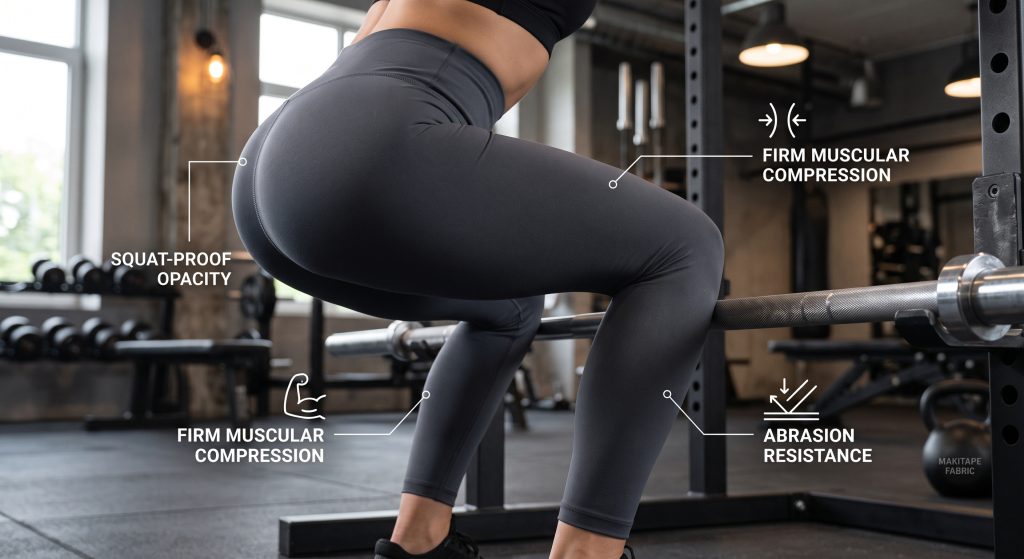
High-density nylon spandex interlock knits are ideal for gym leggings because they provide squat-proof opacity, firm muscular compression, and exceptional abrasion resistance. Premium sports textiles withstand contact with barbells and gym equipment without pilling or shedding fibers.
Why Choose Nylon Spandex for Legging Fabrics?
Nylon polymer chains possess extraordinary physical toughness, making them vastly more resistant to friction than standard polyester fibers. Here is why that matters: blending nylon with 20% to 25% elastane yarn yields intense multi-directional stretch memory.
- High elastane content supplies supportive muscular compression.
- Dense nylon yarns resist pilling from fitness equipment friction.
- Cool-to-the-touch surface feel enhances comfort during intense gym workouts.
Designing athletic leggings with navy or midnight blue nylon interlock gives your apparel line a supportive, sculpting feel.
How Do Interlock Fabrics Ensure Squat-Proof Opacity?
Squat-proof performance requires a double-knit interlock construction with a fabric weight of at least 240 GSM to 300 GSM. Look at the facts: single-knit fabrics thin out when stretched over knees, revealing underlying skin, whereas interlock knits preserve complete opacity.
- Double-knit interlock structure prevents sheer-through under stretch.
- Dense physical construction supports muscular stabilization during lifting.
- High GSM weight ensures reliable coverage during deep squat movements.
Key Takeaway: High-density nylon spandex interlock above 240 GSM guarantees squat-proof opacity, muscle support, and long-term abrasion resistance.
| Fabric Construction | Stretch Opacity | Pilling Resistance | Compression Grade |
| Nylon Spandex Interlock | Fully opaque (240+ GSM) | Exceptional resistance | Firm muscle support |
| Polyester Single Jersey | Risk of sheer-through | Moderate resistance | Light compression |
Testing confirms double-knit interlock construction maintains complete visual coverage under maximum stretch tension.
How do sports textiles fleeces protect activewear outerwear?
Double-knit fleece materials protect activewear outerwear by combining wind-resistant outer faces with soft, heat-trapping internal fleeces. Technical sports textiles shield athletes against cold winds while allowing internal sweat vapor to escape during outdoor workouts.
Can Double-Knit Fleeces Block Cold Wind?
Tightly knitted double-faced polyester forms a protective outer barrier that significantly slows cold air penetration during winter training. This is where it gets interesting: the brushed inner surface traps warm body heat, while the outer face repels ambient dampness.
- Compact knit face blocks chilly gusts during outdoor running.
- Durable water repellent coatings shed light moisture effortlessly.
- Brushed fleece backing creates thermal insulation without heavy weight.
Choosing deep blue double-knit fleeces gives your sportswear line an attractive, weather-ready option for cool-climate training.
How to Balance Thermal Protection with Breathability?
Achieving optimal thermal control requires internal grid-fleece backings that channel body vapor outward. What is the real story? Grid-patterned fleece creates microscopic air passages that trap heat when resting but release warm air when moving.
- Grid-fleece channels speed up moisture vapor release during cardio.
- Added elastane fibers allow unrestricted arm movement during workouts.
- Lightweight double-knits reduce bulk compared to traditional winter coats.
Key Takeaway: Double-knit polyester fleeces with brushed grid interiors deliver wind blockage, thermal warmth, and active sweat vapor release.
| Outerwear Feature | Brushed Double-Knit Fleece | Single-Face Knit Material |
| Wind Defense | Blocks chilling wind gusts | Allows wind penetration |
| Heat Retention | Traps warm insulating air | Minimal thermal protection |
| Water Repellency | Supports DWR water repellent | Absorbs surface water drops |
Evaluating outerwear parameters proves double-knit fleeces supply essential wind defense and thermal insulation for sports garments.
Why do sports textiles cationic dyes resist fading and sweat?
Cationic polyester fabrics resist fading because their chemically altered fibers bond tightly with ionic dyes, creating vivid, long-lasting colors. Using cationic sports textiles allows manufacturers to produce attractive two-tone heathered blue shades that remain vibrant despite heavy perspiration and solar exposure.
How Does Cationic Dyeing Create Heathered Blue Tones?
Cationic polyester fibers accept specialized ionic dyes at lower processing temperatures than standard synthetic yarns. Check this out: combining cationic polyester with regular polyester in one weave generates rich two-tone heathered effects during a single dye bath.
- Dual-tone heathered patterns add premium visual interest to activewear.
- Lower dyeing temperatures reduce factory energy use during production.
- Deep chemical bonding prevents color bleeding during heavy sweating.
Using blue cationic fabrics for gym shirts and running gear provides a stylish look that masks dry sweat marks.
Can Cationic Fabrics Resist UV and Sweat Fading?
Outdoor sports expose apparel to sun rays and acidic body perspiration, which can cause cheap dyes to fade into dull tones. Ready for the good part? Cationic dye bonds resist molecular breakdown from UV light and sweat, maintaining original color fastness.
- High colorfastness ratings guard against sun exposure and washing.
- UPF 50+ sun protection properties shield skin from solar rays.
- Fast-drying yarn properties stop sweat salts from staining fabric surfaces.
Key Takeaway: Cationic dyed polyester offers remarkable color stability and attractive heathered blue visuals that resist UV rays and perspiration fading.
| Dye Method | Colorfastness Grade | Visual Pattern | UV Stability |
| Cationic Polyester Dye | Grade 4.5 (High) | Two-tone heathered blue | Outstanding sun protection |
| Standard Piece Dye | Grade 3.5 (Moderate) | Solid uniform color | Moderate UV resistance |
Testing data shows cationic dyeing achieves superior colorfastness grades compared to traditional piece dyeing methods.
Can sports textiles ensure color matching in activewear sets?
Color-matched synthetic interlock and jersey fabrics ensure precise shade uniformity across sports bras, shirts, and matching leggings. High-grade sports textiles maintain consistent stretch recovery and identical shade density across complete multi-piece apparel lines.
How to Achieve Perfect Color Uniformity Across Garments?
Achieving exact color matching across matching sets requires automated spectrophotometer shade verification during dye house processing. Here is the kicker: processing all fabric rolls for tops and bottoms within a single continuous dye batch prevents shade variation.
- Automated color testing maintains strict shade tolerances across production batches.
- Single-lot dyeing guarantees identical blue shades across tops and bottoms.
- Consistent finishing heat keeps fabric handfeel completely identical.
Delivering perfectly matched blue activewear sets gives your sportswear brand a premium appearance that builds buyer loyalty.
What Prevents Fabric Sagging in Stretch Activewear Sets?
Preventing fabric sagging in matching activewear sets relies on using high-grade elastane yarns with strong elastomeric memory. Look at the facts: quality elastane fibers recover their original shape after repeated stretching, keeping leggings and bras fitting snugly.
- Quality elastane retains over 95% elastic recovery after fifty washes.
- Balanced warp and weft tension provides consistent support across garment pieces.
- Heat-set finishing fixes fabric dimensions to prevent distortion over time.
Key Takeaway: Single-lot dyeing and high-recovery elastane yarns ensure activewear sets maintain identical blue shades and lasting shape recovery.
| Quality Control Parameter | Controlled Batch Production | Uncontrolled Batch Production |
| Color Deviation (Delta E) | Under 0.8 (Imperceptible difference) | Over 1.5 (Visible color difference) |
| Elastic Recovery | 95%+ recovery after repeated stretching | Loss of tension causing baggy knees |
Precision quality control eliminates shade variations and elastic sagging across matching activewear sets.
How do sports textiles recycled yarns support green clothing?
Global Recycled Standard (GRS) certified recycled polyester yarns support green clothing initiatives by turning post-consumer plastic bottles into high-performance activewear fabrics. Modern recycled sports textiles provide identical strength, moisture wicking, and color depth as virgin synthetic fibers.
Does Recycled Polyester Match Virgin Fiber Performance?
Recycled polyester (rPET) made from post-consumer plastic bottles offers equal tensile strength and wicking performance as virgin polyester. What is the real story? Advanced spinning processes create clean filament yarns that accept dyes evenly and resist tearing under strain.
- GRS-certified recycled polyester reduces energy consumption during fiber production.
- High filament quality accepts deep blue dyes for rich color saturation.
- Strong physical properties match virgin polyester durability across activewear uses.
Building your blue activewear collection with recycled materials aligns your brand with eco-friendly purchasing trends.
How to Confirm Safety Standards for Export Markets?
Meeting international quality and safety regulations requires verifying independent environmental certifications for all activewear textiles. Here is the deal: OEKO-TEX Standard 100 certification confirms that your knitted fabrics contain no toxic chemicals or hazardous dye residues.
- OEKO-TEX Standard 100 guarantees safety for direct skin contact.
- GRS certification tracks authentic recycled yarn content through the supply chain.
- Independent lab testing verifies colorfastness and physical performance specs.
Key Takeaway: GRS-certified recycled polyester offers an eco-friendly foundation for building sustainable blue sportswear lines that satisfy international compliance.
| Environmental Certification | Core Focus Area | Primary Brand Benefit |
| OEKO-TEX Standard 100 | Non-toxic chemical safety for skin contact | High consumer safety and buyer trust |
| Global Recycled Standard (GRS) | Recycled material tracking through production | Authentic eco-friendly marketing claims |
Verifying international certifications ensures your activewear products satisfy strict safety regulations and environmental claims.
Which sports textiles balance handfeel and airflow overall?
Matching specific fabric constructions—such as bird’s eye mesh for running tops, pique for polos, and nylon interlock for leggings—is the best way to balance handfeel and airflow overall. Selecting specialized sports textiles based on target activity, GSM weight, and required stretch ensures optimal garment performance across your entire activewear line.
What Is the Final Verdict Between Bird’s Eye Mesh and Pique?
Comparing bird’s eye mesh against pique knit highlights distinct functional benefits that dictate their ideal garment uses. Ready for the good part? Bird’s eye mesh excels in ultra-lightweight, high-sweat running tops, whereas pique knit is ideal for structured athletic polos.
- Choose bird’s eye mesh for running shirts, training tees, and breathable liners.
- Choose pique knit for structured polos, tennis shirts, and golf wear.
- Choose nylon interlock for high-compression leggings and supportive sports bras.
Understanding these structural differences allows you to select the ideal material for each athletic garment you manufacture.
How to Match Fabric Properties to Activewear Garments?
A clear fabric selection matrix simplifies your sourcing decisions, saving time and preventing costly sample revisions. Check this out: evaluating yarn type, GSM weight, stretch percentage, and dye performance before production guarantees high-end finished garments.
- Match heavy GSM (240+) interlock fabrics to leggings for complete opacity.
- Select medium GSM (140-180) micro-jersey for versatile gym t-shirts.
- Use light GSM (90-120) bird’s eye mesh for targeted cooling panels.
Key Takeaway: Matching structural fabric properties like mesh pinholes or pique waffle weaves to specific athletic end-uses ensures superior activewear performance.
| Activewear Category | Recommended Fabric | GSM Weight Range | Core Performance Feature |
| Running & Gym Tops | Micro Bird’s Eye Mesh | 110 – 140 GSM | Fast drying with silky skin feel |
| Athletic Polos | Polyester Pique Knit | 180 – 220 GSM | Sharp collar stability and structured shape |
| Leggings & Shorts | Nylon Spandex Interlock | 240 – 290 GSM | Squat-proof opacity and supportive compression |
This selection framework provides a clear guide for sourcing high-performance knitted fabrics across all sportswear categories.
Action Plan for Sourcing Performance Sports Textiles
Selecting ideal performance fabrics requires matching material structure with athletic demands, whether using silky bird’s eye mesh for cardio tops or structured pique knit for sports polos. By sourcing verified synthetic materials like moisture-wicking polyester spandex and durable nylon spandex, you ensure strong stretch recovery, vibrant color fastness, and reliable sweat management for your sportswear brand. Working with experienced textile manufacturers equips your apparel collection with OEKO-TEX certified materials and consistent dye quality that stands out in competitive wholesale markets. To discuss custom fabric specifications or request sample rolls for your next apparel line, contact us today to start developing technical sportswear fabrics tailored to your exact production requirements. We remain committed to advancing functional textile engineering, providing activewear brands worldwide with cutting-edge, sustainable fabric solutions.
Frequently Asked Questions
- Q1: Can I use bird’s eye mesh for high-intensity cardio workout garments?
Yes, bird’s eye mesh is ideal for high-intensity cardio workout garments because its micro-perforated structure accelerates air circulation and speeds up sweat evaporation to keep athletes dry. - Q2: What’s the best fabric weight for structured performance polo shirts?
A fabric weight between 180 GSM and 220 GSM is best for performance polos because it provides sufficient body to keep collars crisp without adding excess heat. - Q3: How do I know if activewear leggings will stay opaque during squats?
Activewear leggings stay opaque during squats when made from high-density double-knit interlock fabric weighing at least 240 GSM, which prevents sheer-through under stretch tension. - Q4: Can I combine pique and bird’s eye knits in one shirt design?
Yes, combining pique knit for the main torso and bird’s eye mesh for underarm panels allows you to balance structured garment appearance with targeted cooling relief. - Q5: How do I know if recycled polyester performs as well as virgin yarn?
Recycled polyester performs as well as virgin yarn when verified by GRS certifications, offering identical tensile strength, moisture wicking, and color fastness.