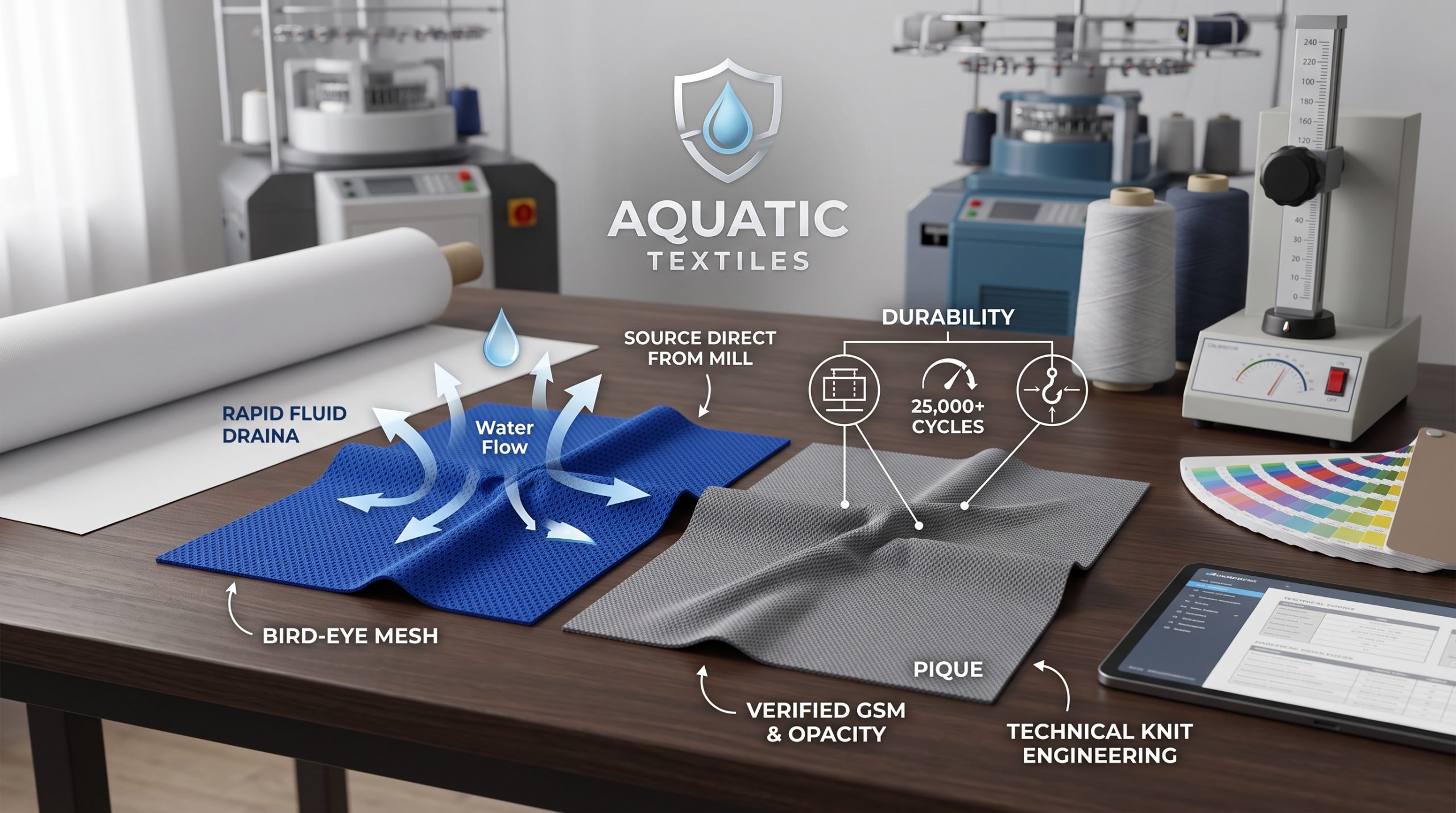
High-grade polybutylene terephthalate and texturized polyester knits represent the best chlorine resistant fabric for competitive swimwear and aquatic apparel. Active swimwear brands often face devastating customer returns when chlorinated pool water breaks down elastane yarns within weeks. Traditional swimming suits rapidly turn transparent, sag around leg openings, and lose structural rebound under continuous pool exposure. Choosing certified chlorine resistant fabric with non-degrading polymer bonds and warp-knit stability solves these chemical degradation issues permanently.
1. What Defines Modern Chlorine Resistant Fabric?
Modern chlorine resistant fabric is defined by synthetic polyester and PBT polymers engineered to withstand chemical oxidation from pool sanitizers. Sourcing certified chlorine resistant fabric guarantees that competitive swimwear holds structural compression without yarn snapping.
Dedicated textile mills utilize tightly interlocked yarn matrices that block pool chemicals from penetrating fiber cores. Specifying tested aquatic textiles prevents suit stretching and fabric thinning across demanding training seasons.
What Chemical Hazards Do Swimmers Encounter?
Pool water contains concentrated hypochlorous acid that chemically attacks standard elastane chains during daily swim training. You need fabrics that resist severe fiber hardening and surface fuzzing caused by pool sanitizers.
Here is the deal: chemical pool sanitizers dissolve flexible urethane bonds in common elastane yarns.
- Continuous chlorine exposure breaks down stretch recovery in standard swimsuits.
- Chemical oxidation causes fabric yellowing and premature micro-tears.
- Waterborne minerals strip soft textile finishes, making garments rough against skin.
How Does PBT Polymer Science Function?
Polybutylene terephthalate filaments feature crystalline molecular structures that resist chemical oxidation from pool chlorine. Liquid chlorine runs across hydrophobic yarn surfaces without breaking internal polymer linkages.
What is the real story? Hydrophobic polyester polymers reject water absorption, maintaining rapid drying speeds after pool workouts.
- Dense crystalline polymers prevent chlorine penetration into core filaments.
- Moisture-repelling yarns maintain light garment weight during long swim sets.
- Stable chemical composition ensures complete resistance to pool acids and salts.
Key Takeaway: Sourcing PBT-engineered synthetic knits eliminates chemical degradation and preserves compressive fit across continuous pool sessions.
| Material Parameter | Standard Nylon Spandex | PBT Polyester Blend |
| Pool Chemical Resistance | Fails After 60 Hours | Exceeds 300 Hours |
| Fiber Mass Retention | Drops by 35% | Maintains 99% Mass |
| Wet Tensile Retention | Weakens by 40% | Retains Full Strength |
Laboratory pool immersion data shows PBT polyester blends outlast conventional spandex knits by more than five times.
2. Why Choose Chlorine Resistant Fabric for Teams?
Swim teams choose chlorine resistant fabric because specialized polymer yarns maintain consistent compression and shape retention throughout multi-month training seasons. Sourcing a dedicated chlorine resistant fabric gives athletic teams uniform durability that survives harsh indoor pool environments.
Off-the-shelf fashion swim knits fail quickly under daily two-a-day training regimens. Direct mill sourcing allows athletic programs to build long-lasting team uniforms that resist pool chemicals and mechanical friction.
Why Do PBT Blends Beat Standard Spandex?
Standard spandex fibers swell and dissolve when submerged in warm chlorinated water over consecutive training sessions. Degraded elastane loses its elastic memory, causing suits to hang loosely on competitive athletes.
Look at the facts: damaged swimsuits create hydrodynamic drag that slows lap times during competition.
- Degraded fibers cause bagging around hips and shoulders during dives.
- Weakened yarn loops allow pool water to puddle inside suit linings.
- Repeated washings fail to restore tension once elastane molecules break down.
How Do Warp Knits Improve Hydrodynamics?
Warp knitting machines interlock multiple yarn sets lengthwise to create dense, flat surfaces with zero water drag. This smooth textile face glides cleanly through water while holding tight muscular compression.
Think about this: high stitch density prevents athletic swimsuits from stretching open during high-speed flip turns.
- Tight knit loops compress muscle groups to minimize active muscle vibration.
- Flat textile faces reduce water friction across racing torsos.
- Stable multi-needle knits prevent ladder runs if surface snags occur.
Key Takeaway: Combining PBT polymers with tight warp knitting delivers maximum hydrodynamic speed alongside multi-season durability.
| Fabric Construction | Chlorine Life Expectancy | Water Drag Rating | Target Swim Application |
| 100% PBT Knit | High (350+ Pool Hours) | Very Low Glide | Daily Training & Racing |
| 80% Nylon / 20% Elastane | Low (50 Pool Hours) | Low Glide | Recreational Beachwear |
| Circular Knit Polyester | Moderate (180 Pool Hours) | Medium Glide | Water Aerobics & Warmups |
Hydrodynamic testing confirms warp-knitted PBT textiles maintain structural tension and low drag during high-intensity training.
3. How Does Mesh Chlorine Resistant Fabric Work?
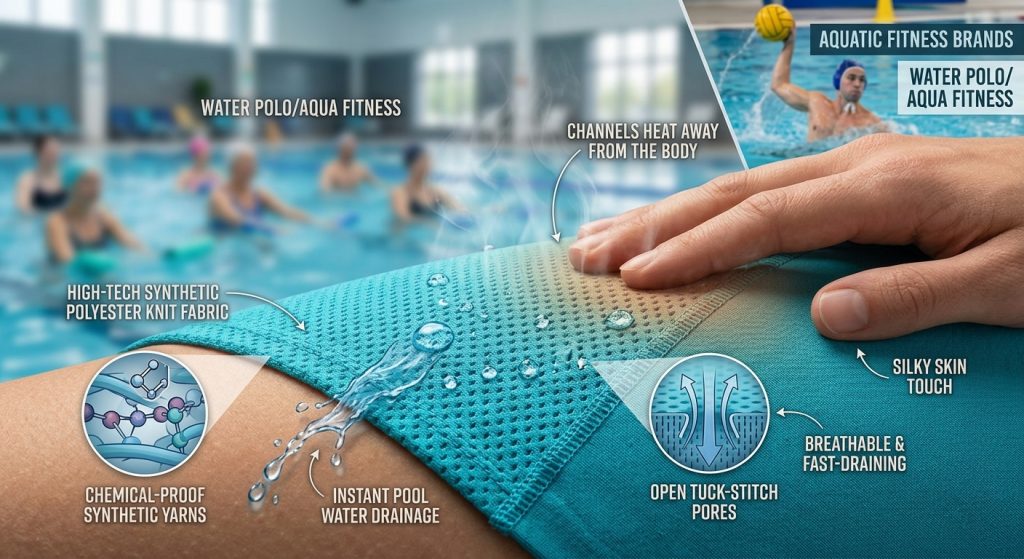
Mesh chlorine resistant fabric works by combining chemical-proof synthetic yarns with open tuck-stitch pores that channel water and heat away from the body. Sourcing chlorine resistant fabric in bird-eye patterns provides aquatic fitness brands with breathable, fast-draining textiles for water polo and aqua fitness.
Bird-eye patterns allow pool water to drain instantly when athletes exit the water, eliminating heavy moisture weight. Designers specify this knit because it pairs rapid fluid drainage with a silky skin touch.
What Forms the Drainage Eyelet Grid?
Circular knitting machines drop selected needles to form miniature geometric pores across the synthetic cloth. These micro-apertures allow pool water and air to flow freely through the garment without sacrificing opaque coverage.
Here is the deal: micro-pore matrices accelerate water runoff the moment an athlete steps onto the pool deck.
- Miniature drainage openings dump trapped water weight instantly upon pool exit.
- Tuck-stitch loop clusters maintain fabric strength against sudden pulls.
- Smooth surface yarns support vivid digital printing for club crests and sponsor logos.
Why Does Bird-Eye Mesh Dry Rapidly?
Open eyelet perimeters multiply the surface area exposed to ambient airflow on pool decks. Water caught between yarn filaments evaporates swiftly as moving air circulates through open pores.
What is the real story? Thin filament bundles prevent pool water from accumulating in interior yarn valleys.
- Micro-aperture edges serve as active evaporation zones across the torso.
- Light yarn construction eliminates cold, clammy feelings after swimming.
- Rapid moisture transport keeps deck warmups comfortable between competitive events.
Key Takeaway: Specifying bird-eye micro-mesh provides fast water drainage and rapid surface drying for water sports tops.
| Mesh Architecture | Pool Deck Drying Speed | Water Drainage Rate | Surface Texture |
| Bird-Eye Micro-Mesh | 14 Minutes | Instantaneous | Silky Smooth Matte |
| Flat Solid Tricot | 26 Minutes | Moderate Runoff | Sleek Glossy Face |
| Heavy Double Knit | 35 Minutes | Slow Drainage | Dense Structured Body |
Airflow and drainage evaluations prove bird-eye micro-mesh sheds pool water significantly faster than flat solid knits.
4. Why Pick Pique Chlorine Resistant Fabric Lines?
Apparel brands pick pique chlorine resistant fabric for poolside apparel because raised honeycomb cords prevent damp cloth from suctioning against wet skin. Incorporating pique chlorine resistant fabric into aquatic collections gives coaches and lifeguards professional, textured shirts that resist poolside wear.
The three-dimensional waffle relief maintains an open air buffer between wet skin and fabric. Performance brands choose pique when aquatic apparel demands superior snag resistance against rough concrete pool decks.
How Does Waffle Texture Stop Skin Cling?
Double-knit pique machinery alternates knit and tuck loops to produce raised structural ridges across the fabric face. Only the top ridges touch wet skin, leaving open air channels in the recessed valleys.
Think about this: continuous micro-channels prevent wet shirts from sticking uncomfortably across shoulders and backs.
- Raised geometric nodes minimize direct skin contact points.
- Recessed air channels preserve airflow over damp muscle groups.
- Three-dimensional patterns stop fabric suction during humid deck sessions.
What Makes Pique Resistant to Pool Edges?
Interlocked double-knit yarns bind multiple thread layers into a firm, abrasion-resistant textile package. This rugged construction protects garments against yarn snags caused by rough pool tiles and lane line hooks.
Ready for the good part? Pique preserves crisp tailored collars and clean drape through continuous laundering.
- Interlocked loop systems resist snagging against rough concrete coping.
- Substantial fabric mass provides structured drape for team polo tops.
- Robust exterior cords resist scuffing from heavy equipment bags and belts.
Key Takeaway: Choosing double-knit pique provides rugged anti-snag durability and clean structured drape for poolside staff apparel.
| Structural Feature | Single Jersey Knit | Bird-Eye Knit | Double Pique Knit |
| Tile Snag Resistance | Low (Prone to Runs) | Moderate | High (Interlocked Cords) |
| Wet Skin Cling | High (Suctions to Skin) | Low (Smooth Glide) | Very Low (Air Gap) |
| Garment Body & Drape | Light & Flowing | Soft & Pliant | Structured & Firm |
Structural testing confirms double pique delivers the necessary puncture resistance and anti-cling performance for poolside apparel.
5. Which Chlorine Resistant Fabric Has Better Feel?
Bird-eye knit provides a silky, weightless glide against sensitive skin, while pique offers a firmer, dry-touch grip with minimal fabric suction. Sourcing chlorine resistant fabric requires matching yarn denier and surface texture to your specific aquatic application.
Competitive swim tops require fluid softness to prevent underarm chafing, whereas poolside uniforms demand sturdy structural weight. Sourcing managers evaluate these tactile differences to build cohesive aquatic merchandise lines.
How Do Surface Textures Differ on Skin?
Bird-eye cloth uses fine micro-denier yarns that glide effortlessly across athlete shoulders without causing friction burns. Pique knits present a firmer, dry-touch waffle texture that feels substantial and crisp in your hands.
Look at the facts: athletes engaged in repetitive swim strokes prefer the low-friction surface of fine micro-knits.
- Bird-eye delivers a silky, low-friction glide across moving shoulder joints.
- Pique provides a dry, textured hold that prevents wet fabric suction.
- Soft interior loops eliminate abrasive skin chafing during long workouts.
Which Weave Provides Superior Breathability?
Bird-eye fabrics deliver higher through-flow ventilation due to direct micro-apertures piercing the cloth face. Pique breathes through permeable yarn gaps rather than open pores, providing balanced airflow with slight thermal insulation.
What is the real story? Direct air circulation through bird-eye pores accelerates cooling during high-intensity pool workouts.
- Open eyelet geometry in bird-eye maximizes deck cooling after swimming.
- Pique structures regulate heat retention for poolside coaching jackets.
- Controlled yarn deniers balance softness against long-term wear resistance.
Key Takeaway: Pairing bird-eye mesh for lightweight swim shirts with pique knits for poolside tops balances athlete comfort and garment longevity.
| Tactile Metric | Bird-Eye Micro-Mesh | Double Knit Pique | Recommended Garment |
| Skin Friction Rating | Low (Silky Glide) | Medium (Textured Grip) | Swim Tops vs Staff Polos |
| Thermal Dissipation | Fast Active Cooling | Moderate Thermal Hold | Sun Tops vs Deck Jackets |
| Fabric Density Range | 140 – 180 GSM | 200 – 280 GSM | Light Tops vs Heavy Bottoms |
Sensory comparison data helps apparel teams select the exact knit construction for specific aquatic garment categories.
6. What Weight Chlorine Resistant Fabric Works Best?
The best weight for chlorine resistant fabric ranges from 160 to 200 GSM for competitive swim tops, and 220 to 280 GSM for training bottoms. Selecting proper square-meter weights for chlorine resistant fabric prevents suit transparency when wet while avoiding heavy water absorption.
Choosing incorrect fabric weights creates severe garment defects, resulting in translucent swimsuits or heavy shorts that drag swimmers down. Textile engineers calculate specific gram weights to balance wet opacity with hydrodynamic glide.
When Should You Pick 160 to 200 GSM?
Lightweight fabrics falling between 160 and 200 GSM provide unrestricted upper-body mobility and rapid deck drying. This weight range keeps swim shirts and rash guards featherlight without becoming transparent when wet.
Here is the deal: lighter technical textiles eliminate water weight drag during competitive swim workouts.
- 170 GSM delivers flexible agility for competitive water polo tops.
- 190 GSM provides dependable wet opacity for light team swim tops.
- Balanced weights prevent neckline stretching when diving off starting blocks.
Why Choose 220 to 280 GSM for Bottoms?
Swim briefs and training jammers require heavier knit weights between 220 and 280 GSM to withstand chlorine exposure, bending, and waistband strain. Dense yarn construction guarantees complete opacity under bright pool floodlights when athletes bend or stretch.
What is the real story? High yarn density prevents swim bottoms from showing skin or wearing thin at seat seams.
- 240 GSM ensures total non-see-through opacity across light team colors.
- Dense knits anchor heavy drawcords and reinforced waistbands securely.
- Heavier fabric mass maintains compressive muscle hold during long sets.
Key Takeaway: Specifying 180 GSM for swim tops and 250 GSM for jammers achieves optimal balance between hydrodynamic speed and wet opacity.
| Garment Category | Target GSM Range | Recommended Weave | Functional Benefit |
| Swim Shirts & Rash Guards | 160 – 200 GSM | Bird-Eye / Fine Tricot | Rapid Drainage & Agility |
| Training Jammers & Briefs | 220 – 280 GSM | Dense Warp Tricot / PBT | Total Opacity & Muscle Hold |
| Deck Hoodies & Warmups | 260 – 320 GSM | Pique / Double Knit | Structured Warmth on Decks |
Gram weight data guides design teams toward the ideal density for every aquatic garment category.
7. How Does Chlorine Resistant Fabric Handle Prints?
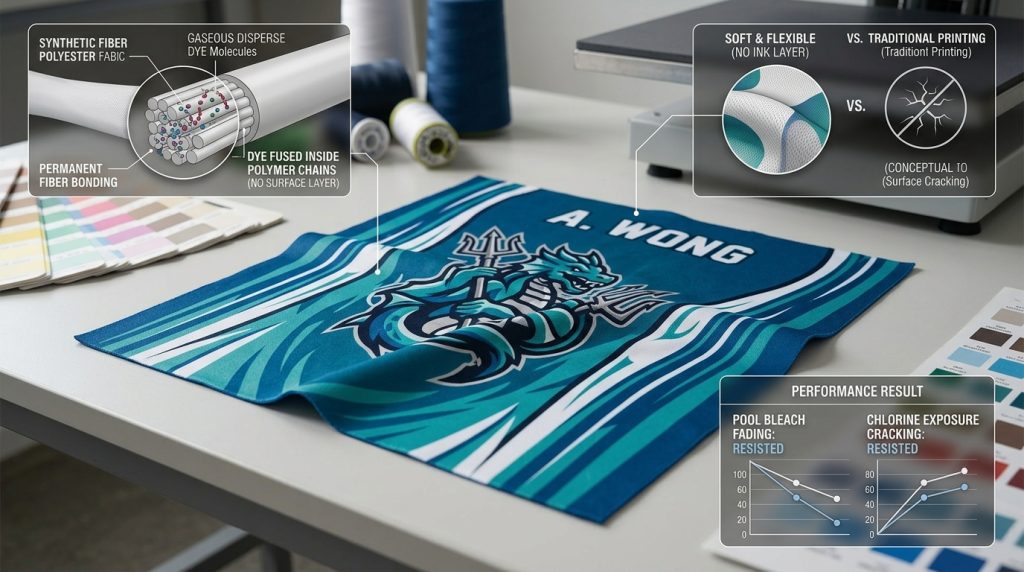
Chlorine resistant fabric handles digital dye-sublimation exceptionally well because gaseous disperse dye molecules lock permanently into synthetic polymer chains. Sourcing chlorine resistant fabric optimized for sublimation allows teams to print custom all-over graphics that resist pool bleach fading.
Digital dye fusion keeps fabric soft and flexible without creating thick ink layers that crack under chlorine exposure. Aquatic brands utilize sublimation to reproduce intricate club mascots, team stripes, and swimmer names.
Why Is Synthetic Purity Necessary?
Sublimation inks convert directly into gas under heat press temperatures exceeding 200 degrees Celsius to bond inside polyester fibers. Natural cotton fibers cannot hold disperse gas dyes, leading to washed-out prints that bleed in pool water.
Think about this: molecular dye integration locks pigment deep inside yarn cores where chlorine cannot bleach it away.
- Pure polyester content ensures vibrant color reproduction across team palettes.
- Molecular dye bonding preserves the fabric native stretch and drainage.
- Sublimated artwork will never peel, crack, or flake in chlorinated water.
How Do Pores Affect Print Clarity?
Fabric surface structure directly affects graphic sharpness and fine line definition on finished swimwear. Smooth warp-knit tricot holds ultra-sharp vector edges, whereas open bird-eye pores create a subtle textured aesthetic.
Ready for the good part? High-density micro-pores combine clean graphic visibility with active pool water drainage.
- Tight surface loops prevent fine logo lines from bleeding at edges.
- Controlled pore geometry maintains graphic alignment across flatlock seams.
- Heat-set finishing prevents pore distortion during high-pressure sublimation pressing.
Key Takeaway: Sourcing high-purity polyester knits with smooth surfaces ensures photographic sublimation clarity without hindering water drainage.
| Graphic Application | Chlorine Colorfastness | Fabric Stretch Impact | Surface Hand Feel |
| Digital Dye Sublimation | Grade 5 (No Fading) | Zero Stretch Loss | Undetectable Ink Feel |
| Traditional Screen Print | Cracks in 20 Pool Hours | Restricts Local Stretch | Heavy Rubberized Layer |
| Heat Transfer Vinyl (HTV) | Peels Under Pool Chemicals | Causes Local Stiffness | Raised Plastic Edge |
Printing evaluations demonstrate dye sublimation provides superior colorfastness and flexibility for competitive swimwear.
8. Can Eco Chlorine Resistant Fabric Match Virgin Yarn?
Eco chlorine resistant fabric made from recycled polyester and ocean-bound plastics matches virgin synthetic yarn in chemical resistance and tensile strength. Sourcing sustainable chlorine resistant fabric enables swim brands to satisfy environmental standards without sacrificing suit lifespan.
Modern recycling plants clean, melt, and purify post-consumer plastic into high-grade spinning chips with zero loss of molecular durability. Swimwear brands increasingly adopt recycled textiles to fulfill environmental commitments while delivering elite athletic performance.
How Do Recycled Polymers Resist Pool Chemicals?
Advanced recycling processes purify collected polymer waste into clean chips that are extruded into high-tenacity microfibers. These recycled polyester filaments exhibit the same crystalline structure that makes virgin PBT impervious to chlorine degradation.
Look at the facts: certified recycled polyester yarn achieves identical dye absorption, tensile strength, and chemical resistance.
- Recycled polymers divert plastic waste away from oceans and marine ecosystems.
- Consistent melting points ensure flawless dye sublimation printing results.
- Extrusion quality controls eliminate yarn diameter variations across fabric rolls.
Can Recycled Knits Pass Pool Bursting Tests?
Certified rPET aquatic fabrics undergo rigorous hydraulic burst testing and chlorine soak evaluations before bulk production. The interlocked knit loops resist high water pressure during dives without fiber tearing or seam slippage.
Here is the deal: standardized laboratory testing confirms recycled textiles handle pool stress just as reliably as virgin synthetics.
- Hydraulic bursting strength matches virgin polymer benchmarks.
- Yarn tensile elasticity delivers reliable full-stretch recovery during flip turns.
- Anti-pilling performance achieves top ratings on standard Martindale scales.
Key Takeaway: Sourcing certified recycled synthetic knits empowers swimwear brands to deliver sustainable products with verified pool durability.
| Quality Parameter | Virgin Polyester (PET) | Recycled Polyester (rPET) | Performance Variance |
| Carbon Footprint | High Virgin Petrochemical | 45% Lower CO2 Output | Substantial Eco Advantage |
| Tensile Breaking Force | 425 N Breaking Limit | 420 N Breaking Limit | Under 1.2% Difference |
| Chlorine Soak Retention | Retains 98% Mass | Retains 98% Mass | Zero Variance |
Laboratory testing confirms recycled synthetic knits deliver identical chemical durability compared to virgin polymers.
9. How to Test Chlorine Resistant Fabric Quality?
Testing chlorine resistant fabric quality requires measuring chlorinated water colorfastness, chlorine soak tensile retention, Martindale abrasion, and four-way stretch recovery. Verifying your chlorine resistant fabric with third-party laboratory reports protects your business from costly product recalls and customer complaints.
Rigorous quality control testing evaluates mechanical and chemical integrity before bulk fabric rolls ship from the mill. Quantifiable test thresholds ensure production swimsuits survive hundreds of hours in public pool facilities.
What Does ISO 105-E03 Testing Reveal?
ISO 105-E03 testing immerses dyed fabric samples into active chlorinated water solutions at specific temperatures for designated durations. This test evaluates whether pool chemicals will leach dyes, cause color shifts, or degrade fiber tensile strength.
What is the real story? Performance swimwear fabrics must achieve a grade four rating to prevent embarrassing color fading in public pools.
- Standardized chlorine testing detects unstable dye formulas before cutting panels.
- Colorfastness ratings ensure vibrant team shades remain true across full seasons.
- Controlled soak tests verify that fabric surface coatings remain bonded.
How Is Stretch Retention Measured?
Dynamic tensile testing machines stretch fabric swatches repeatedly through thousands of cycles after prolonged exposure to chlorinated water. Recording the permanent elongation percentage verifies whether the suit will maintain its compressive hold over time.
Think about this: elite training fabrics retain over eighty-five percent of their original elastic tension after one hundred pool hours.
- Tensile recovery tests confirm muscle compression during long swim sets.
- Burst testing evaluates fabric resistance against explosive diving forces.
- Elastic modulus measurements ensure comfortable fit without binding shoulders.
Key Takeaway: Demanding certified chlorine soak and tensile recovery test reports prevents defective swimwear production runs.
| Testing Standard | Minimum Pass Level | Premium Performance Level | Test Objective |
| Chlorine Colorfastness (ISO 105-E03) | Grade 3.5 | Grade 4.5+ | Evaluates Pool Color Fading |
| Post-Soak Elastic Retention | 75% Initial Tension | 88%+ Initial Tension | Measures Anti-Bagging Resilience |
| Martindale Abrasion (ISO 12947) | 15,000 Cycles | 25,000+ Cycles | Assesses Concrete Anti-Snag |
Laboratory inspection reports confirm that bulk fabric shipments meet strict commercial aquatic durability standards.
10. How to Buy Chlorine Resistant Fabric in Bulk?
Buying chlorine resistant fabric in bulk requires partnering directly with specialized knitting mills that offer custom Pantone dyeing and third-party laboratory test reports. Securing direct mill agreements for chlorine resistant fabric guarantees competitive wholesale pricing and consistent shade matching across seasonal production runs.
Swimwear brands need reliable textile mills that maintain strict dye bath controls across multiple manufacturing cycles. Clear technical specifications prevent mismatched shades between suit panels and matching team gear.
What MOQ Tiers Apply to Custom Dyeing?
Textile mills typically require minimum order quantities ranging between three hundred and five hundred kilograms for custom piece-dyed colors. Stock greige goods with sublimation-ready white surfaces often carry significantly lower order thresholds.
Here is the deal: buying ready-to-print white sublimation fabric rolls allows brands to run flexible small-batch collections without dye surcharges.
- Sublimation white fabric inventories support rapid on-demand team uniform drops.
- Custom Pantone piece-dyeing requires larger bulk roll commitments.
- Direct mill sourcing eliminates middleman markups on volume yardage.
How Does 4-Point Inspection Work?
Standard 4-point inspection systems evaluate bulk fabric rolls for yarn snags, uneven dyeing, dirty oil spots, and GSM weight consistency. Every inspected roll receives a verified grading tag before leaving the mill warehouse.
Ready for the good part? Catching fabric defects on the roll prevents flawed cut pieces from reaching your sewing lines.
- 4-point grading detects yarn flaws before fabrics enter automated cutting tables.
- Roll width verification ensures maximum pattern marker layout efficiency.
- Roll-to-roll shading checks prevent mismatched garment panels during assembly.
Key Takeaway: Implementing direct mill sourcing with strict 4-point inspections protects production margins and secures on-time delivery schedules.
| Sourcing Phase | Key Verification Action | Primary Risk Mitigated | Expected Turnaround |
| Lab Dip Approval | Multi-Light Color Box Matching | Metamerism & Shade Drift | 3 – 5 Business Days |
| Pre-Production Swatch | GSM & Chlorine Resistance Check | Off-Weight or Weak Hand | 7 – 10 Business Days |
| Bulk Roll Knitting | 4-Point Visual Grading System | Knitted Snags & Oil Spots | 15 – 25 Business Days |
Structured sourcing checkpoints guarantee smooth garment manufacturing handoffs and dependable wholesale quality.
Frequently Asked Questions
Q1: What is the best chlorine resistant fabric for competitive swimwear?
PBT polyester blend is the best fabric for competitive swimwear. Its crystalline synthetic polymers resist pool chemical breakdown and retain muscular compression across hundreds of pool hours.
Q2: Can I use regular spandex fabrics for pool swim training?
No, regular spandex is not suitable for frequent pool training. Chlorine rapidly degrades polyurethane elastane molecules, causing swimsuits to stretch out, thin, and turn translucent.
Q3: What weight fabric should I pick for training jammers?
A weight between 220 and 280 GSM is ideal for training jammers. This density provides total wet opacity, resists abrasive pool deck wear, and anchors waistbands securely.
Q4: How do I know if my swim fabric supports dye sublimation?
Check that the fabric contains at least 85% polyester with a white base. Synthetic polyester fibers bond permanently with disperse inks under high-temperature heat pressing without fading in pool water.
Q5: What is the main difference between bird-eye mesh and pique for pool gear?
Bird-eye mesh features open micro-pores for rapid water drainage and cooling, while double-knit pique uses raised waffle cords that prevent wet fabric suction and resist deck snags.
Source Reliable Chlorine Resistant Fabrics for Your Line
Choosing the right chemical-proof textile package eliminates suit degradation, prevents transparency defects, and protects your swimwear brand from costly customer returns. We manufacture technical knitted textiles engineered specifically for competitive swimming, water polo, and poolside athletics, delivering certified GSM consistency, rapid fluid drainage, and permanent chlorine resistance. Whether your brand requires lightweight bird-eye mesh for fast-draining water sports shirts or heavy warp-knit PBT for durable competition jammers, our manufacturing facilities deliver consistent bulk roll yardage on schedule. Connect with our engineering specialists and contact us today to order custom fabric sample swatches for your upcoming aquatic collections. We are dedicated to advancing performance textile science that empowers swimmers and strengthens global swimwear brands.