
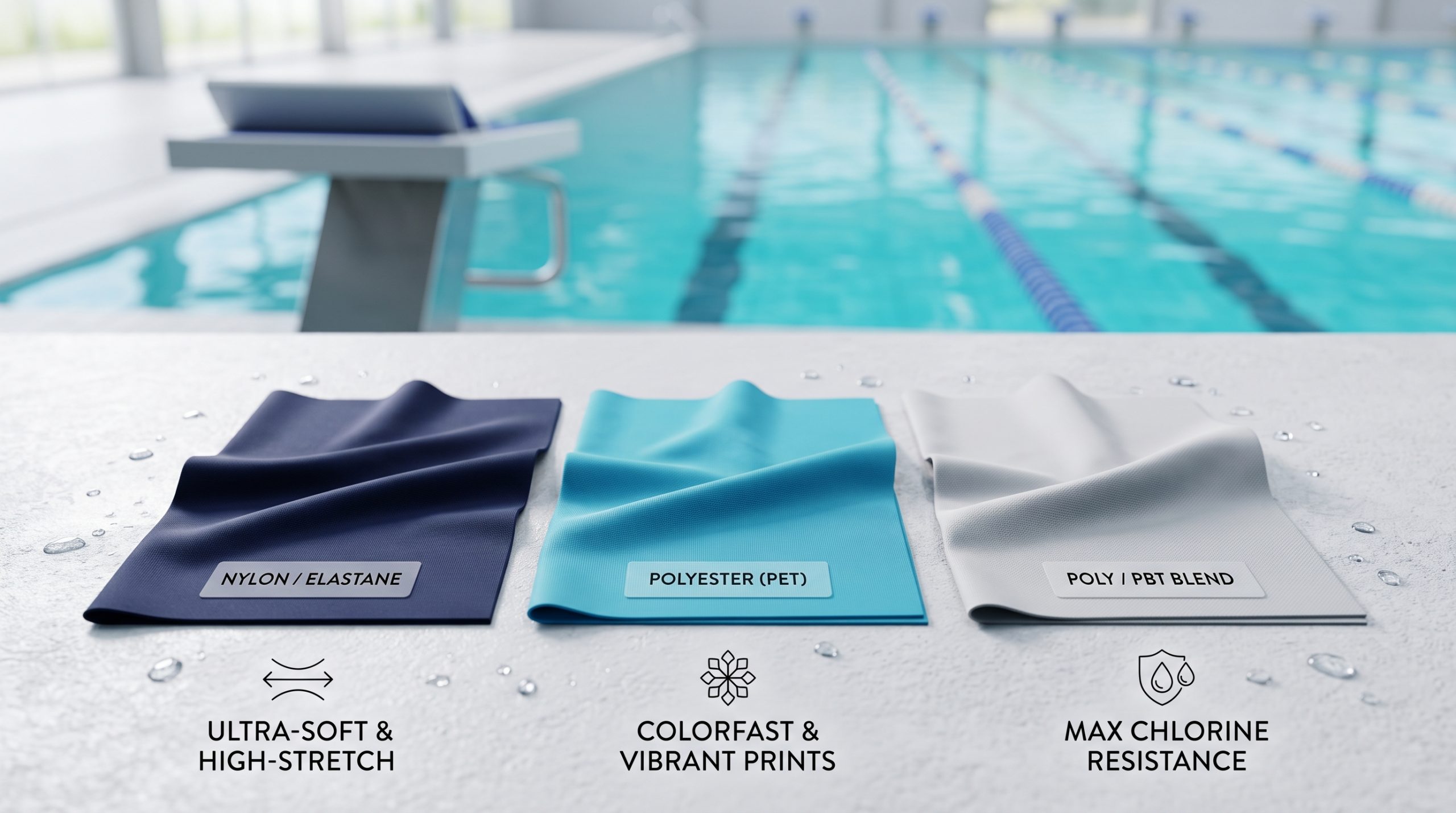
The best textile for aquatic sportswear combines superior chlorine resistance, dimensional recovery, and low water absorption to maintain hydrodynamic compression over prolonged pool training. Competitive athletes often encounter sagging waistbands, faded colors, and brittle yarns after just a few weeks of rigorous training. You face mounting product returns and customer dissatisfaction when standard activewear textiles deteriorate under chemical exposure. Specifying a tailored swimmers fabric engineered from specialized polyester, polyamide, or polybutylene terephthalate resolves these durability issues while securing long-term brand loyalty.
Why Does Choosing the Right Swimmers Fabric Matter?
Choosing the correct swimmers fabric directly dictates product longevity, garment fit, and athlete speed during rigorous aquatic training. Inferior materials degrade rapidly under ultraviolet radiation and pool sanitizers, resulting in bagging and see-through panels. Premium textiles maintain high tensile resilience to ensure consistent muscle compression across hundreds of swimming sessions.
What Performance Demands Ruin Weak Knits?
Constant chemical exposure and mechanical friction degrade standard circular knits rapidly during everyday lane workouts. Water absorption increases overall garment weight, which increases swimmer fatigue and ruins stroke efficiency.
- Pool chlorine oxidizes polymer bonds, causing elastane breakage and severe bagging.
- Friction against rough pool edges causes rapid surface abrasion and pilling.
- Solar ultraviolet rays fade vivid sublimation prints and weaken tensile stability.
Here is the deal: selecting textiles built specifically for high-chlorine settings shields your athletic apparel from premature degradation.
Why Do Elite Athletes Need Specific Yarn Blends?
High-performance athletes demand hydrodynamic glide combined with gentle anatomical support that will not bind during shoulder rotation. Precise yarn construction eliminates chafing while stabilizing major muscle groups to delay physical exhaustion.
- High micro-filament counts reduce skin drag against moving water layers.
- Controlled four-way modulus balance prevents waistband sliding during flip turns.
- Quick-drying polymers lower post-swim chill during extended deck intervals.
Think about this: fine-gauge yarn configurations give athletes a tangible mechanical advantage on race day.
Key Takeaway: Sourcing dedicated aquatic knits prevents premature garment failure, protecting your brand reputation against costly warranty returns.
| Fabric Challenge | Standard Active Knit | Specialized Swim Knit |
| Chlorine Resistance | Degrades in under 25 hours | Endures 200+ pool hours |
| Wet Weight Gain | Absorbs 15% to 20% water weight | Retains under 5% moisture |
| Recovery Rate | Sags after moderate stretch | Snaps back to original dimensions |
These comparative metrics show why athletic swimwear requires purpose-built polymer construction rather than generic activewear yardage.
How Does Nylon Swimmers Fabric Compare to Polyester?
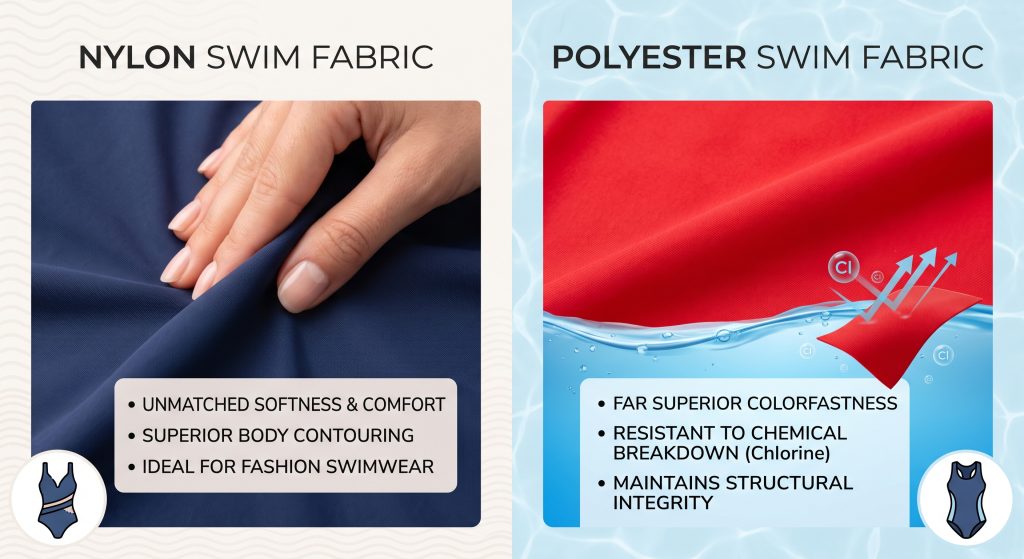
Nylon swimmers fabric provides unmatched softness and body contouring, whereas polyester delivers far superior colorfastness and resistance to chemical breakdown. Polyamide yarns stretch effortlessly to create a second-skin feel ideal for fashion-forward swimwear and casual beachwear. Polyester knits maintain structural integrity under severe chemical stress, making them the standard choice for team training suits.
What Makes Polyamide Deliver Superior Softness?
Polyamide fibers feature a supple molecular structure that feels exceptionally gentle against delicate skin. This smooth fiber handfeel prevents friction burns around the armpits and neck during long-distance swim sessions.
- Silky surface touch increases comfort during recreational ocean swimming.
- Excellent lateral elasticity accommodates dynamic body movements without resistance.
- Deep dye receptivity produces vibrant, rich solid colors for premium collections.
What is the real story? Polyamide remains unbeatable for pure tactile luxury despite its moderate chlorine sensitivity.
How Does Polyester Resist Harsh Pool Chemicals?
Polyester filaments resist acid and chlorine attack due to their dense crystalline molecular configuration. These synthetic threads do not swell in warm pool water, preserving original garment dimensions over extended seasons.
- Stable polymer chains withstand aggressive chemical bleaching agents.
- Low moisture regain ensures rapid surface drying on the pool deck.
- High thermal tolerance supports crisp, permanent sublimation transfer graphics.
Check this out: polyester provides the longest operational lifespan for institutional swim team uniforms.
Key Takeaway: Choose nylon for casual beachwear where handfeel matters most, but specify polyester for rigorous daily training lines.
| Property | Polyamide (Nylon) | Polyethylene Terephthalate (Polyester) |
| Handfeel Softness | Ultra-smooth and plush | Crisp and structured |
| Chemical Longevity | Moderate (50-80 pool hours) | Extreme (250+ pool hours) |
| Color Vibrancy | Deep solid saturation | Superior printed sublimation |
Selecting between nylon and polyester depends entirely on balancing tactile consumer appeal against long-term chemical durability.
Is PBT Swimmers Fabric Best for Chlorine Resistance?
Polybutylene terephthalate, commonly known as PBT swimmers fabric, provides the industry benchmark for chlorine resistance by delivering natural mechanical stretch without relying on vulnerable elastane fibers. Standard spandex threads dissolve when exposed to pool oxidizers, whereas PBT filaments retain full elasticity indefinitely. Manufacturers use PBT knits to produce durable training gear that survives multiple competitive seasons.
Why Does Polybutylene Terephthalate Resist Sagging?
PBT utilizes a unique crimped molecular structure that expands and retracts mechanically under physical tension. Because this elasticity stems from fiber geometry rather than chemical additives, pool water cannot strip away its stretch properties.
- Chemical-resistant polymer chains prevent fiber embrittlement and thinning.
- Natural mechanical recovery replaces fragile polyurethane elastane yarns.
- Stable filament tension eliminates suit sagging around the chest and hips.
You might wonder: how long can a PBT training suit genuinely last under daily chlorine exposure?
When Should You Specify PBT Blends for Competition?
Specify PBT when producing performance apparel for high school squads, collegiate clubs, and triathletes who train twice daily. The fabric retains tight body compression through repeated laundering and intense sunlight exposure.
- Resists snagging from lane line cables and kickboard friction.
- Retains shape through commercial laundering and spin dryers.
- Provides reliable UV protection ratings exceeding UPF 50+ consistently.
Here is why: building suits with PBT eliminates the number-one consumer complaint regarding stretched-out swimwear.
Key Takeaway: Specifying PBT textiles guarantees that your athletic swimwear collections will outlast competitors using conventional elastane blends.
| Fabric Composition | Chlorine Lifespan | Stretch Recovery | UPF Protection |
| 80/20 Nylon Spandex | 40-60 Hours | Rapid initial snap | UPF 30-40 |
| 85/15 Poly Spandex | 80-120 Hours | Moderate recovery | UPF 40-50 |
| 100% PBT / Poly-PBT | 300+ Hours | Durable mechanical recoil | UPF 50+ |
Investing in PBT yarn blends provides long-term cost efficiencies for sports brands seeking minimal defective product returns.
What Makes Birdseye Mesh a Great Swimmers Fabric?
Birdseye mesh serves as an exceptional swimmers fabric because its micro-punctured knit structure accelerates drainage and reduces overall wet drag. The geometric tuck-stitch pattern creates subtle surface indentations that break surface water tension around the moving athlete. Designers frequently use birdseye knits for internal suit linings, drag shorts, and water polo training suits.
How Does Birdseye Micro-Texture Improve Airflow?
The tiny circular knit pattern allows air and moisture vapor to escape freely when athletes exercise out of the water. This open texture prevents moisture from getting trapped between fabric layers during high-output workouts.
- Micro-perforations speed up water drainage during deck transitions.
- Diamond-shaped eyelet gaps reduce skin adhesion when wet.
- Breathable structure keeps outdoor swimmers cool during summer practices.
What is the bottom line? Birdseye textures eliminate that sticky, suffocating feeling common with dense single-jersey swim linings.
Why Select Birdseye Weave for Active Swim Panels?
Integrating birdseye panels into high-motion suit sections promotes rapid ventilation without sacrificing textile durability. The textured knit also conceals body contours effectively, allowing for thinner suit designs that dry rapidly.
- Provides reliable structural opacity even in lighter pastel shades.
- Traps less water weight compared to flat continuous knits.
- Offers excellent puncture resistance against sharp locker room benches.
Look at the facts: substituting solid linings with birdseye knits noticeably trims total garment weight.
Key Takeaway: Incorporating birdseye mesh panels upgrades ventilation and moisture discharge, giving swimmers a lighter suit in and out of the water.
| Feature | Solid Jersey Lining | Birdseye Mesh Lining |
| Water Drainage Speed | Moderate flow through | Immediate water evacuation |
| Surface Texture | Smooth and clingy | Raised anti-stick pattern |
| Garment Weight (Wet) | Heavy water retention | Lightweight drainage |
Strategic use of birdseye knit structures creates lighter swimwear that dries substantially faster between training heats.
How Does Pique Structure Affect Swimmers Fabric Feel?
Pique structures give swimmers fabric a distinctive raised, textured handfeel that improves tactile grip and prevents the material from adhering to damp skin. The geometric waffle-knit construction introduces micro-air pockets across the textile surface, creating a sophisticated matte aesthetic. This structured handfeel makes pique an exceptional choice for premium aquatic polos, rash guards, and lined swim shorts.
What Gives Pique Knits Their Distinct Raised Grip?
Pique textiles are produced using specialized tuck stitches that create a subtle three-dimensional honeycomb relief across the surface. This elevated architecture minimizes the physical contact area between damp fabric and swimmer skin.
- Waffle grid reduces friction resistance during heavy perspiration.
- Textured exterior provides an upscale, sporty matte appearance.
- Firm structural body hides minor seam puckering along curved borders.
Here is the deal: pique fabric delivers a crisp tailored silhouette that holds its shape through heavy active use.
How Does Honeycomb Texture Prevent Fabric Clinging?
The three-dimensional geometry of pique knits creates natural channels that facilitate water runoff and prevent vacuum suction against the torso. Swimmers experience less restriction across the shoulders when pulling through the water.
- Continuous air channels encourage uniform evaporation across the garment.
- Rigid knit balance resists fabric collapse when fully saturated.
- Raised surface nodes reduce chafing across sensitive skin areas.
Ready for the good part? Pique knits offer athletic garment developers a distinctive texture that stands out in a crowded market.
Key Takeaway: Utilizing pique knit structures elevates garment perceived value while eliminating fabric cling for active water sports apparel.
| Fabric Characteristic | Flat Plain Knit | Pique Honeycomb Knit |
| Surface Appearance | Glossy or flat matte | Three-dimensional waffle pattern |
| Skin Contact Area | 100% continuous contact | 60% contact via raised nodes |
| Silhouette Rigidity | Soft and draping | Structured and tailored |
Textile surface relief changes consumer comfort perception by minimizing wet clinging across demanding aquatic sports.
Which Swimmers Fabric Delivers Peak Hydrodynamics?
A high-gauge, tightly knitted swimmers fabric treated with a durable water-repellent coating provides peak hydrodynamics by preventing water absorption and reducing turbulent skin friction. When textiles stay dry at the microscopic surface level, water slips past the athlete without generating micro-vortices. Elite racing suits rely on these specialized high-density woven and knitted composites to shave fractions of a second off race times.
How Do Surface Finishes Minimize Water Drag?
Hydrophobic chemical treatments repel incoming water molecules, forcing liquid into distinct round beads that slide away instantly. This barrier stops water from infiltrating the yarn bundles, maintaining minimum overall suit weight throughout the heat.
- Hydrophobic coatings prevent yarn wetting and reduce viscous drag.
- Calendered smooth surfaces flatten microscopic fiber ends against the face.
- Low drag coefficients increase forward glide efficiency off starting blocks.
This is where it gets interesting… microscopic surface smoothness makes a measurable difference in competitive split times.
What Compression Levels Support Muscle Efficiency?
High modulus elastomeric textiles compress large muscle masses to minimize muscle oscillation and stabilize joint movement during power output. This physiological containment reduces fatigue accumulation during repetitive sprint events.
- Targeted graduated compression improves venous blood return to working muscles.
- Tight core containment assists swimmers in maintaining streamlined horizontal body lines.
- High tensile fibers stabilize tissue to reduce kinetic energy loss.
Think about this: correct muscular support allows competitive swimmers to maintain technical form during late race stages.
Key Takeaway: Investing in hydrodynamic finishes and balanced muscle compression creates performance suits that deliver quantifiable speed improvements.
| Performance Attribute | Untreated Swim Knit | Hydrophobic Compressive Knit |
| Surface Wetting Rate | Instant surface absorption | Beads water continuously |
| Drag Coefficient | Moderate baseline friction | Minimized hydrodynamic friction |
| Muscle Oscillation | Uncontrolled tissue movement | Firm anatomic containment |
Advanced hydrophobic integration ensures athletic apparel glides effortlessly through water while maintaining structural support.
How Does Stretch Recovery Define Quality Swimmers Fabric?
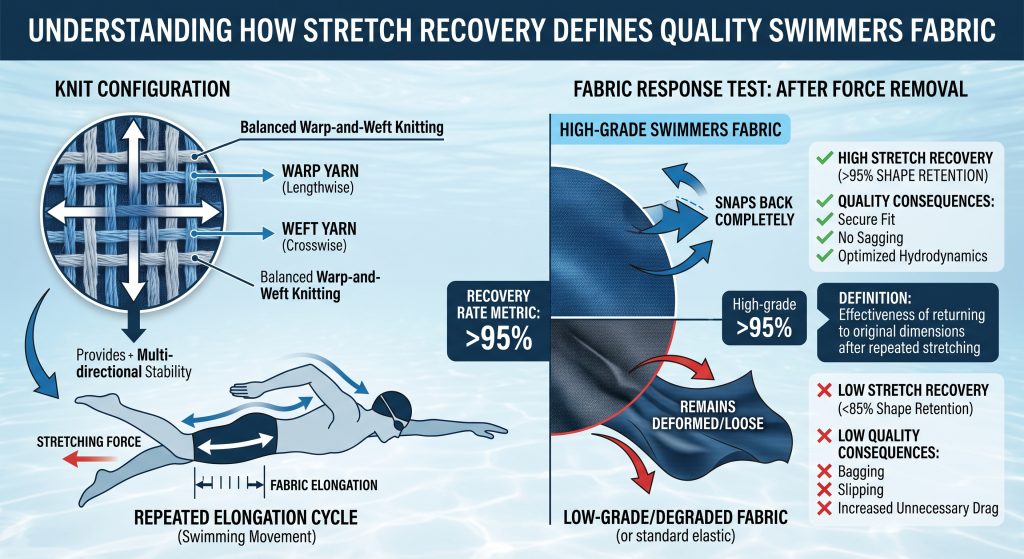
Stretch recovery measures how effectively a swimmers fabric returns to its original dimensions after being subjected to repeated elongation cycles during physical movement. High elasticity without dependable elastic recovery causes swimwear to bag, slip, and generate unnecessary drag during active strokes. High-grade aquatic materials achieve over ninety-five percent recovery rates through balanced warp-and-weft knitting configurations.
Why Does Elastane Degrade in Chlorinated Water?
Standard polyurethane elastane contains vulnerable chemical bonds that split apart when exposed to pool oxidizers and sunlight. As these elastic strands snap inside the yarn structure, the fabric loses its retractile power and stretches out permanently.
- Chlorine oxidizes urea linkages within standard polyurethane elastane filaments.
- Heat from drying rooms accelerates molecular chain breakdown and fiber snapping.
- Broken internal filaments appear as tiny white threads protruding from the knit.
What is the real story? Poor quality elastane ruins suit fit long before the base synthetic face yarn shows any surface wear.
How Can You Ensure Long-Term Shape Retention?
Choosing chlorine-shielded elastane or mechanical stretch PBT polymers prevents structural sagging and maintains exact pattern sizing over time. Tight stitch density prevents fiber slippage under mechanical stress.
- Specifying protected elastane yarns prevents early polymer breakdown.
- High needle-count knitting secures elastomeric threads firmly in place.
- Pre-heat-setting stabilization balances residual shrinkage before garment cutting.
Here is why: strict fiber qualification guarantees that your finished suits maintain their custom tailored fit across months of usage.
Key Takeaway: Rigorous elastic recovery standards protect your athletic brand against consumer complaints regarding sagging seams and loose waistbands.
| Elastic Fiber Type | 100-Hour Recovery Rate | Chlorine Degradation Risk |
| Conventional Spandex | Drops below 70% | High fiber snapping |
| Chlorine-Resistant Spandex | Retains 88% to 92% | Low to moderate wear |
| PBT Mechanical Stretch | Retains 98%+ | Zero chemical breakdown |
Selecting resilient elastic configurations ensures competitive apparel maintains consistent compression throughout rigorous athletic seasons.
Can Eco-Friendly Knits Excel as Swimmers Fabric?
Recycled polyamide and polyester yarns deliver the exact same tensile resilience, colorfastness, and chlorine durability as virgin synthetic swimmers fabric options. Modern recycling technologies purify post-consumer plastic bottles and recovered ocean fishing nets into premium filament fibers. These sustainable textiles allow activewear brands to satisfy environmental standards without sacrificing technical swimming performance.
Are Recycled Synthetic Fibers Strong Enough for Pools?
High-grade regenerated polymers undergo rigorous purification processes that restore mechanical tensile properties to virgin performance levels. The resulting synthetic yarns withstand chemical sanitizers, heat, and UV rays just as effectively as virgin feedstocks.
- Regenerated nylon yarns provide identical filament tensile strength and elasticity.
- Recycled polyester chips yield consistent dye receptivity for bright prints.
- Closed-loop yarn extrusion maintains uniform gauge consistency across large production runs.
You might wonder: does choosing recycled textile options compromise fabric softness against athlete skin?
What Certifications Validate Sustainable Swim Textiles?
Verifying third-party mill certifications ensures that your recycled swim fabrics adhere to genuine environmental and chemical safety standards. Reputable certifications guarantee traceability from raw waste retrieval to finished knitted yardage.
- Global Recycled Standard (GRS) tracks verified post-consumer recycled content percentages.
- OEKO-TEX Standard 100 certifies fabrics free from harmful chemical residues.
- Bluesign approval confirms environmentally responsible dyehouse chemical management.
Check this out: documented sustainable sourcing offers strong marketing value for eco-conscious athletic consumers.
Key Takeaway: Modern recycled technical yarns provide high-durability performance while reducing reliance on virgin petroleum-based feedstocks.
| Metric | Virgin Polyester Knit | GRS Certified Recycled Poly |
| Tensile Strength (N) | 450 N Warp / 380 N Weft | 445 N Warp / 380 N Weft |
| Chlorine Durability | 200+ Test Hours | 200+ Test Hours |
| Recycled Content | 0% | 85% to 100% Certified |
Performance testing proves that sustainable swim textiles meet identical durability specifications compared to traditional virgin materials.
How Do You Test and Inspect Swimmers Fabric Quality?
Testing swimmers fabric requires standardized laboratory evaluations for chlorine colorfastness, seam burst strength, and four-way stretch modulus before mass cutting commences. Relying strictly on supplier spec sheets without independent batch testing exposes apparel brands to unexpected batch inconsistencies. Systematic quality audits verify that knit rolls meet strict performance standards for active aquatic use.
Which Laboratory Tests Measure Colorfastness Best?
Standard ISO and AATCC test methods subject fabric swatches to concentrated chlorinated solutions, artificial sweat, and intense xenon arc lighting. These tests verify that dyes will not bleed into pool water or fade under radiant sun exposure.
- ISO 105-E03 evaluates color fastness against chlorinated swimming pool water.
- AATCC 16.3 measures textile resistance to light degradation and color fading.
- ISO 105-X12 tests dry and wet crocking resistance against surface rub off.
Here is the deal: systematic lab checks prevent embarrassing garment dye bleeds during team competitions.
How Do You Verify Elastic Tensile Recovery?
Calibrated mechanical tensile testers pull fabric strips to specified elongation percentages repeatedly to record tension decay and hysteresis loss. These data curves confirm whether the textile maintains adequate muscle support over extended wear cycles.
- ASTM D4964 measures dynamic stretch and tension recovery in knitted fabrics.
- Cyclic hysteresis testing detects internal elastomeric fiber fatigue early.
- Wet elongation audits verify that saturated fabrics maintain appropriate fit.
Look at the facts: laboratory tensile data provides objective validation of fabric durability before committing to bulk manufacturing.
Key Takeaway: Rigorous pre-production laboratory testing protects apparel programs from expensive recall costs and preserves end-user satisfaction.
| Test Parameter | Test Standard | Acceptable Pass Benchmark |
| Chlorine Colorfastness | ISO 105-E03 | Grade 4.0 – 5.0 Rating |
| Elastic Recovery (Wet) | ASTM D4964 | Minimum 92% Recovery after 1 hr |
| Bursting Strength | ASTM D3786 | Minimum 250 kPa Resistance |
Standardized laboratory data provides definitive verification that production yardage meets athletic performance specifications.
What Sourcing Factors Impact Your Swimmers Fabric Cost?
Raw fiber composition, fabric weight per square meter, specialty chemical finishes, and minimum order quantities dictate the base manufacturing cost of technical swimmers fabric. Custom color dyeing and specialized functional prints increase per-meter pricing compared to running mill stock yardage. Balancing material specifications against budget limits helps apparel brands achieve healthy gross profit margins.
What Production Minimums Impact Custom Knitting?
Custom yarn spinning, dedicated color lab dips, and unique knit textures require higher minimum order quantities from reputable circular knitting mills. Sourcing running standard blends lowers unit pricing for emerging apparel brands launching smaller capsule lines.
- Stock program colors provide lower minimum order thresholds for new designs.
- Custom pantone dye lots require larger batch dyeing capacities per colorway.
- Specialized hydrodynamic surface coatings require specific run volumes to set up machinery.
What is the real story? Partnering with mills offering flexible stock programs simplifies inventory cash flow management.
How Do You Balance Fabric Weight and Unit Price?
Fabric weight measured in grams per square meter directly correlates with yarn consumption and final manufacturing costs per yard. Choosing the right GSM weight ensures sufficient modesty without spending money on unneeded fabric heaviness.
- Lighter weights (170-190 GSM) work well for lined youth suits and fashion items.
- Mid weights (200-230 GSM) offer the ideal balance for general athletic lines.
- Heavy weights (240-270 GSM) provide maximum compression for elite racing cuts.
Think about this: matching exact fabric density to intended garment use prevents over-engineering your apparel line.
Key Takeaway: Strategic textile selection aligns functional performance requirements with target production costs to secure strong market profitability.
| Fabric Tier | Primary Material Composition | Target Application | Average Cost Range |
| Entry Athletic | 82/18 Poly Spandex (190 GSM) | Recreational & Youth | Accessible Budget |
| Mid Performance | 80/20 Nylon Spandex (210 GSM) | Boutique & Active Fitness | Standard Commercial |
| Elite Endurance | 100% PBT / Poly-PBT (230 GSM) | Competitive & Team Gear | Premium Professional |
Evaluating these production parameters ensures that your sourcing selections meet both financial targets and athlete performance expectations.
Strategic Sourcing for High-Performance Swim Collections
Navigating competitive swimwear production requires selecting textiles that withstand chlorine degradation, maintain compressive shape recovery, and provide hydrodynamic efficiency in the water. We solve your sourcing challenges by engineering technical warp and circular knits that resist chemical fading, fiber snapping, and excessive wet weight gain. Whether you need durable PBT team blends, supple polyamide knits, or textured pique and birdseye structures, we supply verified performance textiles tailored to your exact manufacturing specifications.
Take your aquatic apparel line to the next level by partnering with specialized textile engineers. Reach out to our development team and contact us today to request custom swatch headers, laboratory testing data, and competitive wholesale yardage quotes for your upcoming swimwear collections. We believe that champion athletes deserve world-class materials engineered for peak endurance and uncompromising speed.
Frequently Asked Questions
Q1: Can I use regular activewear spandex fabric for competitive swimwear?
No, you should not use standard activewear spandex because regular elastane degrades rapidly when exposed to chlorinated pool water. Pool oxidizers dissolve the chemical bonds within generic spandex, causing suits to sag, turn transparent, and lose elasticity in under forty pool hours.
Q2: What is the best fabric composition for daily swim team practice suits?
A blend of one hundred percent polyester or polybutylene terephthalate (PBT) provides the best performance for daily swim team suits. These synthetic fibers resist chemical degradation completely, maintaining compressive tension and color vibrancy across hundreds of continuous training hours.
Q3: How do I know if a swimwear fabric provides adequate opacity when wet?
Check the fabric weight and knit density by testing the textile under direct lighting while fully saturated with water. Premium swimwear fabrics feature a weight of at least two hundred grams per square meter or utilize specialized textured knit linings like birdseye to prevent see-through stretching.
Q4: Can I print custom vibrant graphics on chlorine-resistant PBT fabrics?
Yes, you can easily apply custom full-color graphics to polyester and PBT fabrics using dye sublimation printing techniques. Sublimation fuses ink directly into the synthetic polymer filaments, resulting in permanent, high-definition designs that will not peel, crack, or fade under intense sunlight.
Q5: What is the main difference between nylon and polyester swim textiles?
Nylon delivers a noticeably softer, more supple handfeel with superior elastic stretch, whereas polyester provides significantly higher resistance to chlorine and chemical bleaching. Brands typically select nylon for luxurious resort wear and polyester for intensive athletic and competitive swimming suits.