
Lycra fabric represents a premier elastomeric synthetic textile engineered to deliver exceptional omnidirectional stretch capacity along with shape recovery properties for high-performance athletic apparel lines. Activewear startup procurement managers regularly face intense wholesale distributor rejections when low-grade workout leggings lose structural tension after a single rigorous training match. Running clothing brands routinely suffer corporate reputation damage because primitive elastic materials sag permanently when subjected to heavy mechanical washing machine cycles. Fuzhou HG Textile Co., Ltd. from China completely resolves this persistent manufacturing bottleneck by supplying top-tier sports lycra fabric engineered to maintain a pristine tailored silhouette through extended commercial consumer lifecycles.
1. What Is Sports Lycra Fabric for Running Gear?
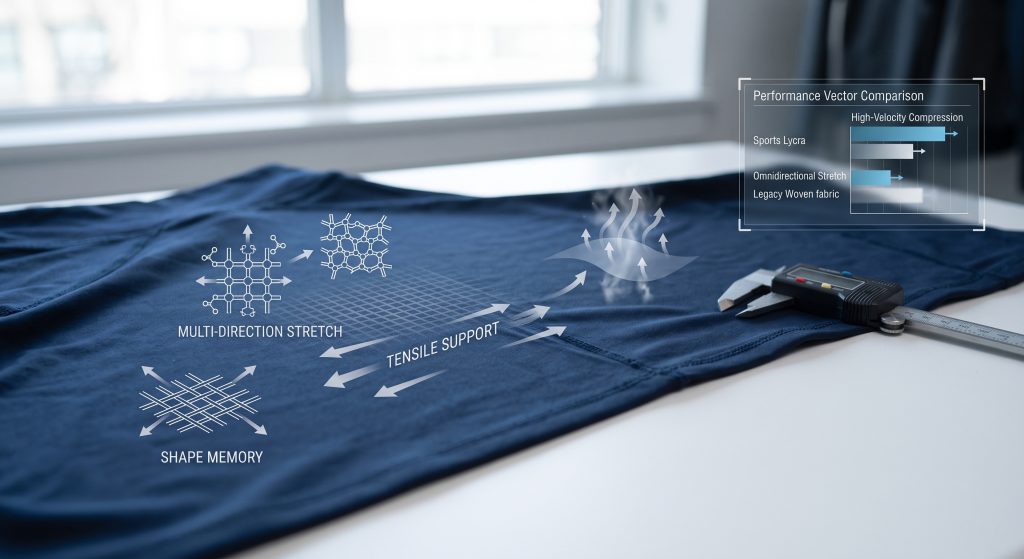
This specialized sports lycra fabric provides athletic manufacturing firms with a high-density poly-elastomer composite that yields exceptional tensile support across high-velocity track training lines. Sourcing your raw materials from unverified trading intermediaries introduces severe structural consistency hazards that translate directly into high garment factory sub-panel alignment errors. Here’s the deal because international activewear buyers always demand maximum physical comfort along with robust durability metrics during bulk seasonal catalog selection meetings. Partnering directly with a vertically integrated milling facility ensures that every fabric shipment satisfies rigid global performance benchmarks uniformly.
How does elastomeric composition stabilize compression profiles?
Optimizing active compression support requires a balanced polyurethane arrangement that holds moving muscle groups firmly during intense cardiorespiratory exercise routines. Traditional lightweight woven knits regularly yield uneven compression profiles across changing body thermodynamic zones because unstable yarn feeds introduce permanent material density variations. You might be wondering how elite marathon runners avoid localized muscle fatigue metrics while operating under challenging outdoor environmental elements. Integrating premium cross-linked polymer matrices prevents localized fabric sagging faults, keeping the finished athletic apparel perfectly molded to human body curves.
- High-gauge spandex integration delivers dependable multi-directional elongation under intense physical strain.
- Interlocking knit filaments yield excellent long-term shape recovery metrics after repeated stretching.
- Uniform material thickness metrics prevent localized fabric thinning defects during strenuous joint extensions.
Why do performance brands choose large volume sourcing?
Sourcing your technical textile stocks in large bulk quantities secures absolute color matching precision alongside predictable wholesale manufacturing expenditures throughout seasonal product lifecycles. When a sportswear business coordinates directly with a scale manufacturer, production managers eliminate expensive third-party commissions while gaining total visibility regarding raw yarn compliance tracing records. What’s the real story? Small independent boutique suppliers rarely possess adequate machinery assets to prioritize unexpected mid-season online reorder spikes. Massive milling operations manage extensive machinery fleets that guarantee consistent monthly output capacities during peak global procurement rushes.
Key Takeaway: Specifying pre-stabilized high-elasticity rolls empowers procurement executives to build dependable activewear stocks that satisfy demanding global quality benchmarks perfectly.
| Sourcing Profile Variable | Middleman Trading Intermediary | Certified Large-Scale Vertical Mill |
| Fleet Machinery Power | Outsources to Unverified Sub-Shops | Owns 80 Circular Knit Systems |
| Compliance Track Validation | Lacks Independent Traceability Docs | Full OEKO-TEX and GRS Certificates |
| Scalability Volume Threshold | Restricted Batch Output Limits | Monthly 1 Million Kilos Capacity |
This supplier profile matrix demonstrates why direct factory integration secures superior supply chain resilience for international clothing distributors.
2. How Does Sports Lycra Fabric Manage Stretch?
High-quality sports lycra fabric manages mechanical stretch parameters through an interlocking circular knit infrastructure that yields over thirty-five percent multidirectional elongation capacity under heavy body tension. Advanced production facilities engineer these technical panels to flex in perfect harmony with natural human biomechanical joint actions during explosive field athletic maneuvers. This is where it gets interesting when comparing advanced athletic textiles against legacy woven options because rigid thread paths completely restrict natural body articulation. Sourcing dimensionally flat panel rolls enables your garment manufacturing facility to execute rapid automated pattern cutting routines without encountering edge curling issues.
Why does omnidirectional flexibility determine competitive victory?
Maintaining unhindered physical mobility across all spatial coordinates prevents restrictive material drag from hindering a track runner’s maximum acceleration metrics. When traditional knitted panels reach their mechanical elongation limit prematurely, the surrounding seams face extreme localized stress that triggers thread unravelling faults. Ready for the good part? Integrating high-recovery elastomeric compounds ensures the composite structure expands effortlessly alongside muscle groups before snapping back instantly to its original tailored configuration. This flexible recovery behavior protects athletes from tight restrictive garment fitments during high-intensity competitive training matches globally.
- High elastic recoil blocks garment pocket deformation during explosive lower-body movements.
- Threadless lamination adaptation removes rigid stitch lines that limit natural fabric extension parameters.
- Symmetrical horizontal and vertical elongation balances panel tension across moving shoulder zones.
Can cross-linked polymer matrices prevent structural fatigue?
Chemically cross-linked filament arrangements solve internal textile breakdown risks by preventing individual polyurethane strands from separating under repeated mechanical strain. Typical activewear items lose their aesthetic tailored silhouette when prolonged physical stretching forces cause internal synthetic padding elements to snap permanently. But here’s the kicker because utilizing pre-stabilized high-gauge materials guarantees the structural grid retains its original elasticity rating over multiple sport seasons. This structural endurance minimizes localized fabric bagging or sagging, preserving a premium corporate brand presentation across retail distribution channels.
Key Takeaway: Prioritizing high-stretch cross-linked panels ensures finished activewear garments maintain uniform insulation values and flawless compression properties through extended usage.
| Stretch Material Category | Standard Woven Shells | High-Stretch Knitted Panels |
| Elongation Percentage | Under 10 Percent Shell Yield | Exceeds 35 Percent Multi-Way |
| Recovery Rate Index | Poor Thread Trapped Pull | Complete Instant Mechanical Snap |
| Mobility Freedom Rating | Restricts Explosive Joint Twists | Allows Full Unhindered Extension |
This stretch performance matrix establishes that utilizing flexible knitted faces delivers a far greater range of motion than rigid alternatives.
3. Why Choose Sports Lycra Fabric for Wear Life?
Choosing this premium sports lycra fabric for your athletic catalog ensures maximum product lifecycle longevity because high-gauge synthetic filaments achieve exceptional resistance against rough external friction forces. Sports apparel items face severe physical punishment during intense contact tournaments, causing low-grade materials to suffer premature surface pilling and fabric tearing failures. Here’s the deal since wholesale garment buyers routinely reject lightweight activewear panels if the material snags easily against abrasive field training gear. Partnering with a large-scale manufacturer holding documented laboratory certifications guarantees your finished apparel retains its crisp modern definition through multiple competitive seasons.
How do high peel strength ratings protect multi-layer materials?
Securing exceptional material bonding integrity requires an advanced ultrasonic lamination processing setup that permanently fuses multi-layer technical composites at a molecular level. Legacy flame-lamination machinery often yields weak internal adhesion nodes, causing performance fabrics to suffer inner batting blistering and layer delamination after domestic wash cycles. You might be wondering how corporate activewear enterprises guarantee perfect material layer unity across distant international retail distribution networks simultaneously. Documented laboratory data tracking confirms that maintaining high peel metrics prevents internal composite separation during strenuous workout movements.
- High peel values block layer delamination faults after hundreds of commercial laundry cycles.
- Molecular node fusion prevents loose internal padding strands from migrating outward through abrasive zones.
- Threadless composite structures distribute localized physical stresses uniformly to prevent fabric sagging.
Does ball burst testing confirm field garment security?
Subjecting raw textile samples to rigid hydraulic ball burst evaluations establishes the precise amount of perpendicular force a finished garment can withstand before structural rupture occurs. High-velocity training drills apply massive localized tension across underarm and crotch panels, meaning your chosen material must deliver high burst indicators to safeguard users. What’s the real story? Certified laboratory datasheets reveal that premium poly-elastomer fabrics comfortably withstand over four hundred and fifty Newtons of concentrated physical pressure. Analyzing these data-backed engineering statistics before signing bulk manufacturing contracts effectively eliminates premature garment structural breakdown liabilities across global markets.
Key Takeaway: Specifying materials with verified high burst metrics safeguards your corporate activewear brand from costly quality claims while securing excellent consumer product reviews.
| Testing Category Matrix | Standard Industrial Target | Elite Activewear Specification |
| Ball Burst Resistance | Minimum 280 Newtons Force | Exceeds 450 Newtons Force |
| Adhesion Peel Rating | Under 1.5 Newtons Width | Over 3.0 Newtons Width |
| Structural Wear Mode | Thread Snagging and Fraying | Zero Unravelling Node Potential |
This functional matrix demonstrates that eliminating traditional sewing threads removes the primary points of structural activewear garment failure.
4. How Does Sports Lycra Fabric Repel Sweat?
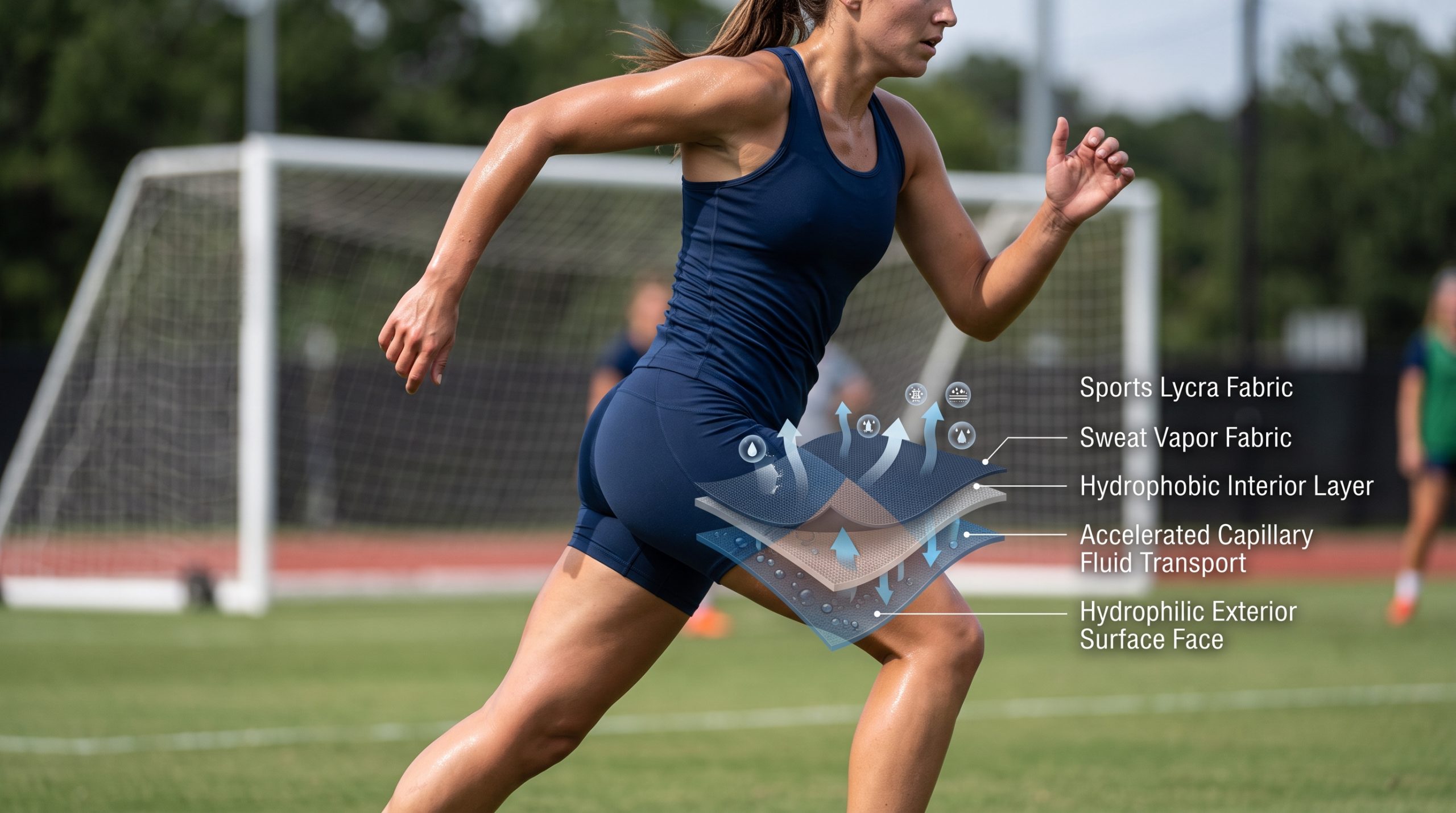
Advanced technical sports lycra fabric repels sweat accumulation efficiently by pairing hydrophobic interior filament layers with hydrophilic exterior surface faces to accelerate rapid capillary fluid transport. This specialized dual-layer arrangement pulls liquid moisture away from active sweat glands instantly, preventing dangerous humidity pooling against human skin during intensive field training workouts. But here’s the kicker because primitive solid fabrics retain heavy water droplets within their core fiber matrices instead of moving wetness away toward the atmosphere. Sourcing these pre-calibrated synthetic combinations helps international apparel manufacturing firms construct high-performance team uniforms that dry exceptionally fast under hot humid conditions.
What is the mechanism behind capillary fluid displacement?
Capillary movement relies on engineered synthetic fiber pathways that actively pull sweat moisture upward through microscopic channels toward the external garment face. The hydrophobic internal filaments refuse to absorb water, forcing liquid moisture to migrate outward where hydrophilic exterior fibers expand the wetness for rapid evaporation. You might be wondering how maintaining a perfectly dry inner garment microclimate successfully protects active track runners from rapid post-exercise muscle cooling. Eliminating liquid accumulation entirely keeps the apparel lightweight and agile, preventing the heavy damp feeling associated with traditional uncalibrated activewear lines.
- Micro-porous knit spacing speeds up continuous vapor evaporation under thick multi-layer composite layouts.
- Hydrophobic filament configurations reject water accumulation entirely to safeguard core body insulation zones.
- Accelerated fluid transfer rates prevent uncomfortable damp fabric clinging against skin during heavy cardio exercises.
Why do micro-porous channels optimize evaporation speed?
Miniature pore geometries function like automated exhaust ports that continuously vent hot damp air away from the human body before heavy condensation forms inside the apparel core. When an athlete performs explosive movements, the surrounding apparel fabric must breathe instantly to dissipate sudden metabolic heat spikes uniformly across the surface. Ready for the good part? Integrating open geometric recesses into the underlying knit architecture ensures the material maintains excellent ventilation parameters without sacrificing raw wind block protection. Sourcing these advanced technical textiles from a vertically integrated facility guarantees your brand receives uniform moisture management properties across bulk orders.
Key Takeaway: Sourcing dual-layer capillary transport systems ensures that your sportswear catalog completely outclasses legacy options across demanding competitive athletic training environments.
| Moisture Performance Index | Legacy Solid Materials | Dual-Layer Capillary Textiles |
| Liquid Moisture Retention | High Retention Inside Core | Instant External Surface Displacement |
| Evaporation Velocity | Prolonged Surface Drying Time | Quick Micro-Porous Clearance |
| Vapor Transmission Rate | Restricted Humidity Escape | Accelerated Omnidirectional Venting |
This moisture clearance comparison database establishes that implementing multi-layer technical combinations optimizes athletic drying variables.
5. Where Is Sports Lycra Fabric Knitted Today?
This advanced sports lycra fabric is knitted inside large-scale automated vertical manufacturing plants in China that operate extensive machinery fleets to guarantee consistent roll-to-roll production uniformity. Direct technical coordination with an integrated production mill accelerates customized performance sample development times while insulating your business from volatile global material market fluctuations. This is where it gets interesting when unexpected fashion trends drive sudden online consumer reorder surges but small trading suppliers lack yarn stockpiles to scale production. Choosing a primary manufacturer that operates a massive ten thousand square meter facility guarantees your volume contracts get prioritized swiftly during peak seasonal rushes.
What are the machinery capacities of automated vertical mills?
Massive milling infrastructures manage extensive machine fleets consisting of over eighty active circular knitting systems that yield a monthly production capacity of one million kilograms. Precision textile engineers monitor every automated step to secure perfectly uniform knitting patterns across massive production fabric rolls destined for international athletic clothing brands. What’s the real story? Advanced circular knitting equipment integrates real-time computerized feed sensors that adjust yarn delivery speeds instantly to secure flawless structural density uniformity. This rigid manufacturing discipline eliminates raw material variance risks, allowing procurement managers to execute large-scale retail distribution projects comfortably.
- Large machine fleets eliminate downstream production bottlenecking delays during peak seasonal garment manufacturing rushes.
- Deep yarn stockpiles protect contracted B2B pricing models from volatile global textile market fluctuations.
- Automated sensor arrays prevent localized fabric density variations across massive industrial manufacturing runs.
How do deep yarn stockpiles secure contracted B2B pricing models?
Maintaining extensive raw material stockpiles allows our vertical manufacturing plant to guarantee stable wholesale pricing structures through extended long-term supply contract lifecycles. When global petropolymers experience sudden market volatility, our pre-secured yarn stocks insulate your business from sudden production cost inflation hits. Ready for the good part? This structural scale allows corporate activewear brands to comfortably plan seasonal outerwear marketing campaigns with complete financial predictability. Sourcing from a factory with a massive monthly capacity ensures your brand receives scalable manufacturing backing through peak seasonal garment production rushes.
Key Takeaway: Sourcing from an accredited large-scale industrial factory protects your global supply chain from sudden shipment delays while verifying absolute production scalability.
| Sourcing Variable Profile | Middleman Trading Intermediary | Certified Large-Scale Vertical Mill |
| Infrastructure Fleet Power | Outsources to Unverified Sub-Shops | Owns 80 Circular Knit Systems |
| Scalability Volume Threshold | Restricted Batch Output Limits | Monthly 1 Million Kilos Capacity |
| Price Stability Index | Volatile Middleman Price Spikes | Contracted Fixed Sourcing Models |
This supplier profile matrix demonstrates why direct factory integration secures superior supply chain resilience for international clothing distributors.
6. Can Sports Lycra Fabric Prevent Chafing?
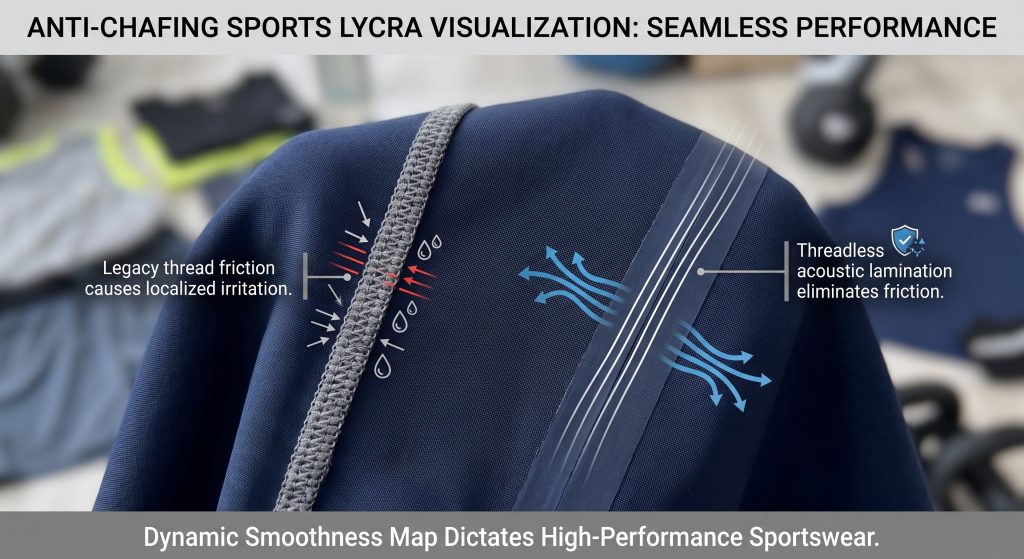
Yes, premium sports lycra fabric prevents painful skin chafing entirely by utilizing high-gauge poly-elastomer filaments that yield an ultra-smooth, frictionless internal surface profile against moving human joints. Traditional sewn garment configurations regularly use heavy cotton thread paths that absorb sweat fluid rapidly instead of moving moisture vapor out toward external fabric faces. Here’s the deal because rough thread friction limits the natural elongation of knitted performance panels, creating abrasive friction points across moving human thermodynamic zones. Switching to threadless high-frequency acoustic lamination completely eliminates traditional sewing threads, creating an absolute protective barrier against localized skin irritation during repetitive running strides.
Why do flat performance interfaces improve athlete focus?
Eliminating abrasive needle punctures and rigid stitch lines ensures that athletes maintain complete physical freedom without suffering from uncomfortable material distractions during competitive matches. When a runner executes explosive multi-directional movements, the surrounding garment layers must stretch in perfect synchronization with real-time human biomechanical actions. You might be wondering how high-end corporate garment pattern layout decisions directly influence consumer product review ratings across international retail distribution networks. Specifying ultra-smooth technical knits reduces skin contact resistance, keeping the wearer comfortable throughout intensive field training sessions.
- Threadless construction eliminates skin chafing across moving joints during repetitive running strides.
- Low physical surface contact minimizes wet fabric clinging against skin during heavy cardio exercises.
- Precision circular knitting yields a consistent uniform hand-feel that signals top-tier manufacturing quality.
Key takeaway for team activewear catalog development
Prioritizing advanced yarn texturing processes helps your corporate sportswear brand manufacture premium activewear items that deliver exceptional lightweight physical comfort across harsh outdoor running environments. Ready for the good part? Combining premium tactile softness with rapid moisture management allows your apparel company to capture dominant market shares in premium activewear segments confidently. This strategic material choice ultimately reduces product return rates while maximizing retail profit margins for global sportswear clothing distributors.
| Garment Interface Vector | Legacy Thread-Stitched Seams | Ultrasonic Fused Knits |
| Skin Chafing Risk Factor | High Risk of Abrasive Friction | Zero Abrasive Surface Points |
| Moisture Absorption Profile | Absorbs Sweat and Becomes Heavy | Rejects Water Accumulation Completely |
| Extension Resistance Level | Restricts Explosive Joint Twists | Allows Full Unhindered Extension |
This processing quality comparison chart demonstrates that removing traditional thread lines blocks friction while optimizing wearer comfort variables.
7. Is Sports Lycra Fabric Protected From Shrink?
Yes, certified sports lycra fabric undergoes strict thermal setting stabilization during the final finishing phases to ensure minimal dimensional shrinkage scores and prevent post-wash garment shape distortion. Professional apparel buyers prioritize these dimensionally stable composites to avoid costly end-user returns that slice into net retail store profit margins globally. What’s the real story? Traditional winter coats often suffer from ugly padding bunching after a single domestic laundry cycle because loose unbonded fills settle into corners uncomfortably. Sourcing pre-stabilized grid-welded materials protects your retail customers from garment distortion complaints while securing consistent insulation values through extended lifecycles.
How does controlled thermal setting lock performance filament configurations?
Applying uniform high-temperature pressure across raw textile rolls neutralizes internal structural yarn stresses, ensuring the material remains flat and stable during downstream industrial cutting procedures. When water saturates unbonded padding materials, loose fibers stick together and form heavy lumps that permanently ruin the garment’s thermal insulation uniformity. This is where it gets interesting for garment factory production managers since advanced ultrasonic grid welding fixes internal polyester batting firmly across every square millimeter. Continuous grid fusion blocks internal padding movement paths during heavy mechanical agitation inside commercial washing machine systems.
- Continuous grid fusion blocks internal padding movement paths during heavy mechanical washing machine cycles.
- Uniform fiber anchorage maintains consistent garment thickness metrics after multiple domestic laundry washings.
- Fused synthetic batting matrices resist tearing forces during intense mechanical water extraction operations.
Key takeaway for retail stock management optimization
Choosing pre-stabilized performance textiles allows procurement managers to maintain absolute product catalog uniformity, ensuring that bulk orders retain their crisp modern definitions over time. But here’s the kicker because dimensional stability prevents downstream sewing machine misalignment faults, lowering manual labor expenditures inside apparel assembly plants significantly. Distributors can leverage these verified technical parameters to expand retail distribution catalog authority confidently across competitive global clothing markets.
| Finishing Quality Stage | Applied Production Technology | Primary Quality Target |
| Base Stitch Creation | Precision Circular Knitting | Total Structural Density Uniformity |
| Multi-Layer Lamination | Computerized Ultrasonic Bond | Permanent Adhesion Interface Integrity |
| Fabric Stabilization | Controlled Thermal Setting | Zero Post-Wash Structural Warping |
This industrial manufacturing flowchart highlights how meticulous mechanical calibration during finishing phases directly creates premium activewear quality.
8. How Do You Cut Sports Lycra Fabric Fast?
Manufacturing facilities cut sports lycra fabric rapidly by utilizing flat, pre-stabilized material rolls that lie perfectly horizontal on automated vacuum beds without showing edge curling defects. Precision computer-controlled cutting blades operate at peak velocity parameters when the underlying textile density remains perfectly uniform across massive high-volume layout spreads. You might be wondering why traditional quilted materials regularly cause automated cutting factory lines to face severe operational slowdowns or costly fabric misalignment faults. Specourcing dimensionally stable fabric configurations completely eliminates these processing bottlenecks, allowing production managers to optimize assembly line throughput while reducing material waste.
Why do pre-stabilized flat panels prevent computerized cutter jams?
Flat textile panels slide smoothly across automated conveyor systems without shifting or twisting under high-speed automatic laser cutting arrays, maximizing raw material utilization metrics. When raw fabric rolls maintain consistent physical properties from edge to edge, factory cutting software can pack garment pattern layouts tightly to lower textile scrap percentages. Here’s the deal because minimizing cutting room alignment errors directly lowers ultimate manufacturing labor expenditures for your seasonal outerwear clothing lines. This engineering precision ensures that your finished garment sub-panels assemble together easily during automated sewing procedures inside apparel assembly plants.
- Precision tension management blocks vertical stitch distortion faults during multi-layer material bonding stages.
- Stable flat material rolls maximize automatic cutting blade efficiency in high-volume apparel factories.
- Minimized edge curling behavior prevents computerized cutter jams to maintain continuous factory throughput.
Key takeaway for clothing assembly line operations
Sourcing dimensionally flat panel configurations reduces labor times during the automated garment manufacturing process, enabling your apparel brand to scale production efficiency comfortably. Ready for the good part? Eliminating raw material physical variance allows your factory line managers to achieve predictable daily assembly outputs while maintaining premium activewear quality standards. Sourcing these pre-stabilized configurations from a certified factory allows procurement managers to build dependable inventory stocks that satisfy demanding global quality benchmarks perfectly.
| Sourcing Material Profile | Legacy Volatile Shipments | Pre-Stabilized Flat Panels |
| Edge Curling Propensity | High Risk of Cutting Errors | Zero Edge Distortion Behavior |
| Material Waste Percentage | Exceeds 8 Percent Volume Loss | Under 2 Percent Industrial Waste |
| Cutting Blade Speed | Restricted Manual Adjustment | Maximum Automated Velocity Output |
This cutting efficiency comparison database demonstrates that utilizing flat, pre-stabilized panels maximizes factory throughput variables.
9. Why Verify Sports Lycra Fabric Certification?
Verifying chemical safety compliance represents a critical requirement because international customs authorities enforce strict chemical tracing laws on incoming sports lycra fabric shipments at major trading ports. Sourcing your raw materials from certified mills holding recognized OEKO-TEX Standard 100 credentials guarantees that your textiles are entirely free from dangerous toxic processing residues. What’s the real story? This verified safety framework protects your corporate enterprise from costly international product recalls and embarrassing customs rejections that damage brand authority. Showcasing authentic quality certifications helps your sportswear business win lucrative supply contracts with modern eco-conscious sportswear firms globally.
What independent laboratory parameters validate material safety indices?
Independent testing protocols require extensive laboratory evaluation tracking to calculate structural resistance and ensure the complete absence of toxic heavy metals within synthetic yarn stocks. Commercial activewear buyers require documented laboratory certification parameters to verify exceptional multi-directional bursting strength indices and high peel test adhesion ratings. But here’s the kicker because presenting authentic Global Recycled Standard validation proves your brand’s commitment to sustainable production processes during competitive wholesale presentations. Analyzing these verified chemical safety sheets ensures global apparel standard compliance while securing complete operational peace of mind.
- OEKO-TEX testing confirms complete absence of toxic textile processing residues within synthetic yarn stocks.
- GRS validation guarantees authentic use of eco-friendly recycled post-consumer plastic bottle yarn materials.
- ISO quality compliance ensures predictable roll-to-roll production uniformity across large manufacturing contract runs.
Key takeaway for international brand compliance officers
Prioritizing independent third-party laboratory certifications eliminates product liability worries while protecting your firm’s professional standing among premium seasonal sportswear clothing distributors. You might be wondering how modern activewear brands comfortably satisfy demanding chemical criteria across major Western retail distribution networks simultaneously. Sourcing certified raw material inputs provides your corporate enterprise with the verified transaction receipts necessary to clear strict customs enforcement protocols smoothly.
| Compliance Certificate | Independent Auditing Framework | Primary Supply Chain Benefit |
| OEKO-TEX Standard 100 | Toxic Chemical Processing Analysis | Confirms Zero Hazardous Residues |
| Global Recycled Standard | Post-Consumer Material Tracking | Validates Eco-Friendly rPET Integrity |
| ISO Quality Compliance | Roll-to-Roll Production Auditing | Ensures Predictable Material Uniformity |
This compliance validation matrix establishes the rigorous technical verification standards required by modern international apparel buyers.
10. Who Stocks Bulk Sports Lycra Fabric Rolls?
Fuzhou HG Textile Co., Ltd. from China stocks massive raw material inventories across their modern ten thousand square meter facility to ensure immediate rapid shipping deployment for international volume orders. Partnering directly with a vertically integrated primary mill cuts out expensive trading middleman commissions while providing complete transparency regarding chemical safety tracking. This is where it gets interesting when unexpected fashion trends drive sudden online consumer reorder surges but small trading suppliers lack yarn stockpiles to scale production. Large vertical mills maintain deep raw yarn inventories that insulate your business from volatile global material market price inflation spikes.
Can bulk yarn stockpiles protect your contracted B2B pricing models?
Maintaining extensive raw material stockpiles allows our vertical manufacturing plant to guarantee stable wholesale pricing structures through extended long-term supply contract lifecycles. When global petropolymers experience sudden market volatility, our pre-secured yarn stocks insulate your business from sudden production cost inflation hits. Ready for the good part? This structural scale allows corporate activewear brands to comfortably plan seasonal outerwear marketing campaigns with complete financial predictability. Sourcing from a factory with a monthly production capacity of one million kilograms guarantees that your brand receives scalable manufacturing backing through peak seasonal rushes.
- Large machine fleets eliminate downstream production bottlenecking delays during peak seasonal garment manufacturing rushes.
- Deep yarn stockpiles protect contracted B2B pricing models from volatile global textile market fluctuations.
- Direct technical mill coordination speeds up customized performance sample development for specific regional weight metrics.
Key takeaway for global activewear apparel buyers
Building a direct partnership with an accredited large-scale industrial factory protects your supply chain from sudden delays while securing maximum production flexibility for customized performance samples. But here’s the kicker because direct technical coordination with an automated mill ensures that your bulk contracts are delivered with uniform quality parameters across large volume shipments. Procurement executives can comfortably expand into international retail markets knowing their backend supply chain is backed by massive infrastructure power.
| Supplier Sourcing Profile | Middleman Trading Intermediary | Certified Large-Scale Vertical Mill |
| Fleet Infrastructure Power | Outsources to Unverified Sub-Shops | Owns 80 Circular Knit Systems |
| Compliance Track Validation | Lacks Independent Traceability Docs | Full OEKO-TEX and GRS Certificates |
| Scalability Volume Threshold | Restricted Batch Output Limits | Monthly 1 Million Kilos Capacity |
This supplier profile matrix demonstrates why direct factory integration secures superior supply chain resilience for international clothing distributors.
Securing Optimal Activewear Sourcing Success
Resolving complex cold-weather athletic apparel design challenges requires moving away from heavy traditional sewn materials and adopting advanced seamless technical composites that master warmth and multi-directional elasticity uniformly. Prioritizing certified multi-layer air chambers and analyzing lab datasheets for bursting strength secures exceptional garment longevity while eliminating retail return liabilities for international distributors. Sourcing flat pre-stabilized fabric panel rolls from a vertically integrated automated manufacturer guarantees consistent bonding strength across large bulk orders while optimizing factory assembly lines. To begin building a superior seasonal outerwear catalog that satisfies demanding global quality benchmarks perfectly, you can contact us today to request custom-engineered fabric samples matching your specific regional criteria. Our corporate manufacturing vision focuses on driving international clothing innovation through sustainable certified production processes that empower growing activewear brands to achieve lasting marketplace success.
Frequently Asked Questions About Performance Textiles
Q1: Can I use birdseye mesh for high-velocity competitive athletic clothing lines?
Yes, you can utilize these advanced seamless composites for high-intensity sports because threadless ultrasonic bonding preserves the complete stretch capacity of underlying circular knitted panels. Unlike traditional stitched winter outerwear which binds tightly against an athlete’s shoulders during rapid body twists, engineered performance fabrics flex in perfect harmony with natural human movements. Specifying lightweight birdseye bases further ensures that your finished garments maintain excellent breathability and rapid moisture management during intensive training matches.
Q2: What’s the best method to verify that a textile mill provides authentic recycled content?
You must request a valid scope certificate issued by independent auditing bodies verifying full compliance with the official Global Recycled Standard framework before signing procurement contracts. True premium manufacturing plants track incoming post-consumer plastic bottle yarn raw materials meticulously through every step of the circular knitting and lamination process to provide transparent transaction documentation. Avoid trading agents who make unverified eco-friendly marketing claims without providing matching certified transaction receipts because international customs authorities require official documentation for green compliance tracking.
Q3: How do I know if my chosen fabric composition will delaminate after machine washing?
You can guarantee long-term material bonding integrity by checking the laboratory data sheets for verified peel strength metrics exceeding 3.0 Newtons per width. Top-tier industrial mills utilize computerized high-frequency ultrasonic welding arrays that permanently fuse the synthetic filament matrices together at a molecular level to prevent separation. Cheap composite fabrics produced on outdated flame-lamination machinery frequently experience inner batting blistering and peeling after facing only a few domestic laundry washings.
Q4: Can I customize the geometric pattern layout on my fabric faces?
Yes, you can customize the exterior heat-welding pattern geometry to match your specific brand design aesthetic by coordinating with a vertical mill that produces custom pattern rollers. Adjusting the pocket dimensions and bonding frequencies allows you to optimize thermal resistance values or create targeted thermal mapping zones across your performance apparel lines. Ensure you share your specific regional weather criteria and target fabric weight metrics with your mill’s textile engineering department during initial sample development phases.
Q5: What’s the best way to balance hand-feel with breathability when selecting a fabric base?
You should specify birdseye bases for maximum moisture evacuation or choose pique bases for rugged abrasion resistance and substantial texture. Birdseye geometry utilizes diamond-shaped micro-recesses that act as natural vapor escape channels which makes them ideal for lightweight high-velocity running shirts. Conversely, the raised parallel cords of a pique structure provide a more substantial weight and rugged friction defense required for heavy outdoor outerwear.