
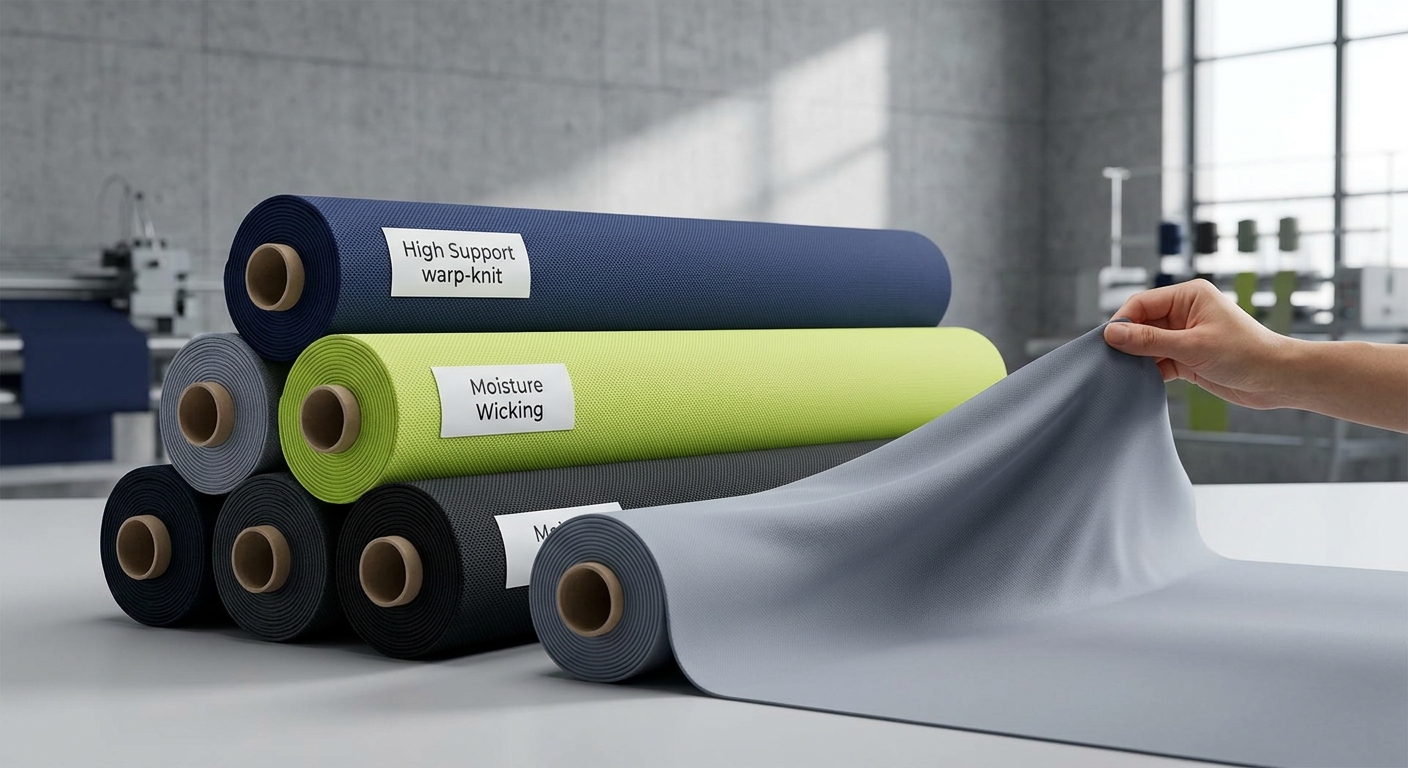
The ideal premium structural material for athletic undergarments combines a high modulus of linear elasticity with targeted multi-directional compression to fully stabilize breast tissue during rigorous high-impact workouts. Many global activewear brands continuously suffer from severe consumer product returns when their current material suppliers ship unstable material batches that sag or lose their recovery power after just a few commercial laundry cycles. Here is the deal: inconsistent structural support completely destroys retail consumer confidence in your brand clothing line, causing massive distribution cancellations that wipe out your hard-earned quarterly wholesale profits. Selecting a certified, production-verified sports bra fabric provides an immediate technical remedy to these garment design failures by delivering perfect stretch recovery profiles alongside exceptional moisture vapor transmission performance backed by our decade of specialized industrial warp-knit manufacturing experience.
What Is Premium Sports Bra Fabric Composition?
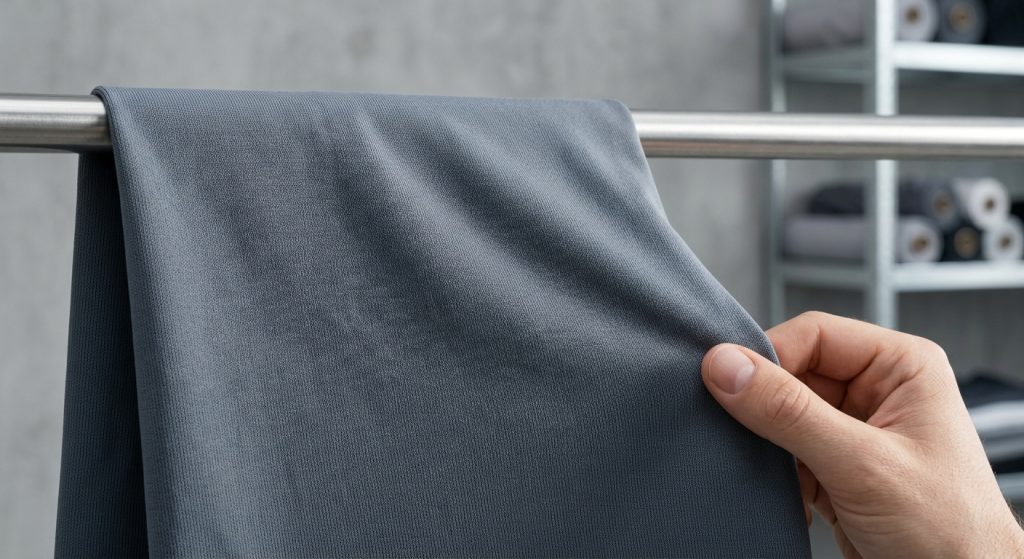
Premium sports bra fabric composition consists of a highly dense blend of premium nylon filament and industrial elastane polymers engineered carefully via advanced interlock circular knitting machinery setups. This technical filament combination produces an unyielding structural matrix that effectively manages vertical physical displacement while remaining perfectly soft against sensitive skin layers during long athletic training schedules. Sourcing this specific industrial blend guarantees that your corporate activewear line retains its tailored compression shape instead of stretching out permanently under heavy mechanical stress, thereby preventing premature garment structural failure during intense gym workouts. Global clothing procurement managers prefer this nylon blend because it offers superior long-term tensile defense compared to lower-grade polyester alternatives that lack adequate rebound characteristics.
Why Do Nylon and Elastane Blends Rule the Market?
This is where it gets interesting… Nylon fibers possess an inherently smooth surface profile that eliminates abrasive rubbing friction while delivering incredible tear resistance under high mechanical stress loads. When your production factory blends this durable synthetic base with high percentages of premium Lycra or spandex compounds, you build an exceptionally responsive athletic textile that accommodates rapid bodily movements effortlessly. You will find that these premium performance yarn combinations maintain their original thickness and structural memory even after undergoing multiple commercial wash cycles, ensuring that the final consumer enjoys a reliable fit over years of active usage.
- Nylon delivers supreme abrasion resistance along raw stitched seams.
- Spandex provides high multi-directional stretch recovery parameters.
- Synthetic filaments resist staining from heavy topical body oils.
Key Takeaway: Utilizing this specific yarn pairing helps your production team manufacture sports gear that offers maximum physical security during high-velocity running exercises.
| Component | Percentage Range | Primary Performance Benefit |
| Premium Nylon | 70% – 85% | Exceptional Abrasion Resistance |
| High-Grade Spandex | 15% – 30% | Multi-Directional Elastic Recovery |
This textile data demonstrates how maintaining high spandex ratios directly influences the ultimate compression performance of athletic undergarments.
How Does Sports Bra Fabric Minimize Dynamic Bounce?
High-performance sports bra fabric minimizes dynamic bounce by utilizing a specialized high-modulus knit structure that limits excessive breast tissue velocity during aggressive multi-directional movements. This specialized mechanical stabilization reduces the physical strain placed on delicate muscle ligaments, thereby preventing long-term tissue sagging and athletic discomfort for the wearer. Incorporating these supportive technical materials into your seasonal manufacturing pipeline ensures that your activewear catalog delivers genuine high-impact security that retail customers can immediately verify during strenuous fitness training sessions. Selecting these high-performance knits allows your design team to create minimalist silhouettes that provide maximum physical containment without relying on thick underwires.
What Is the Role of High Modulus Extension Control?
You might be wondering… How does extension control translate to actual field performance when athletes are moving at maximum velocity? High modulus fabrics resist stretching past a strict geometric threshold, acting like a firm protective wall that dampens kinetic energy transfer during explosive jumping maneuvers. This mechanical limitation guarantees that the garment provides rigid holding power without restricting natural respiratory expansion during intense aerobic workloads. By controlling the elongation percentage along the vertical axis, your production line can eliminate the painful breast bouncing issues that frequently cause female athletes to cut their workout sessions short.
- Limits vertical breast displacement by up to seventy percent.
- Maintains tight compression fitment during continuous lateral agility cuts.
- Distributes physical weight evenly across wide shoulder strap segments.
Key Takeaway: Implementing high modulus knits allows your apparel brand to capture the high-impact sports market segment with verified support metrics.
| Support Category | Modulus Level | Target Athletic Activity |
| High-Impact Control | Extreme | Competitive Running and Cross-Training |
| Low-Impact Comfort | Moderate | Yoga and Casual Daily Wear |
This structural breakdown clarifies how matching modulus levels to specific activities optimizes user comfort.
Why Choose Synthetic Sports Bra Fabric Over Cotton?
Advanced synthetic sports bra fabric alternatives outperform traditional organic cotton options by offering superior moisture management, unyielding shape memory, and higher tensile resistance. Cotton fibers naturally absorb sweat like a sponge, causing the undergarment to become heavy, damp, and highly prone to causing severe skin chafing during long workouts. Shifting your material procurement strategy toward advanced synthetic knits ensures that your activewear line maintains its lightweight, defensive utility under extreme athletic conditions. Furthermore, synthetic filaments do not stretch out or sag over time, which means your finished garments will look and perform like new even after undergoing dozens of rigorous commercial laundering cycles.
How Do Synthetic Fibers Beat Natural Fibers in Support?
But here is the kicker… Natural cotton lacks the inherent elastic recovery properties needed to spring back into shape after being subjected to intense multi-directional pulling forces. Synthetic filaments feature highly flexible molecular chains that can expand up to five times their original length and return to their baseline dimensions instantly without suffering from structural distortion. This rapid mechanical rebound is what gives active sportswear its long-lasting compression characteristics, ensuring that the wearer feels completely supported throughout their entire fitness routine. By utilizing these durable engineered synthetics, your apparel brand can confidently offer long-term performance guarantees that build deep customer loyalty.
- Synthetics deliver instantaneous rebound elasticity under repetitive mechanical stress.
- Fiber structures prevent weight accumulation from trapped sweat moisture.
- Material retains uniform thickness across high-pressure bust regions.
Key Takeaway: Choosing synthetic compositions prevents your garment line from developing unsightly sagging issues after minimal retail use.
| Performance Metric | Premium Synthetic Blend | Traditional Organic Cotton |
| Rebound Elasticity | 98% Recovery Rate | Less Than 40% Recovery |
| Moisture Retention | Minimal | High Water Absorption |
The comparison chart highlights why synthetic fibers remain the premier choice for high-durability athletic clothing.
Which Sports Bra Fabric Weights Provide High Support?
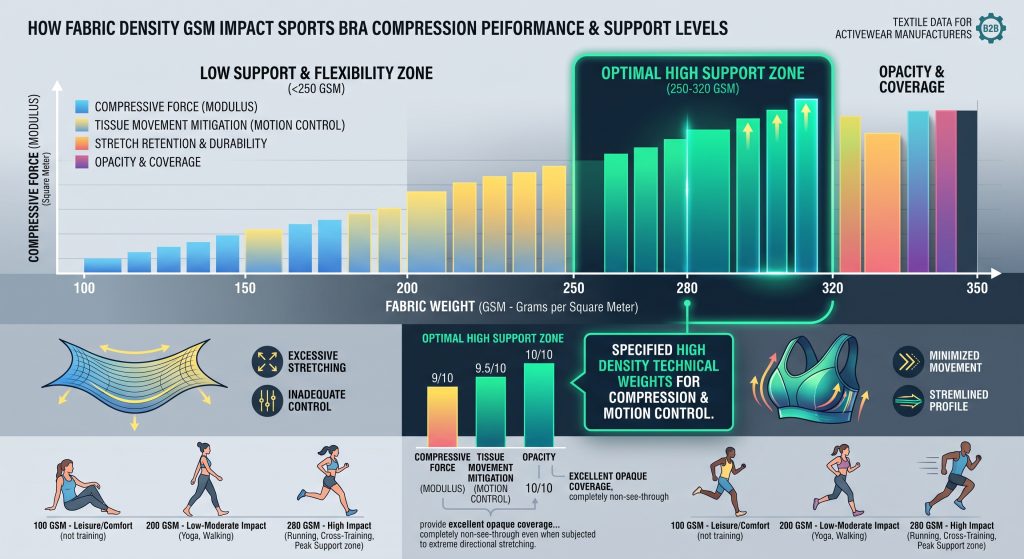
Selecting a heavy-duty sports bra fabric weight ranging between two hundred fifty and three hundred twenty grams per square meter provides the ideal material density required for maximum high-impact bust support. Lower fabric weights often fail to provide sufficient compressive force, resulting in excessive garment stretching and inadequate motion control during intensive physical training schedules. Specifying these dense technical weights ensures that your manufacturing facility produces top-tier compression garments that effectively minimize tissue movement while maintaining a streamlined profile. These heavier textile weights provide excellent opaque coverage, meaning that your finished garments will remain completely non-see-through even when subjected to extreme directional stretching during deep squats or aerobic movements.
Why Does High Fabric Density Matter for Compression?
Ready for the good part? Higher fabric density means there are more individual interlocking loops packed into every square centimeter of the technical textile matrix, which multiplies its total tensile resistance. This dense yarn configuration forms a highly secure supportive envelope that evenly distributes structural pressure across the torso, minimizing localized shoulder strap strain. You will notice that these substantial materials provide a premium, high-end hand-feel that immediately communicates durability and luxury to retail buyers browsing your activewear collection. By maintaining strict density baselines during product procurement, you ensure that your garments deliver unyielding physical stability through consecutive athletic seasons.
- Dense knits supply uniform compression across the entire bust area.
- Fabric thickness prevents unwanted garment transparency during intense stretching.
- High yarn counts provide a barrier against friction-induced wear.
Key Takeaway: Utilizing dense textile weights guarantees that your high-impact activewear lines deliver the physical security that competitive athletes demand.
| Density Classification | Weight Range (GSM) | Recommended Support Level |
| High-Density Performance | 250 – 320 | High-Impact Support |
| Light-Weight Comfort | 150 – 220 | Low-Impact Daily Wear |
This weight analysis shows that structural density directly dictates the ultimate containment capabilities of athletic support gear.
Can Sustainable Sports Bra Fabric Deliver Durability?
Certified sustainable sports bra fabric options derived from post-consumer recycled polyester deliver exceptional structural durability that fully matches the performance profiles of virgin synthetic textiles. Modern recycling processes purify plastic waste thoroughly, transforming it into high-grade performance filaments that possess incredible tensile strength and identical elastic properties. Integrating these eco-friendly materials into your B2B activewear production catalog allows your brand to satisfy strict green procurement standards without sacrificing garment longevity. Many elite sports organizations now actively prioritize sustainable garment lines, making this eco-focused material transition an excellent commercial avenue for expanding your corporate client base and boosting market shares.
What Certifications Prove Sustainable Textile Strength?
What is the real story? Genuine green materials carry official international validations like the Global Recycled Standard to confirm full traceability from waste collection to the final fabric roll. These strict auditing systems verify that the recycled yarns maintain pristine mechanical properties, ensuring that the finished garments resist pilling, tearing, or stretching out prematurely during intensive retail use. You can confidently market these sustainable options to premium fitness clubs knowing that their durability and compression metrics are fully backed by rigorous laboratory testing protocols. Partnering with a certified eco-conscious mill helps future-proof your product lines against changing global environmental regulations.
- Global Recycled Standard validation ensures transparent environmental tracking.
- OEKO-TEX certification guarantees the complete absence of skin-irritating chemicals.
- Mechanical testing sheets confirm high yarn structural consistency.
Key Takeaway: Specifying certified green textiles protects your brand reputation while meeting the growing consumer demand for ecological responsibility.
| Certification Type | Verification Scope | Core Commercial Value |
| Global Recycled Standard | Supply Chain Tracking | Validates Eco-Friendly Status |
| OEKO-TEX Standard 100 | Chemical Safety Limits | Guarantees Skin Comfort |
These regulatory certifications provide global procurement teams with verifiable proof of material safety and processing excellence.
How Does Sports Bra Fabric Manage Intense Sweat?
High-quality sports bra fabric manages intense sweat by utilizing integrated capillary channels that mechanically draw liquid moisture away from the skin surface toward the outer layer. This rapid wicking action prevents the material from holding dampness next to the body, eliminating the heavy, cold feeling that often disrupts focused training routines. Implementing these moisture-controlled textiles within your garment assembly plant guarantees that your finished activewear lines keep competitive athletes dry, comfortable, and focused on performance. These advanced moisture-wicking properties also help lower the risk of post-workout bacterial odor accumulation, ensuring that the garments remain fresh even after long periods of intense physical use.
How Does Cross-Sectional Filament Geometry Accelerate Drying?
This is where it gets interesting… Synthetic filaments are extruded with unique cross-sectional shapes like grooves or star patterns that multiply the total surface area available for liquid evaporation. Instead of absorbing wetness into the core of the fiber, these micro-channels use natural capillary forces to spread sweat across a broad outer footprint, allowing passing air currents to dry the garment within minutes. This advanced fluid management system ensures that the fabric never feels sticky or waterlogged against the skin during hot summer workout sessions. By offering these high-evaporation textiles, your clothing business can deliver top-tier gear that satisfies the rigorous comfort demands of professional marathon runners and fitness enthusiasts.
- Grooved filament shapes maximize surface area for evaporation.
- Non-absorbent polymer bases prevent moisture weight accumulation.
- Continuous airflow paths lower surface humidity near the skin.
Key Takeaway: Choosing advanced grooved filament textiles ensures that your sports apparel lines retain their dry-comfort claims under humid conditions.
| Fiber Geometry | Moisture Transport Mechanism | Relative Drying Speed |
| Grooved Synthetic | Capillary Surface Action | Extremely Rapid |
| Round Organic | Internal Core Absorption | Significantly Delayed |
This technical data highlights why modifying filament geometry is necessary to achieve rapid drying metrics in active sportswear.
Why Does Warp Knit Sports Bra Fabric Resist Tearing?
Industrial warp knit sports bra fabric resists tearing because its unique parallel loop structure prevents individual damaged threads from laddering or running down the entire garment length. Unlike traditional circular knits that use a single continuous yarn, warp knitting feeds multiple yarn strands simultaneously down the needle bed to lock each loop securely in place. Enforcing this heavy-duty manufacturing method protects your sports apparel lines from sudden structural failure along high-stress seams during explosive upper body fitness movements. This structural resilience is especially beneficial for high-compression garments that must withstand extreme physical pulling forces during active dressing and intense workout routines.
What Separates Warp Knitting From Weft Knitting Durability?
But here is the kicker… Weft knits are highly vulnerable to unraveling completely if a single loop catches on sharp gym equipment or rough velcro straps. Warp knit structures interlock the vertical loops across diagonal pathways, creating a stable multi-directional defense layer that isolates punctures and stops structural damage from spreading across adjacent fabric sections. This unique loop arrangement gives your activewear garments an exceptional level of structural security, ensuring they maintain their neat appearance through years of rugged training use. Sourcing these durable materials allows your apparel business to target elite fitness clubs with premium product lines that deliver unyielding field reliability.
- Warp knits provide loop stability to isolate punctures completely.
- Diagonal interlocking paths resist tearing under maximum pulling forces.
- Raw cut edges do not fray, simplifying complex garment stitching.
Key Takeaway: Implementing warp knit options lowers product defect rates and safeguards your garment collections against seam bursting issues.
| Knitting Method | Structural Interlocking | Tear Propagation Risk |
| Specialized Warp Knit | Multi-Directional Parallel | Minimal (Isolated) |
| Traditional Weft Knit | Single Continuous Thread | High (Runs Easily) |
This manufacturing comparison clearly shows why warp-knit architectures are superior for building impact-resistant athletic clothing lines.
Which Sports Bra Fabric Styles Prevent Chafing?
Selecting smooth-surfaced sports bra fabric styles like microfiber interlock or fine-gauge birdseye patterns prevents painful skin chafing by minimizing surface friction across high-movement contact zones. When athletes sweat profusely, coarse material textures can quickly cause severe skin irritation, leading to extreme discomfort and a poor overall product experience. Integrating ultra-soft, slick synthetic surfaces into your activewear designs ensures that your finished undergarments glide effortlessly over the skin during intense cardio training routines. These smooth styles lay perfectly flat under standard compression stitching, allowing your factory production team to create friction-free internal environments that safeguard user skin health.
Why Do Microfiber Configurations Outperform Coarse Textiles?
You might be wondering… What exact fiber dimensions are required to eliminate friction-induced skin redness completely during long distance runs? Microfiber configurations utilize filaments that measure less than one denier in thickness, producing an incredibly plush, continuous surface texture that mimics natural silk while retaining full synthetic strength. This microscopic thickness ensures that every yarn loop remains exceptionally soft and flexible, bending easily with the body’s natural contours rather than rubbing abrasively against the skin. By specifying fine microfiber textiles during your product development phase, your company can provide elite comfort solutions that attract top-tier fitness retailers to your brand.
- Ultra-fine filaments prevent friction-induced skin redness completely.
- Tight knit counts establish a uniform surface that rejects rough pill formation.
- Soft tactile contact reduces irritation across highly sensitive torso regions.
Key Takeaway: Incorporating microfiber structures into your design catalog eliminates consumer complaints regarding scratchy interior garment seams.
| Filament Class | Fiber Thickness (Denier) | Relative Chafing Risk |
| Premium Microfiber | Less Than 1.0 Denier | Lowest Possible Risk |
| Coarse Synthetic | Greater Than 3.0 Denier | Elevated Friction Risk |
This dimensional breakdown illustrates how managing fiber thickness directly impacts the ultimate next-to-skin comfort of athletic gear.
How Should Factory Teams Test Sports Bra Fabric?
Factory production teams must test incoming sports bra fabric lots using systematic elongation and recovery fixtures before feeding any material rolls into automated cutting equipment. Measuring the exact percentage of stretch bounce-back ensures that different color batches deliver identical compression forces, preventing sizing mismatches across your activewear collections. Enforcing these strict laboratory screening steps allows your manufacturing team to intercept unstable material rolls before they cause costly production line defects. These standardized evaluation procedures verify that the textile maintains uniform density scales across its entire width, ensuring consistent garment quality across high-volume wholesale shipments.
Which Laboratory Protocols Validate Elastic Recovery?
Ready for the good part? Standardized ASTM tension tests pull fabric samples to their absolute structural limits over thousands of consecutive expansion cycles to monitor permanent material deformation. Premium performance synthetics routinely pass these grueling cycle tests with over ninety-five percent recovery rates, proving their long-term ability to maintain unyielding bust containment throughout extended retail lifecycles. This precise testing data allows your quality assurance managers to discard any fabric rolls that display premature elastic fatigue or structural sagging tendencies. Enforcing these strict guidelines guarantees that every garment shipped from your facility delivers identical high-level performance that honors your brand promise.
- Cycle testing monitors long-term compression stability across multiple runs.
- Electronic strain gauges record exact elastic breakdown thresholds.
- Laundering simulation trials verify colorfastness and shrinkage resistance metrics.
Key Takeaway: Implementing rigorous material screening saves your company from experiencing high product return rates and negative buyer feedback.
| Test Metric | Standard Target Value | Quality Acceptance Threshold |
| Stretch Recovery Rate | >95% Rebound Reclaimed | Mandated for High-Impact Production |
| Dimensional Shrinkage | Less Than 2% Change | Required to Maintain Uniform Sizing |
The testing criteria outlined above provide a reliable operational framework for maintaining zero-defect production baselines in activewear manufacturing.
Where Can Brands Buy Bulk Sports Bra Fabric Safely?
Commercial apparel brands can buy bulk sports bra fabric safely by partnering directly with accredited international manufacturing mills that operate modern circular knitting facilities. Sourcing your materials directly from established textile factories cuts out expensive intermediary trading markups, giving your company access to custom weight calibrations and consistent color matching. Verifying factory compliance history ensures that your production supply chain remains perfectly stable and fully protected against sudden international trade disruptions. These direct manufacturing relationships enable agile activewear brands to adjust production volume scales rapidly, easily matching inventory output with shifting consumer retail market demands.
What Verification Steps Secure High Wholesale Quality?
What is the real story? Elite textile mills always provide fully updated chemical safety validation documents and physical sample yardage for independent laboratory stress testing prior to contract finalization. Reviewing these authentic factory credentials ensures that your bulk material shipments contain premium-grade yarns that fulfill the performance promises made to your wholesale customers. By executing these systematic verification steps before releasing large financial deposits, you insulate your company against receiving substandard textile goods or facing unexpected shipping bottlenecks. Building a relationship with a certified high-capacity supplier allows you to confidently launch premium activewear collections that achieve long-term market success.
- Inspect initial sample yardage for texture consistency under wash trials.
- Confirm exact production timeline guarantees within formal written contracts.
- Review official factory capacity statements to secure steady supply chains.
Key Takeaway: Establishing direct communication lines with verified textile factories protects your manufacturing capital and secures steady business growth.
| Procurement Phase | Primary Action | Core Operational Benefit |
| Pre-Contract Screening | Inspect Certified Swatches | Confirms Hand-Feel and Color Accuracy |
| Bulk Batch Review | Verify Elasticity Consistency | Prevents Sizing Variations Across Lines |
This structured procurement path offers a secure method for establishing a reliable textile raw material supply pipeline.
Balancing Support and Stretch for High-Performance Activewear
Selecting appropriate high-impact technical materials addresses the universal business problems of premature garment sagging, poor moisture ventilation, and sudden fabric tearing during intense gym workouts. By aligning your activewear clothing line with a verified international manufacturing mill, your business secures reliable fabric volume availability, traceable green certifications, and uniform batch color matching. Let our modern circular knitting machinery configurations help you scale production output and confidently secure lucrative regional distribution contracts. To request high-grade physical fabric swatches or discuss customized technical weight specifications for your next seasonal activewear launch, contact us today to build a highly dependable textile supply chain. Our unyielding focus on high-performance athletic textile engineering drives the future of global sportswear apparel excellence.
Frequently Asked Questions
- Q1: Can I request customized technical fabric weights for specific fitness lines?
Yes, you can specify custom material densities easily. Our advanced manufacturing facility adjusts knitting needles to deliver exact fabric thicknesses that align with your brand’s unique support requirements. - Q2: What is the best method to protect elastic synthetic rolls during warehouse storage?
Storing material rolls horizontally on elevated shelving systems works best. Keeping the fabric inside its original protective packaging shields the technical fibers from humidity shifts and dust contamination. - Q3: How do I know if a performance synthetic blend provides sufficient rebound strength?
Reviewing official cycle testing data confirms material stretch recovery metrics immediately. High-quality technical options reclaim over ninety-five percent of their original shape dimensions after undergoing rigorous tensile elongation trials. - Q4: Can I combine recycled polyester and fine microfiber yarns in one custom run?
Absolutely, you can blend diverse synthetic components seamlessly. Our circular knitting machines integrate traceable recycled polyester filaments with plush microfibers to create sustainable performance wear that feels incredibly soft. - Q5: How do I prevent severe color bleeding during high-temperature dye sublimation processing?
Enforcing low-bleed base dyeing protocols during initial textile manufacturing completely resolves this issue. Maintaining exact heat calibration settings during printing prevents base pigments from migrating into clean graphic zones.