
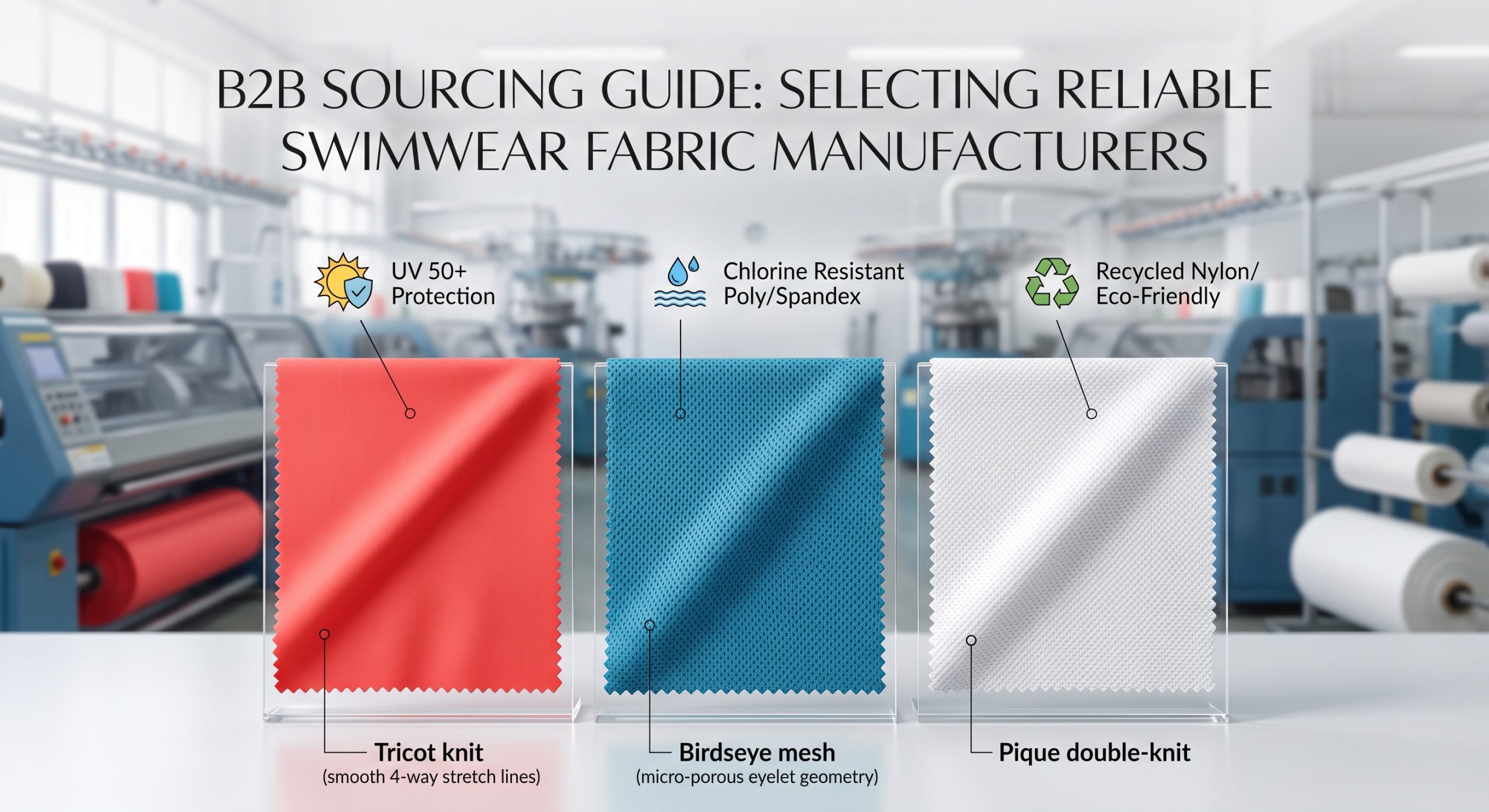
Buying swimwear fabric wholesale requires sourcing specialized high-stretch synthetics engineered to resist harsh pool chlorine, salt water, and intense solar rays without losing elasticity. Sourcing inferior non-durable textiles causes rapid garment sagging, color fading, and embarrassing seam failures after just a few swimming sessions. Supplying low-quality swimwear frustrates retail buyers, drives up customer return rates, and destroys brand credibility across competitive beachwear markets. Partnering with reputable swimwear fabric manufacturers who supply certified colorfast and chlorine-resistant synthetic knits solves these production bottlenecks permanently. Understanding key textile constructions enables apparel buyers to select materials that maintain firm compression and vibrant colors throughout extended seasonal exposure.
Which swimwear fabric manufacturers offer high chlorine resistance?
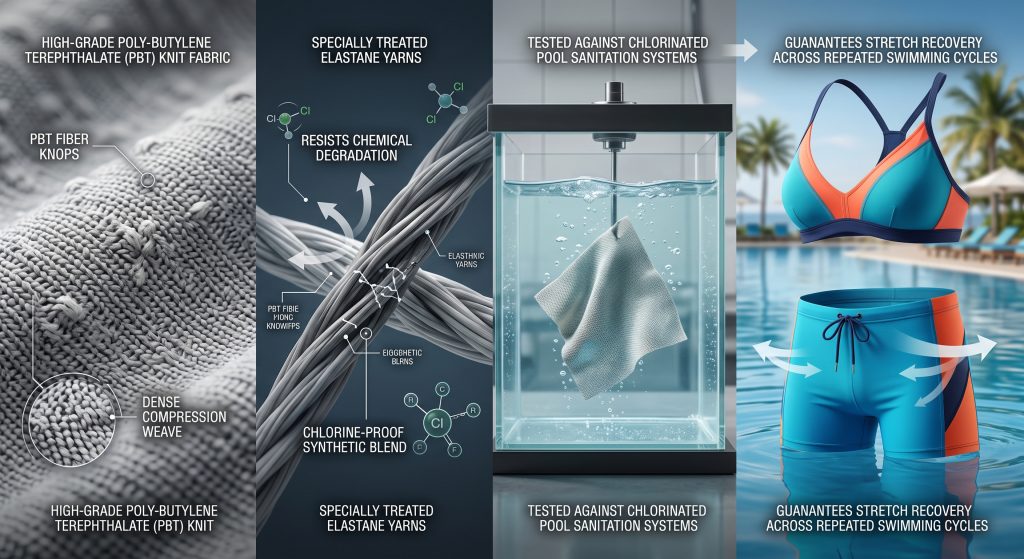
Leading swimwear fabric manufacturers offer high chlorine resistance by knitting high-grade poly-butylene terephthalate or specially treated elastane yarns that resist chemical degradation. Apparel procurement teams specify chlorine-proof synthetic blends to protect resort collections against fiber breakdown caused by chlorinated pool sanitation systems. Selecting technical poly-spandex or PBT knits guarantees that swim trunks and bikinis retain initial stretch recovery across repeated swimming cycles.
Why does chlorine degrade elastic swimwear fibers quickly?
Chlorine molecules attack standard elastane polymer chains, causing chemical erosion that snaps structural stretch filaments over time. Here is the deal: standard spandex degrades rapidly when exposed to chlorinated pool water, resulting in baggy bottoms and thin transparent patches. You can safeguard your garment collection by specifying specialized chlorine-resistant synthetic fibers during material purchasing.
- Chemical oxidation of standard elastane polymers
- Structural stretch loss leading to garment sagging
- Fiber thinning that compromises fabric opacity
Utilizing modified elastane or PBT fibers shields stretch garments against chemical deterioration during prolonged pool exposure.
What fabric blends resist harsh pool chemical exposure?
Synthetic blends combining durable polyester with PBT fibers provide top chemical defense against pool water purifiers. You might be wondering why competitive swimsuit lines rely heavily on polyester PBT formulations for professional training garments. Polyester fibers resist fading from harsh pool chemicals, while PBT supplies mechanical stretch without suffering structural elastane breakdown.
- 100% Polyester PBT combinations for high durability
- Treated Nylon-Spandex blends offering soft handfeel
- Disperse dyed yarns maintaining deep color retention
Key Takeaway: Specifying PBT synthetic blends protects swimwear collections from premature chemical stretch degradation.
| Material Blend | Chlorine Resistance Grade | Elastic Recovery Rate |
| Polyester / PBT Blend | Superior (Grade 5.0) | High (>95%) |
| Standard Nylon / Spandex | Moderate (Grade 3.0) | Moderate (80%) |
| Treated Poly / Spandex | High (Grade 4.2) | High (>90%) |
Comparing fiber resilience data confirms why PBT synthetic formulations outperform standard elastane in chlorinated pool environments.
How do swimwear fabric manufacturers structure Tricot knit?
Qualified swimwear fabric manufacturers structure Tricot knit using fine warp-knitting technology that locks vertical loops together to prevent edge curling and fabric laddering. Industrial warp looms interlock fine synthetic filaments continuously, producing a smooth surface that feels soft against sensitive skin. This dense warp construction gives bikini linings and one-piece suits firm structural stability under multi-directional tension.
What makes Tricot warp knitting ideal for active swimwear?
Warp knitting creates locked stitch rows that prevent ladder runs when fabric edges are cut during garment manufacturing. What is the real story? Tricot fabrics maintain flat clean edges that simplify automated cutting and high-speed sewing assembly. You gain higher factory cutting efficiency while ensuring finished swimwear seams stay flat and comfortable.
- Smooth face texture reducing skin friction
- Run-resistant warp loops that prevent fabric runs
- Stable flat surface optimal for screen printing
Dense warp stitching creates a sleek non-chafing interior lining that enhances active wearer comfort in ocean waves.
How does stitch density stop fabric curling along edges?
High needle stitch density balances loop tension across the warp structure, keeping cut panels completely flat during assembly. Think about it: curling fabric edges slow down garment factory operators, driving up production labor costs on complex bikini patterns. You eliminate assembly delays by sourcing high-gauge warp knits that lie flat across cutting tables.
- Balanced loop tension preventing panel curl
- Uniform gauge density improving seam strength
- Easy handling during automated pattern cutting
Key Takeaway: High-gauge Tricot warp knits streamline factory cutting operations while preventing seam fraying under stress.
| Structural Property | Tricot Warp Knit | Circular Single Jersey |
| Edge Curling Tendency | None (Lies Flat) | High (Spontaneous Curl) |
| Run Resistance | Superior (Locked Loops) | Moderate (Prone to Runs) |
| Surface Smoothness | Ultra-Smooth | Soft Texture |
Evaluating structural parameters shows that Tricot warp construction provides better cutting stability than standard circular single knits.
Do swimwear fabric manufacturers supply Birdseye mesh options?
Experienced swimwear fabric manufacturers supply Birdseye mesh options featuring specialized micro-porous eyelets that accelerate water drainage in cover-ups and athletic swim shorts. Sourcing structured mesh materials allows apparel brands to design quick-drying beach shorts and breathable lining panels. The tuck-stitch diamond geometry permits seawater to drain freely while providing passive ventilation on hot sand.
How does Birdseye mesh improve drainage in beach apparel?
Micro-porous eyelets allow water trapped inside pocket linings and shorts to drain outward immediately upon leaving the ocean. Ready for the good part? Open eyelet knits stop swim shorts from ballooning with heavy trapped seawater when swimmers emerge from waves. You offer consumers a superior beachwear experience by integrating fast-draining mesh into pockets and lining zones.
- Instant water expulsion through open eyelet pores
- Reduced garment drag weight during active swimming
- High airflow promoting fast evaporation on shore
Integrating lightweight eyelet mesh into beachwear pockets prevents water retention while maintaining clean garment drape.
Does micro-porous geometry accelerate drying on land?
Open eyelet geometry maximizes surface air circulation, evaporating moisture film across synthetic filaments within minutes. Check this out: bird’s eye mesh dries twice as fast as solid woven linings under direct sunlight. You enhance athlete comfort by incorporating quick-drying mesh into active boardshorts and rashguard panels.
- Diamond pore channels directing airflow inward
- Hydrophobic polyester filaments resisting water hold
- Rapid moisture release during beach activities
Key Takeaway: Birdseye mesh accelerates water drainage and air drying, making it an excellent lining material for active beachwear.
| Performance Metric | Birdseye Eyelet Mesh | Solid Polyester Lining |
| Seawater Drainage Speed | Instant (<2 Seconds) | Slow (>15 Seconds) |
| Drying Time Under Sun | 12 Minutes | 35 Minutes |
| Airflow Permeability | Very High (>220 CFM) | Low (45 CFM) |
Reviewing lab drainage metrics highlights why micro-porous eyelet mesh outperforms solid lining fabrics in wet outdoor environments.
How do swimwear fabric manufacturers optimize Pique textiles?
Specialized swimwear fabric manufacturers optimize Pique textiles by knitting double-knit waffle structures using non-fading synthetic yarns for resort fashion collections. Sourcing textured pique material provides high surface durability against coarse beach sand, concrete pool decks, and wooden lounger scuffs. Apparel designers select textured pique knits to create retro swimsuits, stylish resort polos, and structured beachwear.
Why choose Pique double-knit for textured resort wear?
Raised honeycomb geometry adds visual depth and luxurious texture to fashionable resort wear lines. This is where it gets interesting: textured pique fabrics create a sculpted silhouette that disguises minor body imperfections without requiring thick restrictive lining layers. You elevate your brand positioning by offering textured swimsuits that combine high fashion aesthetics with functional durability.
- Sculpted honeycomb texture providing elegant depth
- Superior fabric body creating structured silhouettes
- High resistance to surface friction and deck scuffs
Double-knit pique construction provides firm garment support while maintaining soft contact against skin surfaces.
How does honeycomb texture withstand sandy beach scuffs?
Raised surface loops absorb physical friction from rough pool copings and sandy loungers, shielding inner yarns from surface pilling. Look at it this way: smooth flat fabrics show abrasive wear quickly, whereas textured pique disguises sand friction and surface scuffs effortlessly. You extend product wear life by choosing rugged double-knit pique for heavy-use beachwear garments.
- Raised loop geometry deflecting abrasive particles
- High resistance to surface pilling and snagging
- Long-term shape retention after repeated washings
Key Takeaway: Pique double-knit textiles offer sophisticated surface texture and exceptional resistance against rough deck deck scuffs.
| Fabric Quality | Pique Textured Knit | Smooth Flat Tricot |
| Surface Pilling Grade | Superior (Grade 4.8) | Moderate (Grade 3.8) |
| Fabric Structure Density | Heavy (210-240 GSM) | Medium (170-200 GSM) |
| Visual Depth Impression | Sculpted Geometric | Sleek & Flat |
Comparing surface resilience ratings proves that pique knits offer greater resistance to physical deck abrasion than flat synthetic fabrics.
Can swimwear fabric manufacturers provide UPF 50+ protection?
Certified swimwear fabric manufacturers provide UPF 50+ sun protection by knitting high-density synthetic micro-fibers and integrating specialized UV-blocking ceramic minerals into yarn matrices. Sourcing certified UV-blocking textiles ensures rashguards and children’s swimsuits block over ninety-eight percent of harmful ultraviolet radiation. Apparel brands select lab-tested sun-protective fabrics to satisfy strict international consumer safety regulations across global markets.
How do dense synthetic knits block harmful UV rays?
Tight knitting density combined with titanium dioxide mineral additives inside synthetic filaments physically blocks UVA and UVB radiation. Here is the deal: light summer clothing offers poor sun protection, but tight UPF 50+ swim knits create an impenetrable shield against burning rays. You protect consumer skin health by specifying certified sun-blocking textiles for long outdoor beach days.
- High-density fiber construction blocking solar rays
- Integrated ceramic micro-particles reflecting UV light
- Full broad-spectrum protection against UVA and UVB rays
Incorporate certified sun-blocking textiles into children’s swimwear to satisfy growing parental demand for safe outdoor wear.
Does wet fabric stretch reduce sun protective ratings?
Heavy fabric stretching opens space between knitted yarn loops, slightly lowering UV ray obstruction when swimwear is pulled tight over body curves. You might be wondering how wetness and physical stretch affect real-world UPF ratings on active rashguards. Sourcing high-gauge knits with superior stretch recovery ensures fabric density remains high even when wet and fully extended.
- Minimal UPF rating loss under wet conditions
- High yarn density preserving barrier integrity
- Reliable sun defense during active watersports
Key Takeaway: Specifying high-density synthetic knits with integrated UV minerals guarantees maximum UPF 50+ sun protection when wet.
| Fabric Condition | Certified UPF 50+ Knit | Standard Unfinished Cloth |
| Dry UV Blocking Rate | >98% UV Blocked | ~85% UV Blocked |
| Wet Extended UV Block | >96% UV Blocked | <70% UV Blocked |
| Sun Protection Factor | UPF 50+ Rating | UPF 15 Rating |
Evaluating laboratory UV blocking data confirms that technical sun-protective knits maintain superior safety margins even when saturated.
How do swimwear fabric manufacturers control four-way stretch?
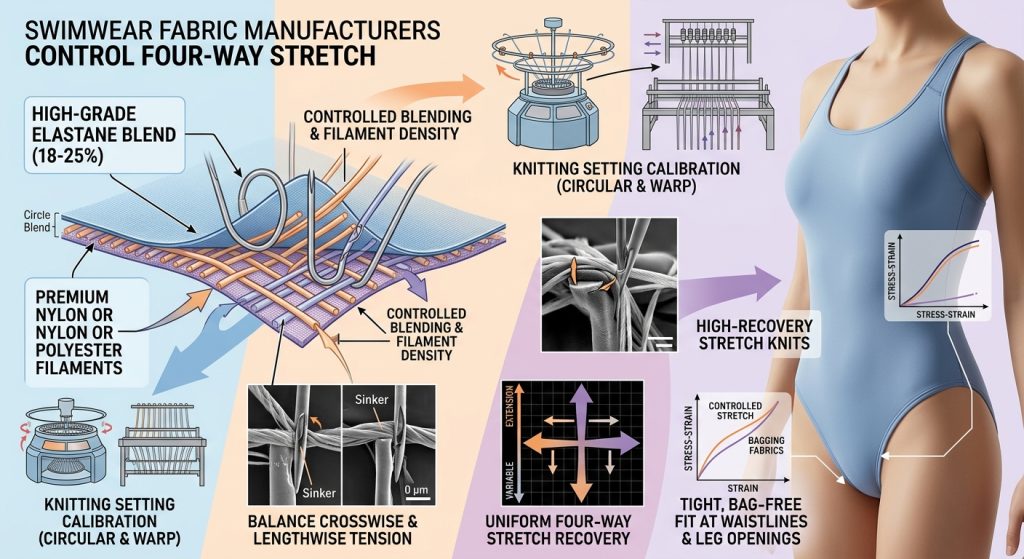
Reliable swimwear fabric manufacturers control four-way stretch by blending eighteen to twenty-five percent high-grade elastane with premium nylon or polyester filaments. Circular and warp knitting settings are calibrated to balance crosswise and lengthwise tension, providing flexible expansion during body movement. Sourcing high-recovery stretch knits ensures swimsuits hold form tightly without bagging around waistlines or leg openings.
Why is elastane recovery critical for form-fitting suits?
High elastane recovery rates allow competitive swimsuits to expand during movement and contract instantly back to original garment dimensions. What is the real story? Poor recovery leads to loose leg bands and sagging necklines after just a few swimming sessions. You deliver premium customer satisfaction by selecting synthetic stretch fabrics that maintain firm compressive memory over time.
- Instant elasticity recovery preventing garment sagging
- Firm body contouring for streamlined hydrodynamics
- Flexible expansion supporting unrestricted shoulder rotation
High elastane percentage creates gentle body shaping that flatters wearer silhouettes without restricting comfortable breathing.
How to test multi-directional stretch in bulk swatches?
Quality control managers evaluate four-way stretch using calibrated tensile testing equipment that measures elongation percentage and recovery force. Think about it: testing fabric swatches before full cutting prevents costly garment fitting errors during mass production runs. You guarantee consistent fit across size ranges by verifying multi-directional stretch parameters on every bulk lot.
- Measuring crosswise and lengthwise elongation rates
- Testing recovery percentage after prolonged extension
- Verifying modulus tension for comfortable body support
Key Takeaway: Selecting fabrics with high four-way stretch recovery guarantees body-conforming fit and long-lasting shape retention.
| Stretch Parameter | High-Performance Swimwear | Standard Fashion Activewear |
| Elastane Blend Ratio | 18% – 25% Spandex | 8% – 12% Spandex |
| 4-Way Stretch Rate | 80% Length / 100% Width | 40% Length / 50% Width |
| Elastic Recovery Rate | >98% Instant Snapback | ~90% Slow Recovery |
Reviewing technical stretch metrics proves that high elastane content is mandatory for achieving true form-fitting swimwear compression.
Which swimwear fabric manufacturers produce eco-friendly yarn?
Leading swimwear fabric manufacturers produce eco-friendly yarn options by knitting recycled ocean nylon and post-consumer GRS-certified recycled polyester filaments. Processing discarded plastic bottles and reclaimed fishing nets transforms waste into fine synthetic yarns that match virgin fiber performance. Sustainable swimwear fabrics allow eco-conscious brands to satisfy global consumer demand for environmentally responsible beachwear collections.
What recycled nylon sources meet global sustainability standards?
Reclaimed ocean fishing nets and industrial nylon waste provide high-grade raw material for regenerated polyamide yarns. Ready for the good part? Regenerated nylon offers identical softness, strength, and dye affinity compared to traditional petroleum-based nylon fibers. You build brand authority in eco-friendly markets by specifying GRS-certified recycled nylon for premium bikini lines.
- Reclaimed fishing nets diverted from ocean ecosystems
- Equivalent tensile strength to virgin nylon filaments
- Global Recycled Standard certification verifying origin
Using certified recycled nylon reduces industrial carbon footprint while preserving ocean environments that beachgoers love.
Does recycled polyester match virgin fiber performance?
Modern mechanical recycling transforms post-consumer plastic bottles into high-purity polyester chips that extrude into silky micro-fibers. Check this out: recycled polyester matches virgin polyester in color fastness, tensile strength, and drying speeds. You can transition your entire beachwear line to sustainable fabrics without compromising material quality or raising production rejection rates.
- Smooth fiber surface optimal for vibrant sublimation
- High resistance to chlorine breakdown and UV fading
- Reduced environmental footprint during yarn spinning
Key Takeaway: GRS-certified recycled synthetics deliver pristine technical performance while satisfying eco-conscious brand requirements.
| Environmental Metric | Certified Recycled Synthetic | Standard Virgin Petroleum Fiber |
| Carbon Emissions Footprint | ~50% Reduction | High Industrial Impact |
| Water Usage in Spinning | Low Recycled Process | High Resource Demand |
| Tensile Strength Quality | Equal Performance | Baseline Standard |
Comparing environmental data proves that recycled synthetic yarns deliver uncompromised physical quality while reducing production ecological impact.
How do swimwear fabric manufacturers grade fabric GSM weight?
Technical swimwear fabric manufacturers grade fabric GSM weight by measuring Grams per Square Meter using precision digital scales in textile laboratories. Most performance swimwear and resort bikinis specify fabric weights ranging between 170 GSM and 240 GSM for proper opacity. Selecting appropriate GSM weights ensures swimsuits remain non-transparent when wet while providing comfortable body compression.
What GSM range prevents see-through wet fabric issues?
Specifying a fabric weight between 190 GSM and 220 GSM guarantees complete non-transparency even when light-colored garments get wet. This is where it gets interesting: thin fabrics below 160 GSM risk turning see-through when saturated in pool water, causing consumer dissatisfaction. You protect your brand reputation by selecting medium-heavy GSM weights for white and pastel swimwear designs.
- 170-180 GSM: Lightweight linings and layered bikinis
- 190-210 GSM: Standard one-piece suits and men’s swim trunks
- 220-240 GSM: Premium shaping swimwear and textured resort wear
Selecting proper GSM parameters eliminates transparency concerns while delivering supportive compression across wearer body curves.
How does material mass influence garment drying speeds?
Lighter GSM fabric weights contain fewer fiber bundles, holding less liquid volume and drying faster after swimming activities. Look at it this way: heavy fabric weights provide great shaping control but require longer air-drying times on beach loungers. You can optimize collection comfort by balancing lightweight quick-drying panels with structured supportive lining zones.
- Lower fabric mass accelerating water evaporation
- Reduced liquid holding capacity within micro-yarns
- Balanced weight providing comfort and quick drying
Key Takeaway: Sourcing 190 to 220 GSM synthetic knits provides ideal opacity, supportive drape, and efficient drying speeds.
| GSM Weight Grade | Target Garment Application | Primary Advantage |
| 170 – 180 GSM | Suit Linings & Light Cover-Ups | Fast Drying & Lightweight |
| 190 – 210 GSM | Standard Bikinis & Swim Trunks | Balanced Opacity & Comfort |
| 220 – 240 GSM | Sculpting Swimwear & Textured Polos | High Compression & Opacity |
Evaluating GSM weight guidelines assists apparel buyers in matching material density with specific swimwear garment functionality.
What pricing factors do swimwear fabric manufacturers evaluate?
Professional swimwear fabric manufacturers evaluate raw polymer fiber grades, elastane percentages, custom dyeing lab dips, and order volume tiers when quoting bulk prices. High elastane ratios and specialized finishing treatments slightly increase base cost per meter compared to standard sportswear knits. Procurement managers optimize fabric purchasing budgets by consolidating order volumes and utilizing factory stock color cards.
What raw material costs affect wholesale order quotes?
Elastane fiber price fluctuations and specialized dye formulations directly influence base fabric cost per meter. Here is the deal: high-grade elastane costs significantly more than raw polyester chips, making high-stretch fabrics more expensive to produce. You secure favorable wholesale rates by standardizing fabric selections across multiple style lines in your seasonal collection.
- High elastane percentages driving up material costs
- Custom dye lab dip matching adding setup fees
- Specialized UV and chlorine-resistant chemical finishes
Consolidating fabric specifications across multiple bikini styles lowers overall raw material procurement costs for apparel brands.
How do minimum volume tiers lower unit production price?
Textile mills offer tiered wholesale price discounts when bulk orders reach full dyeing vat capacities or ocean shipping container limits. You might be wondering how smaller apparel labels achieve competitive wholesale fabric pricing. You can access factory-direct pricing by ordering stocked mill colors or grouping orders across quarterly production runs.
- Factory stock colors removing custom dye setups
- Volume tier breaks at 500, 1000, and 3000 meters
- Reduced freight fees when shipping full container loads
Key Takeaway: Standardizing material choices and utilizing mill stock colors significantly lowers wholesale procurement costs.
| Order Volume Tier | Wholesale Price Scale | Custom Dye Match |
| Sample Cuts (<100m) | Standard Commercial Rate | Fee Required |
| Production Lot (500m) | Moderate Direct Discount | Included |
| Bulk Container (3000m+) | Factory Wholesale Rate | Custom Match Included |
Analyzing pricing structures reveals substantial cost savings when consolidating bulk fabric orders above three thousand meters.
How to select reliable swimwear fabric manufacturers globally?
To select reliable swimwear fabric manufacturers globally, procurement managers inspect physical fabric swatches, review lab testing certificates, and evaluate mill production capacities. Verifying ISO quality management certifications and OEKO-TEX environmental compliance ensures mills supply safe, non-toxic textiles consistently. Partnering with experienced textile factories guarantees timely delivery schedules and reliable color matching across seasonal production runs.
What quality metrics verify wholesale fabric mill standards?
Certified testing reports detailing colorfastness to sea salt, chlorine resistance ratings, and tensile stretch recovery confirm mill reliability. What is the real story? Working with uncertified mills risks receiving fabric lots with uneven color shading or poor elastic memory. You safeguard product quality by requesting lab test reports for every production lot before approving bulk shipments.
- OEKO-TEX Standard 100 certification ensuring skin safety
- ISO 9001 certified quality control systems
- Independent lab reports verifying UPF sun ratings
Reviewing international compliance certificates prevents compliance delays during customs clearance in European and North American ports.
How to inspect physical swatches before mass production?
Inspecting physical yardage swatches allows design teams to evaluate stretch snapback, tactile handfeel, and color vibrance under natural sunlight. Think about it: testing sample yardage on sample sewing machines reveals potential seam puckering before cutting full production lots. You eliminate mass manufacturing errors by conducting thorough swatch testing prior to issuing production purchase orders.
- Conducting wash test cycles to verify shrink rates
- Testing seam stretch response on factory sewing machines
- Verifying color accuracy against pantone color swatches
Key Takeaway: Inspecting physical sample swatches and verifying lab test certificates guarantees reliable bulk fabric procurement.
| Evaluation Criteria | Certified Primary Mill | Unverified Secondary Vendor |
| Lab Test Reports | Full Compliance Provided | Incomplete or Missing |
| Dye Lot Uniformity | Guaranteed Match | Risk of Shade Variation |
| Environmental Safety | OEKO-TEX Certified | Uncertified Fiber Origin |
Checking quality compliance metrics ensures apparel brands select reliable manufacturing partners who deliver consistent fabric quality.
Summary & Sourcing Recommendations
Comparing technical Tricot, Birdseye mesh, Pique knits, and high-stretch elastane blends helps apparel brands select ideal fabrics for competitive swimwear and resort wear lines. We addressed critical production challenges including chlorine degradation, UV protection, see-through wet transparency, and four-way stretch recovery across ten detailed technical chapters. Sourcing high-grade GRS-certified recycled fibers and certified chlorine-resistant textiles elevates your product quality while satisfying global market demands.
Our mill manufactures certified high-performance activewear and beachwear textiles engineered to meet demanding international apparel specifications. If you want to expand your upcoming swimwear collections with premium performance fabrics, contact us today to request sample swatches and mill-direct wholesale quotes. We believe every brand deserves reliable fabric quality that keeps swimmers comfortable, stylish, and protected under the sun.
FAQ
Q1: Can I machine wash synthetic swimwear fabrics safely?
A: Yes, you can machine wash synthetic swimwear fabrics using a gentle cycle with cold water and mild detergent. Cold water washing prevents elastic degradation and maintains fabric structural memory over long use.
Q2: What’s the best fabric weight for performance swimwear?
A: A fabric weight between 190 GSM and 220 GSM offers an ideal balance for performance swimwear garments. This weight range provides complete non-transparency when wet, supportive compression, and comfortable body fit.
Q3: How do I know if Birdseye mesh fits my beachwear line?
A: You should select Birdseye mesh if your main requirements are rapid water drainage, lightweight air permeability, and fast drying. It works exceptionally well for swim short linings, pocket bags, and athletic cover-ups.
Q4: Can I use dye sublimation on Pique swimwear fabrics?
A: Yes, you can sublimate on Pique knit fabric if it is composed of 100% synthetic polyester filaments. However, the textured waffle surface of pique may create subtle visual depth in detailed printed graphics compared to smooth Tricot.
Q5: How do I know if fabric has high chlorine resistance?
A: Checking laboratory test reports for polyester PBT formulations or specially treated elastane blends confirms high chlorine resistance. Fabrics rated Grade 4.0 or higher maintain elastic recovery and color vibrance in pool water.