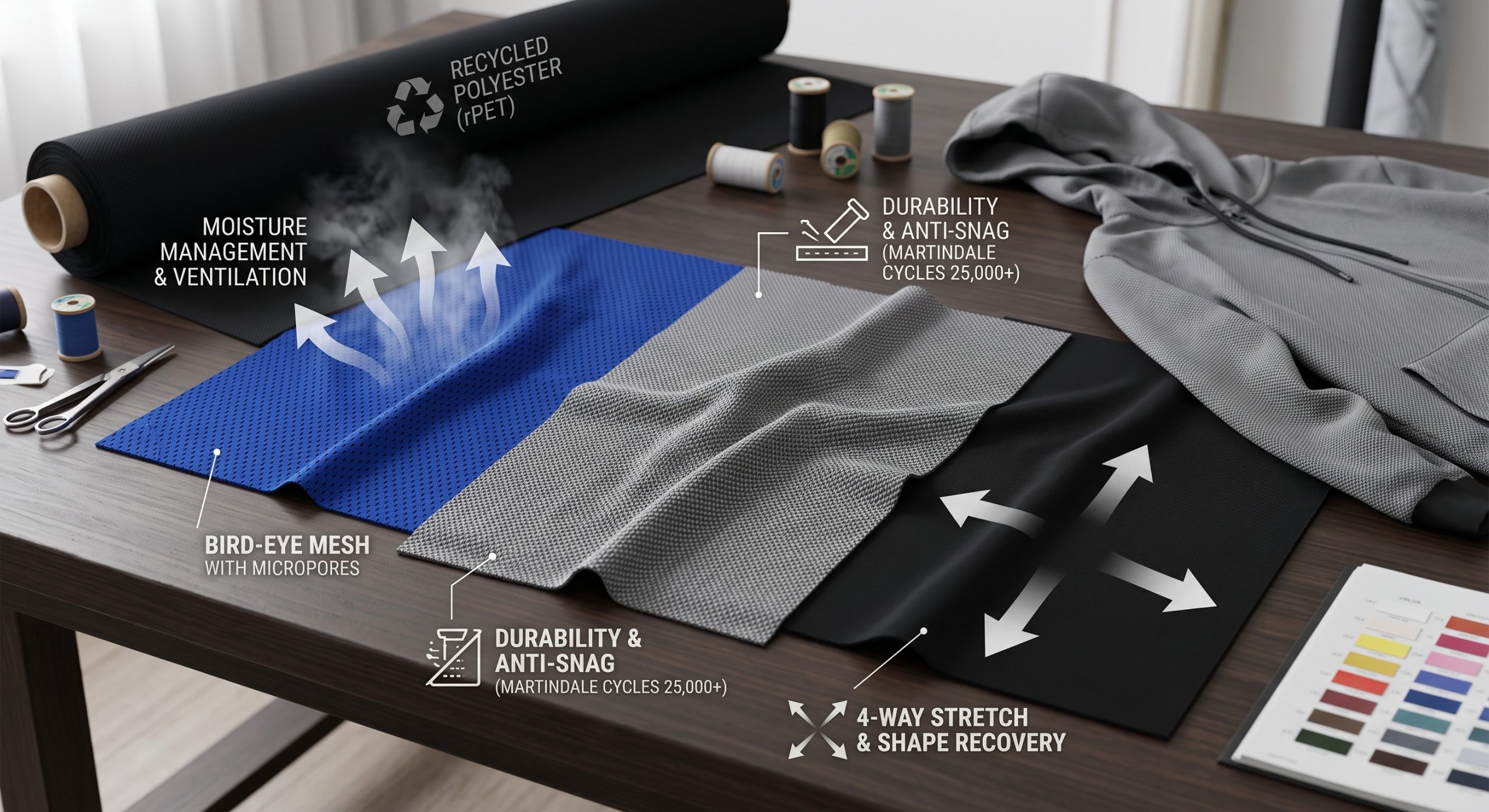
High-performance synthetic polyester and nylon blends with micro-porous or textured knits represent the best knitted fabric for athleisure wear. Apparel brands frequently face severe customer returns when everyday workout clothes sag, trap sweat, or pill after minimal washing cycles. Poorly constructed fabrics cling to overheated skin during workouts and lose their silhouette during casual street wear. Sourcing technical knitted fabric for athleisure with balanced elasticity and rapid moisture evaporation solves these performance problems directly.
1. What Defines Modern Knitted Fabric for Athleisure?
Modern knitted fabric for athleisure relies on engineered synthetic micro-knits that combine multi-directional stretch with rapid moisture transport. Selecting high-grade knitted fabric for athleisure allows apparel creators to manufacture versatile garments suitable for gym training and everyday lifestyle wear.
Textile mills construct synthetic knits that maintain structural memory without degrading under continuous stretch stress. Choosing certified technical knits prevents seam blowout and surface bagging across demanding wear cycles.
What Performance Demands Do Active Wearers Face?
Active lifestyles demand textiles capable of handling intense gym movement alongside casual all-day relaxation. You need fabrics that resist pulling at high-tension seams while flattering natural body contours.
Here is the deal: active garments must stretch smoothly across shoulders and hips without becoming see-through.
- Multi-directional elasticity allows unrestricted movement during floor workouts.
- High yarn tenacity protects flatlock seams during deep stretching.
- Structural recovery prevents sagging at knees and elbows throughout long days.
How Does Dynamic Moisture Management Function?
Engineered filament cross-sections pull perspiration drops outward through continuous capillary pathways. Liquid disperses across the cloth surface where ambient air evaporates wet spots in minutes.
What is the real story? Hydrophobic synthetic fibers reject internal water absorption, keeping apparel featherlight during cardio sessions.
- Rapid capillary action transports sweat away from skin surface pores.
- Broad surface dispersion accelerates ambient evaporation in busy environments.
- Synthetic yarn bundles eliminate soggy garment weight during active commutes.
Key Takeaway: Specifying capillary-engineered synthetic knits eliminates sweat pooling and preserves total comfort throughout hybrid daily routines.
| Metric Parameter | Basic Combed Cotton | Advanced Synthetic Knit |
| Moisture Retention | 8.5% Base Weight | Under 0.4% Base Weight |
| Evaporation Duration | 110 Minutes | 15 Minutes |
| Wet Tensile Tenacity | Weakens by 15% | Retains 100% Strength |
Laboratory testing shows synthetic filament matrices evaporate moisture seven times faster than natural fibers.
2. Why Choose Knitted Fabric for Athleisure Apparel?
Apparel brands select knitted fabric for athleisure because flexible loop structures deliver superior comfort, drape, and shape retention compared to rigid wovens. Knitted loops expand naturally alongside dynamic muscle extension, providing tailored silhouettes that move effortlessly with the wearer.
Manufacturers specify synthetic knit structures to balance wholesale production costs against rigorous laundering demands. Texturized synthetic filaments provide supple softness while keeping garments resilient across hundreds of home washes.
Why Do Synthetic Polymers Outperform Pure Cotton?
Pure cotton yarns trap heavy moisture within hollow fiber walls during continuous physical movement. Saturated cotton apparel sticks uncomfortably against sweaty skin, generating painful friction across underarms and thighs.
Look at the facts: wet natural fibers lose structural tension and shrink unpredictably inside standard drying appliances.
- Cotton traps liquid weight, making garments heavy during long workouts.
- Damp fabric creates abrasive skin friction during repetitive movement.
- Repeated wash cycles cause severe dye fading across dark lifestyle palettes.
How Do Elastane Blends Alter Garment Elasticity?
Knitting spandex filaments into synthetic base yarns introduces reliable four-way elasticity and instant mechanical recovery. This elastic resilience helps activewear hug the body comfortably without restricting normal breathing patterns.
Think about this: adding eight to twelve percent elastane prevents athletic leggings from bagging out around knees.
- High elastic recovery preserves clean garment silhouettes after full-day wear.
- Form-fitting compression supports muscle recovery during strenuous training.
- Flexible loop configurations accommodate natural body contours without binding.
Key Takeaway: Blending durable synthetic polymers with flexible elastane prevents garment bagging while securing active shape recovery.
| Fiber Composition | Elastic Recovery Rate | Moisture Retention | Target Garment Application |
| 100% Synthetic Polyester | Moderate (86%) | Negligible (<0.5%) | Lightweight Workout Tops |
| 88% Poly / 12% Spandex | High (98%) | Low (<1.0%) | Compression Tights & Bras |
| 100% Combed Cotton | Low (50%) | High (8.0% – 10.0%) | Casual Graphic Tees |
Mechanical testing proves poly-spandex blends deliver complete shape retention while resisting sweat accumulation.
3. How Does Bird-Eye Knitted Fabric for Athleisure Work?
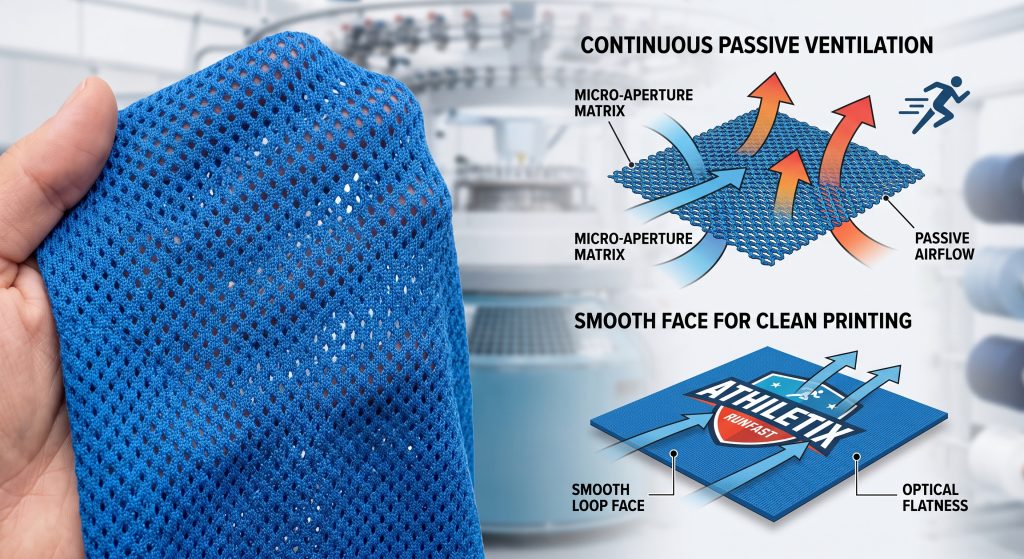
Bird-eye knitted fabric for athleisure features miniature tuck-stitch pores that promote continuous passive ventilation across the body. Sourcing knitted fabric for athleisure in bird-eye patterns gives brands a featherlight textile ideal for high-aerobic training tops and running singlets.
The geometric micro-hole matrix allows hot air to vent continuously without exposing the athlete skin underneath. Designers appreciate this weave because it combines open airflow with an exceptionally smooth face for clean printing.
What Creates the Distinct Pinhole Mesh Geometry?
Circular knitting machinery drops designated needles during continuous cylinder rotations to form open eyelet clusters. These miniature openings create an airy structural grid across the fabric without weakening overall tear resistance.
Here is the deal: the eyelet array breaks boundary heat layers around active bodies to accelerate direct cooling.
- Micro-aperture patterns maximize convective air movement across sweat zones.
- Tuck-stitch loops preserve longitudinal fabric strength against snagging.
- Smooth face yarns support crisp digital printing and silicone logo bonding.
Why Does Micro-Pore Bird-Eye Dry Out So Rapidly?
Miniature surface holes expand the functional area exposed to room air during daily movement. Sweat guided toward pore perimeters meets continuous air circulation, evaporating wet spots in record time.
What is the real story? Thin yarn cross-sections prevent sweat from accumulating inside intermediate knit valleys.
- Open hole rims serve as active evaporation zones across the torso.
- Featherlight yarn bundles eliminate wet fabric pooling during cardio workouts.
- Rapid drying keeps workout tops comfortable during transitions to street wear.
Key Takeaway: Specifying bird-eye micro-mesh provides continuous cooling ventilation and lightning-fast dry times for high-sweat activities.
| Fabric Structure | Air Permeability | Dry Time (5ml Moisture) | Surface Tactile Touch |
| Bird-Eye Micro-Mesh | 195 CFM | 12 Minutes | Silky Smooth Matte |
| Flat Solid Interlock | 60 CFM | 28 Minutes | Ultra-Smooth Gloss |
| Open Heavy Mesh | 320 CFM | 10 Minutes | Textured Semi-Rough |
Air permeability data demonstrates how bird-eye knits deliver generous airflow while preserving opaque body coverage.
4. Why Pick Pique Knitted Fabric for Athleisure Lines?
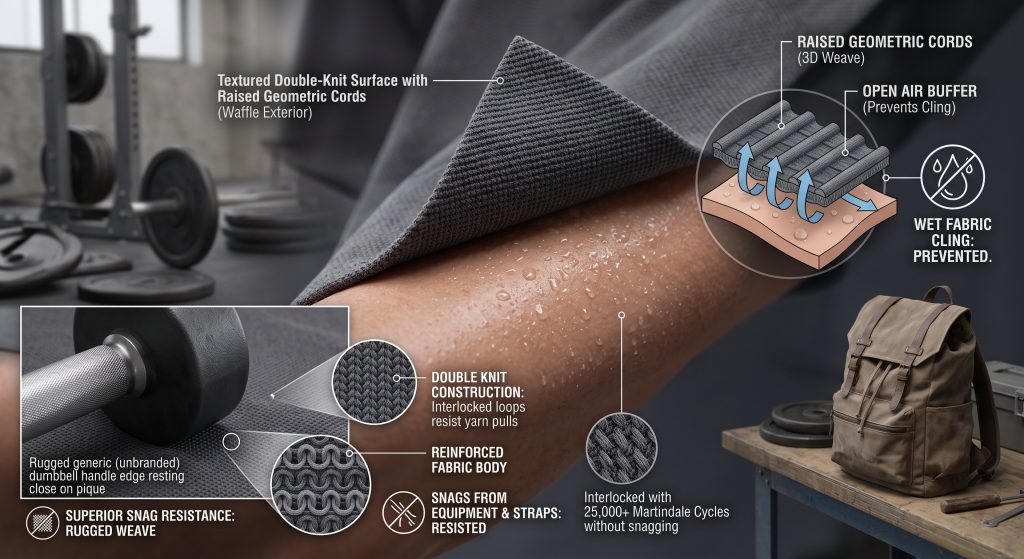
Pique knitted fabric for athleisure offers a textured double-knit surface with raised geometric cords that lift the cloth away from sweaty skin. This physical spacing creates an open air buffer that prevents wet fabric clinging during humid training conditions.
Apparel brands select pique textiles for sporty polos, structured jackets, and training bottoms due to its superior snag resistance. The sturdy waffle exterior resists yarn pulls from gym equipment edges and rough backpack straps.
How Do Raised Geometric Cords Prevent Skin Cling?
Double-knit pique machinery alternates knit and tuck loops to produce a distinct three-dimensional waffle relief. Only the raised geometric nodes make direct contact with skin, leaving open air channels in the recessed valleys.
Think about this: continuous micro-grooves between fabric ridges allow vapor to escape before saturating garment yarns.
- Raised geometric nodes minimize direct skin contact surface area.
- Recessed structural channels preserve airflow across warm muscle groups.
- Three-dimensional patterns eliminate damp fabric clinging during intense workouts.
What Makes Pique Weave Ideal for Durable Bottoms?
Interlocking double-knit yarns bind multiple thread layers into a firm, puncture-resistant textile package. This tight construction protects garments against surface fraying during outdoor training or casual travel.
Ready for the good part? Pique preserves clean garment drape and crisp tailored lines through countless laundering cycles.
- Interlocked loop systems resist snagging along abrasive gym surfaces.
- Substantial fabric mass provides structured silhouette drape for athleisure joggers.
- Robust exterior cords resist surface scuffing during active commuting.
Key Takeaway: Choosing double-knit pique provides rugged anti-snag durability and clean structured drape for heavy-wear athleisure pieces.
| Structural Feature | Single Jersey Knit | Bird-Eye Knit | Double Pique Knit |
| Snag Resistance | Low (Prone to Runs) | Moderate | High (Interlocked Cords) |
| Skin Contact Feel | Flat & Continuous | Smooth Micro-Pores | Raised 3D Texture |
| Fabric Body & Drape | Very Light & Loose | Soft & Flowing | Structured & Firm |
Structural assessments prove double pique provides the ideal body and durability for tailored athleisure bottoms.
5. Which Knitted Fabric for Athleisure Has Better Feel?
Bird-eye knit delivers a silky, weightless glide against bare skin, while pique provides a crisp, structured touch with minimal fabric-to-skin adhesion. Sourcing knitted fabric for athleisure requires matching tactile touch and air permeability to your line intended use.
Active training tops require supple softness to avoid chafing, whereas lifestyle joggers demand heavier structural heft. Product managers evaluate these tactile nuances to build harmonious apparel collections.
How Do Surface Textures Differ Against Bare Skin?
Bird-eye cloth uses fine micro-denier yarns that slide effortlessly across shoulders without creating abrasive friction. Pique knits present a firmer, textured honeycomb feel that feels substantial and crisp in your hands.
Look at the facts: wearers engaging in repetitive cardio movements consistently prefer the smooth glide of bird-eye knits.
- Bird-eye delivers a silky, low-friction glide across athletic torsos.
- Pique provides a dry, textured hold that avoids wet fabric suction.
- Brushed interior finishes soften synthetic loops for all-day skin comfort.
Which Knit Delivers Maximum Cooling Ventilation?
Bird-eye fabrics provide substantially higher through-flow ventilation due to direct micro-apertures piercing the cloth face. Pique breathes through permeable yarn gaps rather than open pores, offering balanced airflow with slight thermal insulation.
What is the real story? Direct air movement through bird-eye pores lowers skin temperatures rapidly during high-intensity intervals.
- Open pinhole geometry in bird-eye maximizes active cooling during cardio.
- Pique structures regulate heat retention for transitional warmup jackets.
- Controlled yarn deniers balance surface softness against durable wear life.
Key Takeaway: Pairing bird-eye mesh for lightweight tops with pique knits for bottoms optimizes both wearer cooling and garment lifespan.
| Performance Attribute | Bird-Eye Micro-Mesh | Double Knit Pique | Recommended Garment |
| Tactile Skin Friction | Low (Silky Smooth) | Medium (Textured Grid) | Tops vs Bottoms |
| Thermal Dissipation | Fast Active Cooling | Moderate Thermal Flow | Tees vs Warmup Jackets |
| Fabric Density Range | 140 – 180 GSM | 200 – 280 GSM | Light Tops vs Heavy Joggers |
Tactile comparison data helps apparel teams allocate the exact knit construction to specific athleisure silhouettes.
6. What Weight Knitted Fabric for Athleisure Works Best?
Ideal knitted fabric for athleisure weighs between 140 and 180 GSM for lightweight tops, and between 200 and 280 GSM for structured bottoms. Specifying correct gram weights prevents see-through tops while keeping pants from feeling uncomfortably heavy or stiff.
Selecting improper textile weights creates noticeable garment flaws, producing flimsy shirts or rigid leggings that restrict agility. Textile engineers balance yarn weight to achieve perfect garment drape during active motion.
When Should You Specify 140 to 180 GSM Knits?
Lightweight fabrics falling between 140 and 180 GSM provide unrestricted upper-body mobility and rapid sweat evaporation. This weight range keeps workout shirts airy without compromising seam pull strength during intense workouts.
Here is the deal: lighter jersey textiles conserve energy by eliminating bulky fabric drag during daily routines.
- 140 GSM delivers ultra-light agility for high-sweat running tees.
- 165 GSM provides dependable non-see-through coverage for light lifestyle tops.
- Balanced weights support clean collar construction without neckline distortion.
Why Choose 200 to 280 GSM for Structured Bottoms?
Athleisure leggings and joggers require heavier knit weights between 200 and 280 GSM to endure friction, bending, and waistband strain. Dense yarn construction guarantees complete opacity during deep squats under bright gym lighting.
What is the real story? High yarn density prevents athleisure bottoms from showing skin or tearing along seat seams.
- 220 GSM ensures complete non-see-through squat-proof performance in leggings.
- Dense knits anchor wide elastic waistbands and pockets securely.
- Heavier drape maintains a clean tailored silhouette for streetwear transitions.
Key Takeaway: Specifying 160 GSM for lifestyle tops and 240 GSM for leggings achieves ideal balance between breathability and squat-proof opacity.
| Garment Style | Target GSM Range | Recommended Weave | Functional Benefit |
| Active Workout Tees | 140 – 180 GSM | Bird-Eye / Fine Jersey | Maximum Agility & Cooling |
| Squat-Proof Leggings | 220 – 280 GSM | Interlock / Dense Rib | Total Opacity & Muscle Hold |
| Transitional Hoodies | 260 – 320 GSM | Pique / French Terry | Structured Drape & Warmth |
Weight specification charts guide production teams toward the ideal square-meter density for every athleisure category.
7. Can Knitted Fabric for Athleisure Handle Sublimation?
Synthetic knitted fabric for athleisure handles digital dye sublimation flawlessly because heat opens polyester molecular chains to lock in disperse dyes permanently. Sourcing knitted fabric for athleisure optimized for sublimation allows brands to print vivid patterns that never peel, crack, or fade.
Digital printing preserves the fabric original softness and breathability without adding thick rubbery ink deposits. Sportswear brands rely on this method to execute intricate fashion prints and subtle tonal graphics.
Why Is Synthetic Composition Required for Printing?
Sublimation inks convert directly into gas under heat press temperatures exceeding 200 degrees Celsius to fuse inside polyester yarns. Natural cotton fibers cannot bond with disperse gas dyes, producing faded colors and rapid wash fading.
Think about this: molecular dye integration locks pigment inside yarn cores without adding surface weight.
- Pure synthetic content guarantees vibrant color reproduction across all design palettes.
- Molecular dye bonding preserves 100% of the native knit breathability.
- Sublimated graphics will never crack, peel, or stiffen under intense body heat.
How Do Mesh Pores Impact Graphic Sharpness?
Surface texture directly influences print resolution and fine graphic sharpness on finished athleisure apparel. Smooth micro-interlock knits hold razor-sharp edges, whereas open bird-eye pores create a subtle textured pattern.
Ready for the good part? High-density micro bird-eye knits combine crisp print resolution with high through-pore ventilation.
- Tight surface loops prevent fine artwork lines from blurring at borders.
- Controlled pore spacing maintains consistent graphic alignment across flatlock seams.
- Heat-set finishing prevents pore distortion during high-pressure sublimation pressing.
Key Takeaway: Sourcing high-purity polyester knits with smooth face loops ensures photographic sublimation clarity without blocking airflow.
| Graphic Method | Color Permanence | Breathability Impact | Tactile Hand Feel |
| Digital Dye Sublimation | Lifetime Colorfastness | Zero Airflow Loss | Undetectable Ink Feel |
| Screen Printing Paste | Cracks After 30 Washes | Clogs Venting Pores | Heavy Rubberized Layer |
| Direct-To-Film (DTF) | Moderate Durability | Partial Breathability Loss | Noticeable Plastic Film |
Sublimation printing proves superior for athleisure by delivering lifetime print durability without hindering natural fabric stretch.
8. Is Recycled Knitted Fabric for Athleisure Durable?
Recycled polyester and nylon knitted fabric for athleisure matches virgin synthetic yarn in tensile strength, elasticity, and moisture management. Modern recycling facilities purify post-consumer plastic bottles into high-grade spinning chips with zero mechanical performance loss.
Eco-conscious activewear brands specify recycled yarns to meet corporate sustainability goals without sacrificing garment durability. Modern lifestyle buyers actively reward brands that combine environmental responsibility with professional garment performance.
How Do Recycled Fibers Match Virgin Polymers?
Advanced mechanical recycling processes clean, shred, and melt consumer plastics into purified spinning chips. Precision extrusion nozzles draw these recycled chips into microfibers that match virgin polymers in yarn tenacity.
Look at the facts: certified recycled polyester yarn achieves identical dye absorption, heat resistance, and surface smoothness.
- Recycled polymers divert post-consumer plastic waste away from oceans and landfills.
- Identical melting points support standard sublimation print workflows.
- Extrusion consistency eliminates yarn diameter variations across production rolls.
Can Eco-Friendly Yarns Pass Bursting Tests?
Certified rPET and recycled nylon fabrics undergo strict hydraulic bursting and tensile pull evaluations prior to bulk production. The interlocked knit loops resist extreme pulling without yarn fracture or seam breakage.
Here is the deal: standardized laboratory testing confirms recycled textiles handle rigorous training stress just as reliably as virgin synthetics.
- Hydraulic bursting strength matches virgin polymer benchmarks.
- Yarn tensile elasticity delivers reliable full-stretch recovery during gym routines.
- Anti-pilling resistance achieves grade four ratings on standard Martindale scales.
Key Takeaway: Sourcing certified recycled synthetic knits empowers activewear brands to market sustainable apparel while guaranteeing premium durability.
| Quality Spec | Virgin Polyester (PET) | Recycled Polyester (rPET) | Performance Variance |
| Carbon Emissions | High Virgin Petrochemical | 45% Lower CO2 Output | Substantial Eco Advantage |
| Warp Tensile Force | 420 N Breaking Limit | 415 N Breaking Limit | Under 1.5% Difference |
| Sublimation Color Match | 100% Target Delta-E | 99.5% Target Delta-E | Visually Indistinguishable |
Comparative test data confirms recycled synthetic knits deliver identical mechanical performance to virgin polymers.
9. How to Test Knitted Fabric for Athleisure Quality?
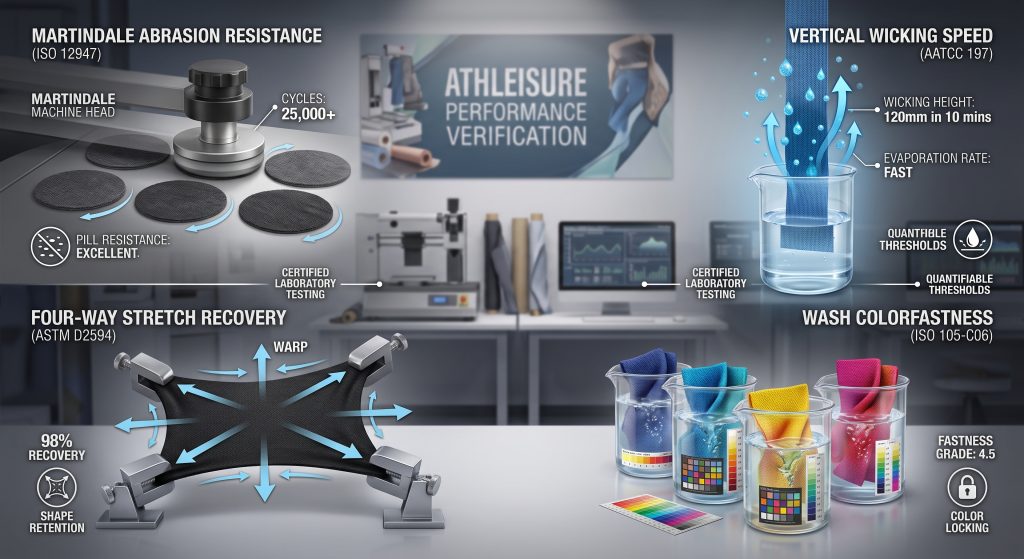
Testing knitted fabric for athleisure quality requires measuring Martindale abrasion resistance, vertical wicking speed, four-way stretch recovery, and wash colorfastness in certified laboratories. Verifying knitted fabric for athleisure with standardized laboratory reports protects your business from costly product defects and negative reviews.
Quality inspection protocols evaluate mechanical integrity before bulk fabric rolls ship from the knitting mill. Quantifiable test thresholds ensure production garments withstand demanding daily use.
What Does Martindale Abrasion Testing Reveal?
Martindale testing rubs circular abrasive wool pads against fabric samples under precise oscillating mechanical pressure. This test reveals how many thousand rubbing cycles an activewear fabric can endure before fibers fuzz or develop unsightly pilling.
What is the real story? Athleisure fabrics must withstand at least twenty thousand Martindale cycles to avoid pilling between thighs or under arms.
- High abrasion scores guarantee fabrics resist friction from backpacks and gym gear.
- Standardized friction cycles detect weak yarn spinning batches before sewing.
- Anti-pilling validation keeps active lifestyle garments looking fresh across seasons.
How Is Vertical Moisture Wicking Verified?
Vertical wicking tests immerse fabric sample ends into distilled water to record how high moisture climbs within ten minutes. Rapid upward climb proves capillary knit pathways pull sweat away from skin during physical exertion.
Think about this: high-performance active knits transport liquid upward over one hundred millimeters within a ten-minute test.
- Fast vertical wicking confirms moisture movement across active muscle groups.
- Horizontal drop tests measure how swiftly moisture disperses across surface pores.
- Evaporation speed measurements confirm rapid drying in everyday environments.
Key Takeaway: Demanding certified Martindale abrasion and vertical wicking laboratory data prevents defective activewear production batches.
| Inspection Standard | Minimum Pass Threshold | Premium Industry Benchmark | Test Objective |
| Martindale Abrasion (ISO 12947) | 15,000 Cycles | 25,000+ Cycles | Evaluates Anti-Pilling Durability |
| Vertical Wicking (AATCC 197) | 60 mm / 10 Min | 110 mm / 10 Min | Verifies Moisture Movement Speed |
| Wash Colorfastness (ISO 105-C06) | Grade 3.5 | Grade 4.5+ | Prevents Dye Bleeding & Fading |
Technical inspection data verifies that bulk fabric shipments meet demanding commercial activewear performance benchmarks.
10. How to Buy Knitted Fabric for Athleisure in Bulk?
Buying knitted fabric for athleisure in bulk requires partnering directly with specialized knitting mills that offer custom Pantone dye matching and verified laboratory inspection sheets. Establishing direct mill partnerships secures volume wholesale pricing and shortens production lead times for expanding sportswear catalogs.
Apparel brands need reliable textile mills that maintain strict color consistency across multiple seasonal reorders. Clear technical specifications prevent mismatched dye lots between tops and bottoms in matching athleisure sets.
What Minimum Order Quantities Apply to Mill Rolls?
Textile mills typically require minimum order quantities ranging between three hundred and five hundred kilograms for custom piece-dyed colors. Stock greige goods with standard sublimation white surfaces often carry significantly lower order thresholds.
Here is the deal: buying ready-to-print white sublimation fabric rolls allows brands to run flexible small-batch collections without dye surcharges.
- Sublimation white fabric inventories support rapid on-demand activewear drops.
- Custom Pantone piece-dyeing requires larger bulk roll commitments.
- Direct mill sourcing eliminates middleman markups on volume tonnage.
How Do You Inspect Production Fabric Yardage?
Standard 4-point inspection systems evaluate bulk fabric rolls for yarn snags, uneven dyeing, dirty oil spots, and GSM weight consistency. Every inspected roll receives a verified grading tag before leaving the mill warehouse.
Ready for the good part? Catching fabric defects on the roll prevents flawed cut pieces from reaching your sewing lines.
- 4-point grading detects yarn flaws before fabrics enter automated cutting tables.
- Roll width verification ensures maximum pattern marker layout efficiency.
- Roll-to-roll shading checks prevent mismatched garment panels during assembly.
Key Takeaway: Implementing direct mill sourcing with strict 4-point inspections protects production margins and secures on-time delivery schedules.
| Sourcing Phase | Critical Verification Action | Primary Risk Mitigated | Expected Turnaround |
| Lab Dip Approval | Multi-Light Color Box Matching | Metamerism & Shade Drift | 3 – 5 Business Days |
| Pre-Production Swatch | GSM & Elastic Stretch Check | Off-Weight or Stiff Hand | 7 – 10 Business Days |
| Bulk Roll Knitting | 4-Point Visual Grading System | Knitted Snags & Oil Spots | 15 – 25 Business Days |
Systematic sourcing checkpoints guarantee smooth garment manufacturing handoffs and dependable wholesale quality.
Frequently Asked Questions
Q1: What is the best knit fabric for everyday athleisure tops?
Polyester bird-eye mesh is the best knit fabric for active tops. Its micro-pore pattern maximizes airflow while keeping garments lightweight and fast-drying during workouts and casual wear.
Q2: Can I use 100% cotton for technical athleisure apparel?
No, pure cotton is not suitable for high-performance athleisure. Cotton fibers trap moisture, become heavy with sweat, cause skin chafing, and lose shape after washing.
Q3: What weight fabric should I pick for squat-proof leggings?
A weight between 220 and 280 GSM is ideal for leggings. This fabric density provides complete squat-proof opacity, supports muscle compression, and anchors wide waistbands securely.
Q4: How do I know if my active knit supports dye sublimation?
Check that the fabric contains at least 85% polyester with a white or light-colored base. Synthetic polyester fibers bond permanently with gas-phase disperse inks under high-temperature heat pressing.
Q5: What is the main difference between bird-eye mesh and pique knits?
Bird-eye mesh features open micro-pores for maximum cooling airflow, while pique uses a textured double-knit waffle weave that prevents skin cling and delivers higher snag resistance.
Step Up Your Athleisure Line With Technical Knits
Selecting the proper synthetic knit package resolves athlete sweat discomfort, prevents seam blowouts, and eliminates costly warranty returns for activewear businesses. We manufacture functional textiles engineered specifically for hybrid athleisure and active lifestyles, delivering certified GSM accuracy, rapid moisture dispersal, and vibrant sublimation printing clarity. Whether your brand requires lightweight bird-eye mesh for breathable training tops or heavy double pique for structured lifestyle bottoms, our manufacturing facilities deliver consistent bulk roll yardage on schedule. Reach out to our technical textile team and contact us today to order custom fabric sample swatches for your upcoming activewear collections. We are dedicated to advancing performance textile engineering that empowers modern active lifestyles and elevates global sportswear brands.